Published
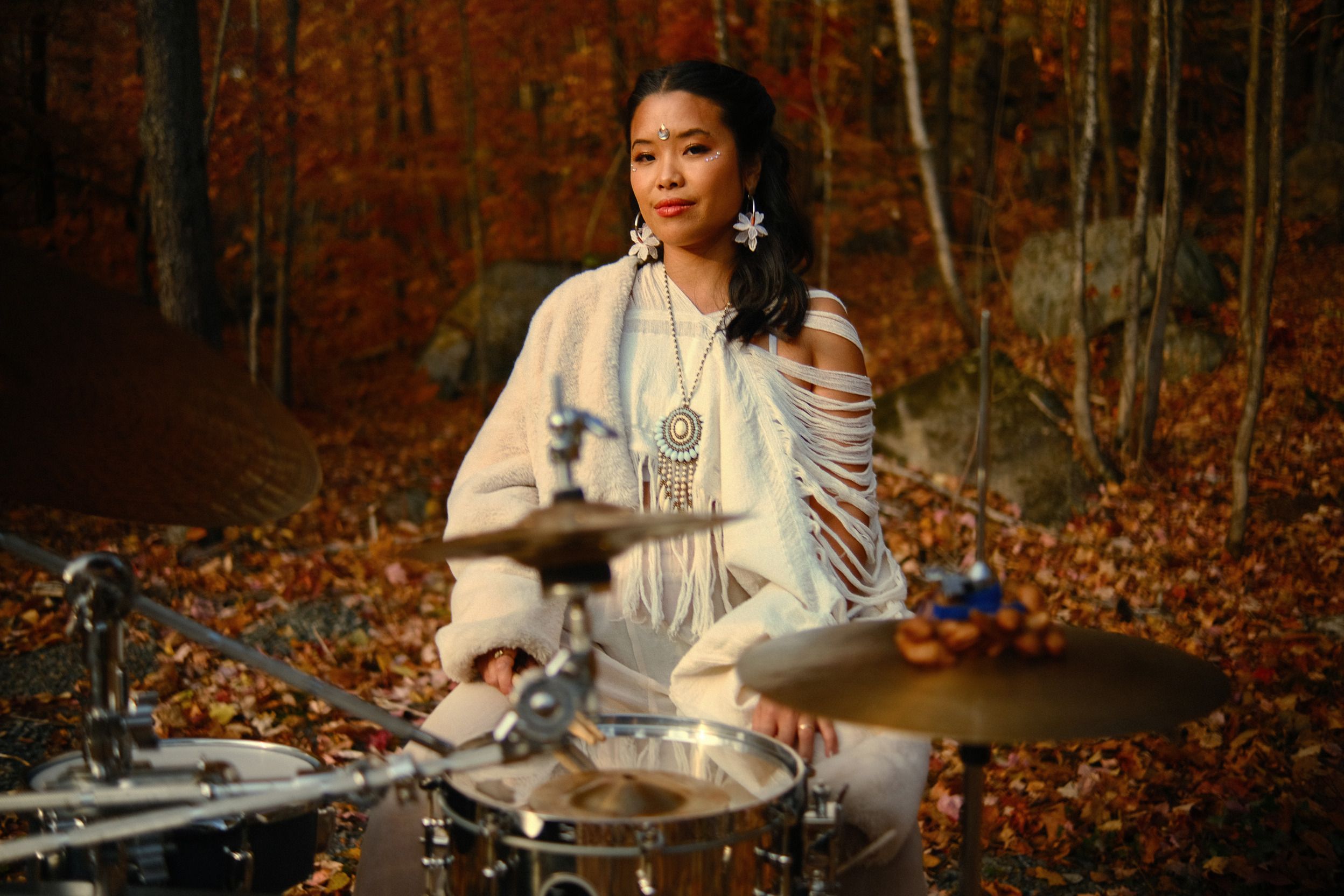
Name: Salin
Occupation: Drummer, composer, producer
Nationality: Thai
Current release: Salin's new album Rammana is out March 28th 2025. Order it directly from her webstore.
Drum music recommendation: I’d say listen to John Bonham. His sound I find is so pure and free. I think the truest essence of the drums sound.
If you enjoyed this Salin interview and would like to stay up to date with her music, visit her official website. She is also on Instagram.
It seems as though most aspiring artists are drawn to the drums and percussion for one of two reasons: Creating sound/noise and creating rhythm. What captivated you?
Being able to hit many things at the same time. I love that.
Everything around drums is based on touch, vibration, and movement. Does this mean that your own perception as a listener is also more connected to touch, vibration, and movement? What happens in your body when you're listening?
I transcend to another world.
What was your first drum set like and what are you using today? What, to you personally, are factors in terms of build and design that you appreciate in drums and percussion instruments?
My first drum set was a Pearl kit. I still miss that kit and remember the days.
I’m using a variety of kits now. I have a Rogers 70s holiday kit, a Ludwig breakbeat kit and a Kouta drums kit. I love them all for different occasions and settings.
For Kouta Drums, I love how portable they are. I fit my whole kit in a carry-on box, strapped it to the back of my bike, and then I can go anywhere I want.
That was the best kit to transport in my opinion and sounds great too.
Late Rush-drummer Neil Peart said: “The equipment is not an influence. It doesn't affect the way I play. It's an expression of the way I play.” What's your take on that?
I think it’s more where you placed the instrument in relation to your body that affects the way you play.
If you put the hi-hat on the right side, instead of the left side, and if you’re a righty, you’re going to play differently. I love how depending on where the drums are in relation to my body, sometimes I surprised myself as well.
To be honest, I don’t really agree with him. If you get a tom to tune like a gospel tuning vs. a jazz tuning, you’re going to play very differently.
The drums and percussive instruments are an integral part of many cultures, and traditions. Which of these do you draw from in your playing – and why?
I think I draw music into my playing, doesn’t matter what instruments. I hear the music rather than rhythms around me. That’s what inspired my playing the most. I’m a music lover first and that drew me to my principal instrument which are drums.
In terms of rhythms, I really love 3 cha at the moment, which is a rhythm from North East Thailand. It works with everything. I also love afro diaspora rhythms. You’ll hear both of these rhythms at the same time in my songs, “Current” and “Rammana.”
What were some of the main challenges in your development as a drummer / percussionist? Which practices, exercises, or experiences were most helpful in reaching your goals?
To feel tempo and to be accurate on the same bpm every time you play that song. Some days you’re more nervous and you feel it faster. Some days you’re more depressed and you feel it slower. I guess that’s just life.
I tried to be able to recall the tempo on the top of my head no matter how I feel.
How would you describe the physical sensation of playing the drums? [Where do you feel the resonances/pulse/groove, what are emotional sensations, is there a sense of release or tension etc …]
To be honest, I don’t recall much physical sensation because I’m always in the moment when I play drums. Perhaps, that’s why I get pain and tension sometimes the day after I play a lot. Hahah
I just feel transcend out of my body into another realm of consciousness, like a meditation.
What is the relationship between harmony, rhythm and melody? How do non-percussion instruments contribute to the overall rhythmic texture of a piece?
For me, rhythm guides everything.
It dictates how much you swing the groove and also dictates the speed and the feel of the song. It can also dictate where the rhythm of the melody should sit, or where the instrumentations should be. You don’t want to be playing against the melody nor the song. It’s an art in itself to be able to tell if you’re playing against melody or the song.
It’s always so subjective and I sure have my own preference. Or sometimes you can play whatever rhythms to whatever melody and it works too.
Do you feel that honing your compositional / songwriting skills has an effect on your drumming skills?
Totally, you hear music as a complete universe more than just one aspect of it. So you can choose where do you want to accentuate and where do you want to support.
I've long been intrigued by bands or ensembles where the drummer is the leader and/or main composer. In as far as it is possible to generalise, what do you think changes in terms of the music or performance in these situations?
To expand on my answer to the previous question, I think that’s why drummers can make a great leader.
The drums have a wide range of frequencies, from the bass drums to the highs of the cymbals, and symbiotically they should be able to hear the whole spectrum of music. And because they can hear everything, they can be a great leader too.
A great leader is someone who can make everyone in their team shine both individually and together as a whole - and that means accentuating each member’s strength, accenting the soloist when it’s the right time, reading the crowd and building the song directly. Drummers that have great intuition, and a good ear and thus can be great leaders.
How are you making use of the timbral and textural potentials/possibilities of your drums and percussion instruments when making music?
I like contrast a lot. It’s like painting. You don’t want just one color. You can do that - but it would get boring very quickly.
So I like big boomy bass drums, with a really short high-pitched snare and a crisp smooth hi-hat to balance it all at the moment. You can add whatever atmospheric percussion in between to give it more character.
There you have my recipe for making music: It’s about mixing textures that compliment each other but I also like to switch them up, depending on the songs and the mood.
How has technology, such as drum machines and sequencers, impacted the way rhythm is created and perceived? Has it been a concrete influence on your own approach?
I think people always like to hear something new and different and the way drum machines interact with music now is an expression of, how much artificial stuff can we take? How can we make it sound new and different?
For me, I’m an old soul I guess. I just like to go back to the roots, just the same old acoustic drums set. The challenge is how do you play them differently to make it sound new?
Physical strain is a particularly serious issue for many drummers. How does it manifest itself, how do you deal with it and in how far does it affect your creativity?
I’ve yet to make it a habit to stretch right after I play, cause I always get so high from the music hah.
But I have incorporated yoga, stretching, and a workout routine into my daily life to keep my posture and myself in shape.
Many recording engineers have remarked that the drums can be particularly hard to capture. What makes drums sound great on record and in a live setting?
For me, it’s mostly how drummers play it.
It depends on what you’re going for but I find drums sound best and biggest when I play softly. It’s about balancing each drum, the snare, the hi hat and the kick to make it sound great as a whole. That's because, when you’re recording drums, you can’t really turn each drum up or down in the overhead, so you have to balance yourself in the mics.
If you can play the drums so it sounds great with just one mic then you know you got a pretty good recipe to get a good drums sound really.
Drums and percussion are remarkably often used for physical therapy / healing. What, from your point of view, makes them particularly suitable tools for this?
Is that so? I thought singing bowls are good for that haha.
I think it’s nice to hit things and to feel safe doing that. It’s a release of emotions and knowing that no one is going get hurt (except yourself perhaps) plus you get a sound out of it too.