Published
Name: Sam Morrison, Bill Laswell
Occupations: Saxophonist, flutist, composer, improviser, performer (Sam Morrison), bassist, producer, composer (Bill Laswell)
Nationality: American
Current release: Sam Morrison's Cosmic Trip, produced and composed by Morrison and “mix-translated” by Laswell, is out via M.O.D. Reloaded.
Sam, many artists tend to work around promotable cycles – album releases, tours, special events – but you appear to prefer operating outside of them and follow your own timeline. Can you talk a bit about this, how you define freedom and how to recognise the moment for releasing something?
Sam Morrison: In the mid 1980s I started buying synths and began recording, but I wasn’t really ready yet to release my solo synth work. I had always been composing and around ‘02 I recorded my first album in about 25 years, Miles Away, released in ‘05.
I decided that I had too many songs to just forget about so I called some old and new friends and recorded it on tape at my house up a mountain in the woods. At that point Pro Tools became available and I finished all the overdubs, etc. with the new software.
When Logic arrived with its, at the time, vast plugin synths, I found my light at the tunnel’s end. I kept on writing and playing and in 2012 I felt I was ready to release my first solo project, Dark Matter. I put it out on my own label with no promotion or fanfare.
A few years later came Howl Revisited, with T Xiques playing drums, guitar, and bass on some tracks. Once again on my own label without any promotion at all.
You experienced Miles Davis's electric phase first-hand and keep coming back to it. What defines this phase in Miles' oeuvre for you – and what makes it interesting creatively?
Sam Morrison: It totally transforms me to a place of peace and serenity.
When I was 18, sophomore year at Columbia, I brought Bitches Brew over to a friend’s room who had a really good stereo for a dorm room, and he gave me a tab of acid. Wow, that was the first time I understood BB! It became clear to me. I never did that again but I was hearing Miles’ trumpet in my head for the next 24 hours! No more going back to Kind of Blue.
I am so comfortable in that head. It feels like anything is possible sound wise, structurally, harmonically, melodically. It’s a multiverse of sound before seemingly science had caught up. It’s the multiverse I choose to compose and perform in.
I find electric Miles fascinating because it seems to demarcate a transition between “electric” music and “electronic” music. Somewhere in the borderzone between the two, there is an intriguing territory – how do you see that yourself?
Bill Laswell: Well, to begin with, I think it's a fairly cluttered genre. And this particular project seemed to rise above that naturally.
I was a little surprised myself that it had the quality to sustain. But the essence of it is Sam's sound and tone … quite strong. So it pushes it out more than most.
Sam Morrison: Maybe that’s because this borderzone is exactly where I live musically!
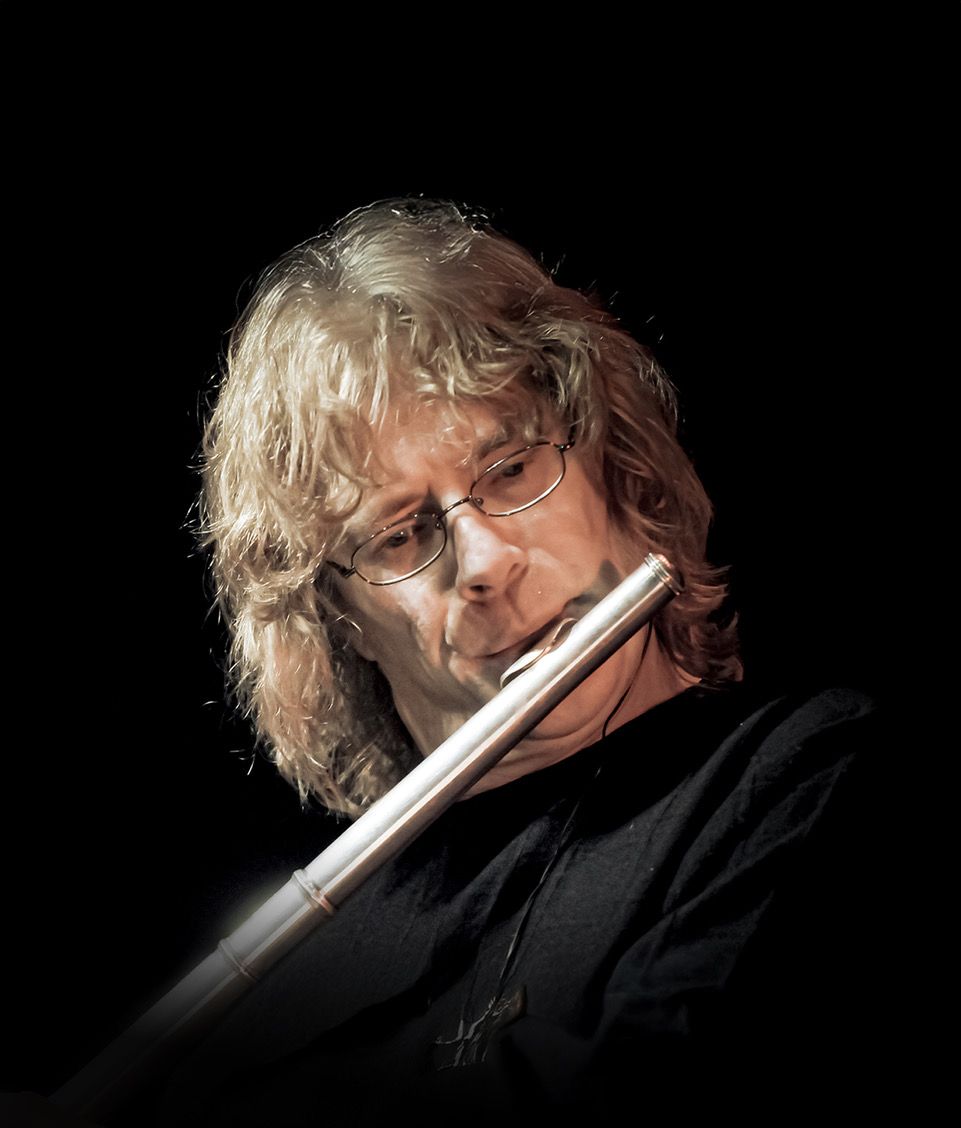
I perform acoustically on saxophones and flutes, bass clarinet, although sometimes electronically altered, in electronic musical settings that I compose and create on my computer with synth plugins and hardware synths as well.
You mentioned that you bought a lot of synths for a while.
Sam Morrison: Early on, after Miles, circa ‘78, I purchased ARP 2600, EMS Synthi, Mini Moog, Lyricon - but I never recorded on my own with them. I did use the Lyricon and ARP on Masabumi Kikuchi’s and Terumasa Hino’s records. Later on, I had Oberheim Expander, DX7.
These were some of the most desirable synths of that era and really need no introduction from me. I thought they were super cool and just wanted to play with them.
I had really no system yet for recording and composing music utilizing them. I felt like an electronic novice! Until I discovered Logic.
What do you still remember about the process of recording Dark Matter?
Sam Morrison: It happened over a period of about two years.
I was getting into Logic and loved the vast variety of their synth sounds via plugins and the ease which I could organize my structures, melodies, harmonies, rhythms etc. I had total control over recording all my woodwinds and compositional ideas. It was a musical paradise smorgasbord!
It took me some time to figure out what I needed but I was able to do so on the fly, rarely reading the manual or looking anything up.
I recently read that you got to meet Klaus Schulze through your mutual friend Michael Shrieve. As a lifelong fan of Schulze's work, I have to ask: What was that meeting like and how would you describe your interest in his music?
Sam Morrison: Listening to his music was trance like for me. Meeting him … he was like a god. His sequencers had endless rows of knobs. I felt like a child in the Master’s presence.
I would listen to his music endlessly in my twenties, wearing out the records.
Schulze has often emphasised how much he learnt from Michael for his own music in terms of how to get the beats right. What role does rhythm play for you as a performer?
Sam Morrison: Michael is of course a master of that. He is incredibly precise. When I played live with him and Patrick Gleeson in Seattle about 8 years ago, I was fascinated about where he hit the snare. It was mesmerizing!
I think of it when I do the drums. Sometimes I’ll go in and modify the drum loops and cut and paste segments of them together to get the feel I want, especially with the bass lines.
Especially since the 1990s, jazz went through a lot of changes. How did you experience that time and the way the genre has kept developing?
Sam Morrison: Honestly I feel like I was a bit out the jazz scene in the 90s. I wasn’t paying a lot of attention to it. Mostly spent a lot of time trying to get my chops back.
I wasn’t that interested in listening to other people’s music. I kind of just wanted my own voice to become alive, more powerful and developed. Late 1990s is where I started reevaluating my compositions and started composing again.
Bill, during this time, you worked on many intriguing projects at the border of jazz, electronics, and a variety of other genres. Many look at this time from a mainly technical perspective (sampling, cheaper gear) – to you, what was it in terms of the music that was really changing on a deeper level?
Bill Laswell: Certain times, everything happens at once, or more than normal. When that happens, everything rises to the top. Many things happening at the same time.
I was fortunate to be in the right place most of the time, and there were some great experiences.
Like you getting featured on Nils-Petter Molvaer's Khmer?
Bill Laswell: He sampled something of mine … I don't even know—and I don't remember-from where! But that's basically how we met. He told me about the sampling.
He's also on the more recent release Mount Analogue. On that album, he creates his own personal ambience. It's just like his own personal Jesus.
What does the term jazz mean today, would you say?
Bill Laswell: I guess to me it means old. And it also could mean past.
I have no real knowledge of what it means, and I have no real knowledge of jazz. I don't come from that background, although there are some great musicians that come through that style.
As of today, what kind of materials, ideas, and technologies are particularly stimulating for you?
Bill Laswell: There's always too much music going on, if you can find it. Sometimes you have to work on finding it. It could involve a lot of research; it could involve travel. Maybe even some kind of sacrifice.
But the music is there. Always.
Where inspirations come from changes all the time. But I respond to both internal and external impulses, to many current developments. I feel that there's always someone who could use support.
What sparked the process for Cosmic Trip and how did the material gradually develop?
Sam Morrison: After I finished Howl Revisited almost ten years ago, I kept programming, progressing and composing. I was coming up with new things to do and enjoying it. I had downloaded new software synth plugins and efx. I had a new video, Cosmic Trip, (pre-Bill’s mix) and a few more tracks that I had completed.
When I received Yoko’s FB friend request and discovered she was Bill’s partner, I sent the video and later more tracks. Yoko and Bill liked them and agreed to consider working on my project together. Bill pushed me to do more tracks, I think almost double, to release the CD on his label.
When I finished, I truly appreciated that.
One of the things I notice on Dark Matter and Cosmic Trip, is how you're using electronics as collaborators in a way that's very individual. How would you describe that approach? How do you rate human collaborators versus machine collaboration?
Bill Laswell: Electronic collaborators compared to humans are, for me, almost always equal. It depends on the moment.
Sam Morrison: Every song has its own path to completion. I may just play around with sounds on a MIDI keyboard with software plugins or on a hardware synth. Come up with a bass line or melody. Or start with a drum track I put together. Perhaps some chords and build the piece from there.
No distinct system present. I just come up with something I like and go from there. The woodwinds enter usually somewhere in the middle of the process and I play around with all of the electronica until I’m happy with it.
As I said, I make a conscious attempt not to listen to other music in my genre to sustain originality.
In terms of the creative process, you mentioned that “melody and harmony flow from the sounds and instruments through me." It sounds like a form of guided improvisation extending beyond typical jazz approaches - describe what that feels like and how that process works.
Sam Morrison: I’ll explore the pallet of sounds first and play melodies and concepts. That can lead me to lines and structures, feelings, moods and sonic environments.
It’s an exploration through magical places that kind of develops itself through me.
Bill Laswell: Improvisation is an extension of everything. You know? It's not exclusively connected to jazz. I'd like to think that it's evolving all the time.
It's everything … it’s all improv. I mean, it’s all connected.
“Funkaduck” has some really cool synth work. Tell me about how that track came together, please.
Sam Morrison: “Funkaduck” is one where I began with the bass and drums first. Most of the synth textures are more in the background.
The soprano sax is quite upfront and highly featured. I spent some time developing the melody. Bill was very creative with the drums and extending the song.
Bill, your input for Cosmic Trip seems to have mainly consisted of working on the mix. I find this interesting, as I actually feel as though this part of the creative chain is often under-appreciated. What did your contribution consist of for this project and how do you see the creative potential of mixing?
Bill Laswell: Think of it as a remix. A few elements were added to enhance recorded sounds. In some cases, it's extremely clear, others more subtle. Otherwise, it's the common balance system of mixing.
The creative potential of mixing can take something from nowhere and put it on a very high level. It can also destroy a work.
There is a lot of space in the arrangements of Cosmic Trip. Do you believe in the old adage that the notes not played are as important as the one which do get played?
Bill Laswell: Of course.
Sam Morrison: Yes, of course, that’s a famous Miles lesson. I believe that quite often less is more, tension and release.
The sparser periods offset the intense sections giving the music diversity and movement. They offer a path to greater creativity and access to different musical colors.
Creativity can reach many different corners of our lives. Do you personally feel as though writing a piece of music is inherently different from something like making a great cup of coffee? What do you express through music that you couldn't or wouldn't in more 'mundane' tasks?
Sam Morrison: I think music is one of if not the ultimate forms of creativity. The musician manipulates wave forms, which are, quantum theory tells us, the fundamental building blocks of all matter and the universe!
Music seems to have an inherent role and effect most humans and societies. Mundane tasks are exactly that. They don’t communicate to the soul and spirit in the manner that music is able to.
To be able to record, compose, and perform music that is appreciated is an incredible privilege and gift.