Published
Name: SticklerPhonics
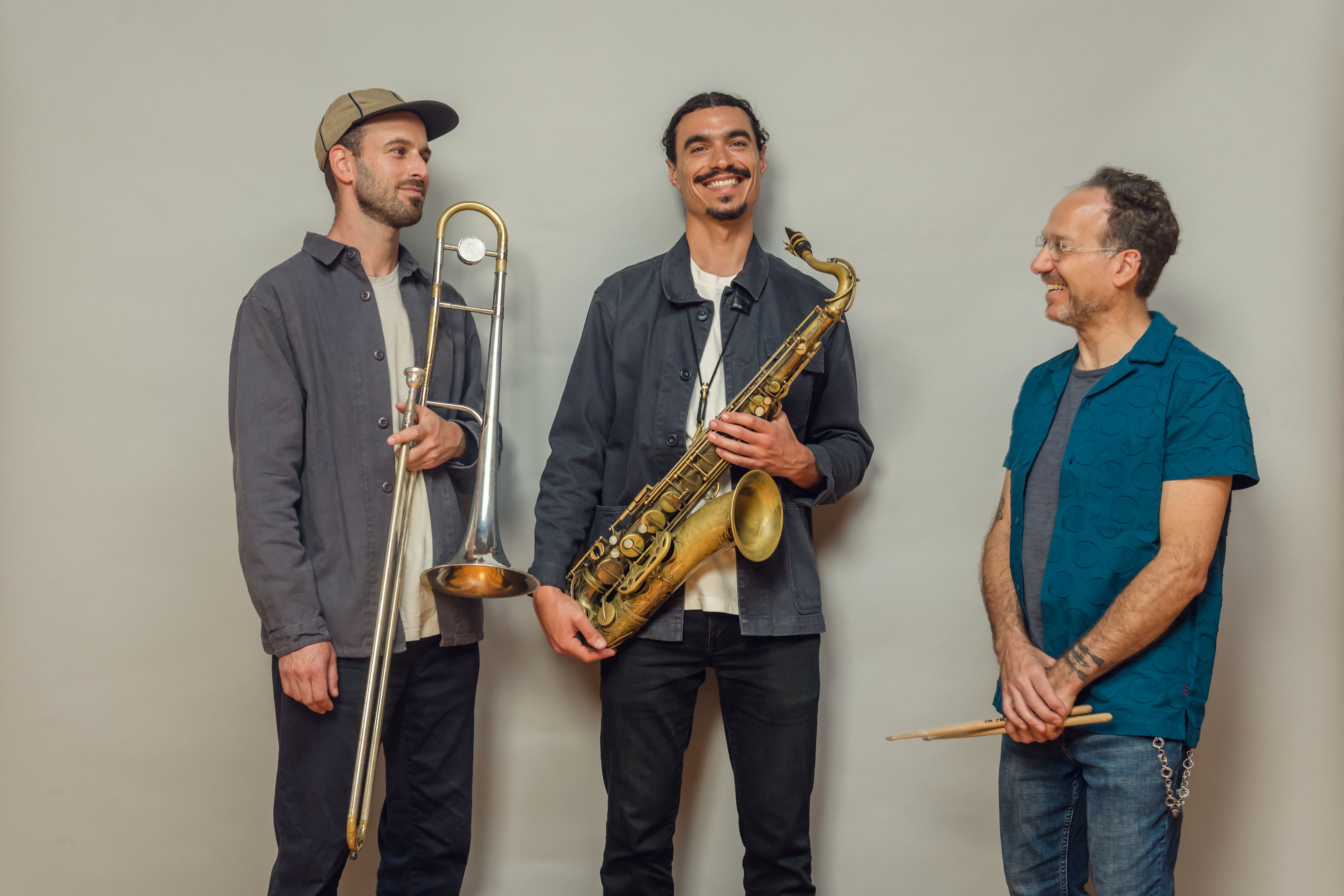
Members: Raffi Garabedian (tenor saxophone), Danny Lubin-laden (trombone), Scott Amendola (drums, percussion, live processed electronics)
Interviewee: Scott Amendola
Nationality: American
Current release: The new SticklerPhonics album Ghost Parade is out via Jealous Butcher.
Recommendations: If you can ever visit the Van Gogh museum in Amsterdam, give it a go! And check out the track, “Black Thorn Rose” on the Weather Report album Mysterious Traveler.
If you enjoyed this SticklerPhonics interview and would like to know more about the band and their music, visit Scott Amendola's official website and Instagram account. SticklerPhonics are also on Facebook.
Do you think that some of your earliest musical experiences planted a seed for your interest in improvisation?
I was a natural improviser. I thought EVERYONE improvised. So my earliest musical experiences were improvising. It’s in my DNA. It took me a while to realize that everyone did not improvise.
I’ve always approached music from the “anything can happen/anything is possible” angle.
When did you first consciously start getting interested in musical improvisation? Which artists, teachers, albums or performances involving prominent use of improvisation captured your imagination in the beginning?
Like I mentioned, improvising was there from the beginning.
My grandfather was a guitar player in NYC starting in the 1930s. We were very close. He used to play for the family at these epic Sunday dinners at the dinner table. Standards, Beatles songs, etc. And he’d make up songs, funny songs. Then when I was older he and I would play together and I started improvising along with playing standards with him. But I always would try and make things up in my basement. From day one.
Seeing the Pat Metheny / Ornette Coleman Song X tour blew it all open for me. I was 17, and I had a very deep emotional reaction. Live changing hearing Jack DeJohnette and Charlie Haden, Ornette, Pat, and Denardo Coleman. Life changing. Things started to make sense.
Or better yet, the ideas in my head, in my hands … I knew I was on to something and that helped validate things for me.
Tell me about your instrument and/or tools, please. What made you seek it out, what makes it “your” instrument, and what are some of the nost important aspects of playing it?
I play the drum set and I use electronics - guitar pedals, a Korg mini Kaoss Pad, and a little mixer with a little clip microphone.
I’ve always been interested in manipulating sound. I was involved in a project with Koto player Miya Masaoka. She was using a small mixer and some pedals. I had played with Nels Cline and seen other guitar players using things like that. I wanted to manipulate sound in real time.
[Read our Nels Cline interview]
But seeing Miya do it and talking to her about it was helpful. She also warned me about the cost and the frustrations that lie ahead! HAHAHA, she was right! But I finally got things to become an extension of the drums, and what I was hearing in my head and more. In a lot of ways, technology caught up to what I wanted to do.
I’m so interested in sound. Nels and I talked about that a lot, how we both are interested in the possibilities of how we can manipulate our instruments in various ways sonically. Finding others that are open to that allowed me to explore. Nels was a HUGE help and supporter of my explorations.
How would you describe your own relationship with your instrument – is it an extension of your self/body, a partner and companion, a creative catalyst, a challenge to be overcome, something else entirely?
It is an extension of my being. It’s one way I can express things inside that I want to share, get out, etc. There’s a deep connection with the drums, and the electronics. I’ve never felt more connected to my instrument, or instruments.
It takes a long time to get good at playing music. And that’s totally okay. There’s a patience one needs, in my opinion. If you can stick with it, it will come, the rewards of that connection.
And I also think if you keep digging, you’ll find it’s endless, a lifetime of possibilities, which to me is inspiring and liberating. It keeps me going.
Derek Bailey defined improvising as the search for material which is endlessly transformable. What kind of materials have turned to be particularly transformable and stimulating for you?
Every single moment is transformable. Every one. That’s how I go into playing. There is not a moment I’m not fully engaged and deeply listening. That’s where the magic happens. If everyone is listening, the music can potentially go anywhere.
Some days are better than others. But I’m always thinking that things can change on a dime, they can transform. For me the “material” is the decision to sit down and play. It’s there. Go get it. I don’t think it’s necessarily definable.
How do you create? I don’t know. I just sit down and see what’s going on. How am I feeling? What am I going to play first? What makes me do “that”? Sometimes I have a thought in my head, sometimes I just don’t know until the last second. And everything in between.
But the place that I’ve come to NOW is a comfortable place where I feel like I can go anywhere, any time and I’m ready. That is something new for me. I feel less intimidated, more inspired, more ready than ever.
Do you feel as though there are at least elements of composition and improvisation which are entirely unique to each? Based on your own work or maybe performances or recordings by other artists, do you feel that there are results which could only have happened through one of them?
I’m not sure I understand this question but let me say that composition is created some how out of an idea one thought of. Like improvising. So for me they are intertwined.
When you're improvising, does it actually feel like you're inventing something on the spot – or are you inventively re-arranging patterns from preparations, practice or previous performances? What balance is there between forgetting and remembering in your work?
I want to think that I’m “inventing” and sometimes I play something that’s new to me. But I don’t get caught up in that. Once I’m done, it’s out in the ether.
Do I remember things? Of course I do. Do I repeat myself? Of course I do. There is nothing wrong with that. A good idea is a good idea. Placing that good idea can be where the magic is. I go into improvising with open ears. That’s about all I can do. And I’m open. So … truly, anything can happen.
Are you acting out parts of your personality in your improvisations which you couldn't or wouldn't through other musical approaches? If so, which are these? What, would you say, are the key ideas behind your approach to improvisation?
As we get older and hopefully find ourselves and feel comfortable with ourselves, that is what I believe we should be going for.
A friend once said in an interview “the easiest thing for me to do is be me.” It’s true. As long as one is comfortable with one’s self, then there it is. Just be you. That’s true, honest, authentic.
Mood, how am I feeling, etc. Many factors affect us all in approaching whatever we do. I’m always trying to be me, whether it’s free improv, or playing a song, or whatever. I’m always thinking about being creative, being open to giving and receiving ideas.
In terms of your personal expression and the experience of performance, how does playing solo compare to group improvisations?
I NOW love playing solo. It’s hard. A lot of pressure. But now I feel comfortable doing it.
I mean, it’s vastly different than having others to bounce ideas off of. Space is a big factor. Not being afraid of space. That took getting used to. Keeping folks engaged whether it’s solo or a duo, or whatever is the same.
But again, not being able to exchange ideas means one has to dig deep and find a way to express alone. I mean, obvious, but not easy.
In your best improvisations, do you feel a strong sense of personal presence or do you (or your ego) “disappear”?
I like to think my ego disappears when I play and I invite everyone in the room into the experience. Live music, for me, is about everyone there. Let’s connect.
I probably will have my eyes closed, but I want to feel the room, the people, and listen and get lost. It goes in and out but that’s the ebb and flow of it all.
In a live situation, decisions between creatives often work without words. From your experience and current projects, what does this process feel like and how does it work?
JUMP IN!!! hahahaha. Sometimes it takes a little while to get connected when playing, sometimes it’s immediate. But really, “LET’S GO FOR IT!”
BUT there is nothing wrong with talking about the process, and I for one encourage folks to discuss, create verbal dialogue, find out what each other is thinking, feeling etc. Why not? It can only help, I think. I’m not talking about micromanaging. Let people be themselves. When it works, GREAT! If it doesn’t, oh well, let’s try again sometime, or on to the next thing.
I don’t want to be precious about this. If musicians are dedicated to their craft, then we as individuals can work on our stuff and when we’re together we’ll see if it works. But everyone has to be 100% present or it’s not going to feel good.
Stewart Copeland said: “Listening is where the cool stuff comes from. And that listening thing, magically, turns all of your chops into gold.” What do you listen for?
He’s right, listening is where the magic happens. I’m listening to folks to figure out who they are and how to connect my ideas with their’s. And to see if they’re listening.
There can be surprising moments during improvisations – from one of the performers not playing a single note to another shaking up a quiet section with an outburst of noise. Have you been part of similar situations and how did they impact the performance from your point of view?
Always … Always … That’s improv.
I have always been fascinated by the many facets of improvisation but sometimes found it hard to follow them as a listener. Do you have some recommendations for “how to listen” in this regard?
Sure it’s hard to follow. Are you as a listener connecting to what’s happening? It’s like finding the music you like and put on.
Just because you like the idea of listening to improvised music, it doesn’t mean you’re always going to connect to it. So you have to take it in stride. You’re already open to the idea of it, but you might not like someone’s approach for some reason or another. Totally fine. We can’t please everyone.
In a way, improvisations remind us of the transitory nature of life. When an improvisation ends, is it really gone, just like a cup of coffee? Or does it live on in some form?
It’s always happening, improvisation. When I’m done playing a feeling lingers, and life goes on. Sometimes I ponder what happened, sometimes I’m just onto the next thing, which doesn’t mean what happened was bad.
But for me, it’s over, out there, let’s digest, and go forward on to the next thing.