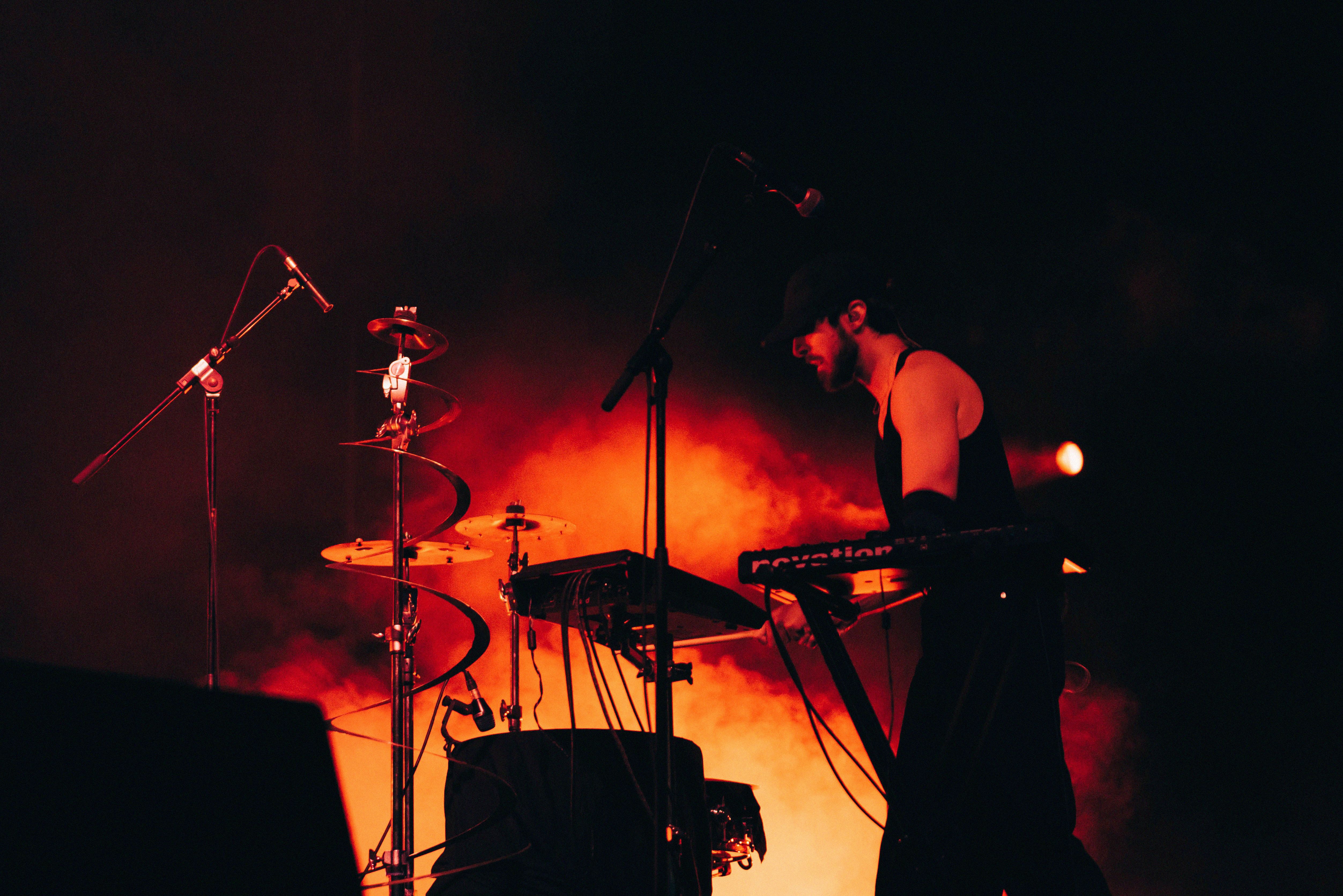
Published
Name: Sébastien Forrester
Nationality: French
Occupation: Percussionist, composer, sound chaser
Recent release: Sébastien Forrester's new album Ármo is out via Superpang.
Recommendation for Paris, France: Definitely the Père Lachaise cemetery, which is right next door to where I currently live, in the 20th arrondissement of Paris. It is such a fabulous, mysterious and poetic place. As soon as I take a break during a studio session I head there for a walk, I wander and get lost. It is so vast. It is actually one of the biggest parks with some of the oldest trees in Paris. Back in April I even saw a fox there, early in the morning
Topic I am passionate about but rarely get to talk about: I am very passionate about late 19th century poetry, which was my main object of study when I was doing my master’s thesis at Sorbonne university. I still read and discover a lot of incredible art from the Romantic and Symbolist eras. I also have a recurring passion for wildlife - sealife and the abyss in particular.
If you enjoyed this Sébastien Forrester interview and would like to stay up to date with his music, visit him on Instagram, Mastodon, bluesky, bandcamp, and Soundcloud.
Where does the impulse to create something come from for you? What role do often-quoted sources of inspiration like dreams, other forms of art, personal relationships, politics etc play?
The creative gesture obeys to a need or an urge I guess. There has to be some kind of shock, whether it comes from an artwork, a landscape, a feeling, a political reflection. It has to make me unrestful.
I do not calculate or intellectualize it too much as I like to keep things quite methodic but also loose and spontaneous. My practice is very informed by my environment and what I go through, both on an intimate, personal level and more globally I suppose.
I like to think about my music as alert and grounded in a way. I hope it says something both about myself and the current state of the world.
For you to get started, do there need to be concrete ideas – or what some have called a 'visualisation' of the finished work? What does the balance between planning and chance look like for you?
I rarely have in mind a clear projection of what the final work is going to be, most of the time I make music with no real purpose, without knowing what I want to achieve. It is pure expression. I can then be in the position to ask my work what it has to say afterwards.
Improvisation and spontaneous composition have been the core of my process for years. I sometimes rely on certain restrictions though: the particular tuning of an instrument I am working with or composing for, a scale, a tempo, an emotion, an intention or an image.
But most of the time I end up crafting a musical object that is completely different from what I had originally imagined, which is equally stimulating and frustrating. I just let it bloom.
Is there a preparation phase for your process? Do you require your tools to be laid out in a particular way, for example, do you need to do 'research' or create 'early versions'?
Art is sometimes quite similar to archeology to me, it is about seeking, receiving and learning. It feels like a transmission.
Research is always part of the process at all levels, either conceptually or genealogically, in the approach to the instruments that I play or write for, and in the different ways that I can alter and mangle sounds and define a sound palette for a piece.
I am constantly trying new effect combinations and patches, using both processing and synthesis as an infinite source of creative inputs. The line between an evolving draft and a finished track can sometimes be quite blurry, timing defines the balance and the aspiration.
Do you have certain rituals to get you into the right mindset for creating? What role do certain foods or stimulants like coffee, lighting, scents, exercise or reading poetry play?
The conditions under which I approach making music depend on where I am and the tools I have access to at a certain moment. Obviously, percussion is very often the starting place, it can take so many different forms, it is almost too broad but I just connect with it on such a deep level, drums are like an extension of my body at this point.
I have no proper routine but I am definitely high on caffeine, especially when in Paris or big cities in general. I have a tendency to slow down when I am away in the country, time stretches and I enter a totally different mindset, but it is quite rare these days, everything seems so hectic.
I do drum workouts everyday though! And when I am on the road I just end up making music on my laptop using nothing but headphones, anywhere, anytime.
For Ármo, what did you start with? If there were conceptual considerations, what were they?
My series of releases on Superpang began in 2022, soon after I had started rediscovering my French family’s Occitan roots, and the musical traditions attached to it: balls, the bourrée, the cabrette bagpipe, the hurdy-gurdy, as well as certain songs and chants, including ancient Cathar vocal music, which sounded oddly familiar to me.
I would not say those works are massively conceptual, but they are definitely rooted in those researches and reconnections with my elders’ relationship to music, dance, rituals.
I have had an infinite love for traditional percussion and wind instruments for a long time, especially the organ and the bagpipe, and it has taken me about fifteen years to realize where this inclination actually comes from. I have been slowly learning about the local culture and reimagining that heritage through my own prism.
Tell me a bit about the way the new material developed and gradually took its final form, please.
Ármo was initially a short improvisation with the psaltery, a chordophone from the Middle Ages that I have been playing using tiny sticks a lot lately, and that I have progressively incorporated into my percussion kit.
I had many leftover gong parts that were imagined and recorded for different tracks - including Coruscate, a composition for gongs, chime bells and bowed vibraphone that was released by Forest Swords’ label Dense Truth last January …
… I layered psaltery on top of one of them, which quickly became the foundation for Ármo, hoist’, the second segment of the piece.
I knew that I wanted it to be linked to both ‘Bouôrgxo’ and ‘Nèplo’ - released earlier on Superpang as well - and my work with Occitan bagpipes and hurdy-gurdy, so I dived into previous sessions to excavate recordings that could eventually resonate with the early stages of Ármo. I also wrote new parts and built sample-based digital bagpipes to achieve what I had in mind. Everything digital - synthesizers, additional percussion elements and effects - was layered and finalized afterwards.
Crafting those longform compositions is very gradual and organic and usually takes forever, as they are wide assemblages of various takes from different periods that I come back to and perform again, enrich and alter in different ways. I would almost compare them to large paintings somehow.
Many writers have claimed that as soon as they enter into the process, certain aspects of the narrative are out of their hands. Do you like to keep strict control or is there a sense of following things where they lead you?
Most of my work is about creating conditions which I do not have full control over, whether through improvisation, experimenting with different approaches and unusual ways of playing my instruments, or using synthesis, digital processing and generative composition tools.
Getting lost and being overwhelmed is an absolute necessity, otherwise I would just get bored I reckon. I wander until I reach a moment of epiphany. The initial shock that I always look for usually comes from this process.
There are many descriptions of the creative state. How would you describe it for you personally? Is there an element of spirituality to what you do?
I would not say I am a religious person, but there is something spiritual in the way I consider music and the arts in general. Creating has a lot to do with transcendence. I have had a hard time believing in anything and I definitely do not want to be saved, most dogmas have been setting boundaries instead of guaranteeing freedom and universal love.
But I am passionate about belief, history and mythology, they give life meaning. I just want to connect with older forms of knowledge and traditions and discover continuities. I feel like I can get closer to something hidden, beloved and sacred when I make or play music and manage to enter certain states.
Trance is something quite universal I reckon.
Once a piece is finished, how important is it for you to let it lie and evaluate it later on? How much improvement and refinement do you personally allow until you're satisfied with a piece? What does this process look like in practise?
Nothing is ever finished - but divested or abandoned in a way. Releasing music is learning how to surrender, isn’t it?
I could be working on the same pieces over and over again until the end of time really - playing some of them live actually provides occasions to invent new iterations and even break them entirely and find ways of improvising within their entrails.
How do you think the meaning, or effect of an individual piece is enhanced, clarified or possibly contrasted by the EPs, or albums it is part of? Does each piece, for example, need to be consistent with the larger whole?
I am all about history and threads so I would say I love fixing limitations for a particular release, even though they may appear to me after a while. Restrictions set the tone, the pace and define the story.
But again, the story can be wild, chaotic, unpredictable. It will make sense if it is achieved with a sense of will and a strong purpose. History and its articulations are so crucial, they are what we remember.
What's your take on the role and importance of production, including mixing and mastering for you personally? In terms of what they contribute to a song, what is the balance between the composition and the arrangement (performance)?
I have a slightly bad tendency to start mixing as soon as I record, assemble and produce a piece. I cannot really distinguish those steps in the process these days, I do everything on-the-fly, very often simultaneously.
For economical reasons, I have to mix my own music most of the time. Even though I have mastered some of my own releases too, especially some of the most rhythmical music I have made, I rely on Paulie Jan these days, he is a very close friend and a real sound wizard.
Music and the accompanying artwork are often closely related. Can you talk about this a little bit for your current project and the relationship that images and sounds have for you in general?
The artwork for Ármo is a phone picture I took in an abandoned Cathar castle in Occitania when I came back there last year for the first time in about a decade. I have wanted to use it as an artwork since then, it has stayed with me for a while, like a portal.
Superpang had their own visual template throughout their digital series, but now that Chris, the founder of the label, has chosen to bring it to an end, I can finally unveil this photograph and it perfectly embodies Ármo somehow.
I spend a lot of time imagining worlds and there needs to be a tight dialogue between the visual aspects and the music for the story and the discourse to feel full and cohesive to me.
After finishing a piece or album and releasing something into the world, there can be a sense of emptiness. Can you relate to this – and how do you return to the state of creativity after experiencing it?
My musical roots will forever be jazz and punk - both genres that are hugely collaborative, abundant, festive, alive. Most of my favorite musicians have produced constantly and relentlessly played on dozens of records, which has fascinated me since I was a child.
I am always practicing my instrument or working on many different things - solo projects, collaborations, commissions, soundtracks, etc - so there is barely any gap in my agenda to be honest. As soon as I complete and deliver something, I am switching to another endeavour, it is a steady flow.
The feeling of emptiness sometimes emerges after being on tour for a while and coming back home, but it never lasts long.
I would love to know a little about the feedback you've received from listeners or critics about what they thought some of your songs are about or the impact it had on them – have there been “misunderstandings” or did you perhaps even gain new “insights?”
It is very enlightening for me to hear and read what peers think about my work, and what images come to their mind when listening to my music.
I would spontaneously cite writer Fanny Chiarello, who I had the chance to meet - each of her feedback feels like a poem. It is extremely magical for me to read her every time, and I could not thank her enough for that.
I am extremely grateful to have around me a strong community of beautiful and talented human beings that I can share my work with.
Creativity can reach many different corners of our lives. Do you personally feel as though writing a piece of music is inherently different from something like making a great cup of coffee? What do you express through music that you couldn't or wouldn't in more 'mundane' tasks?
Creativity is all about love and sincerity I suppose, it is intrinsically linked to daily life and often seems to act as a mirror, I will always cultivate and cherish that.