Published
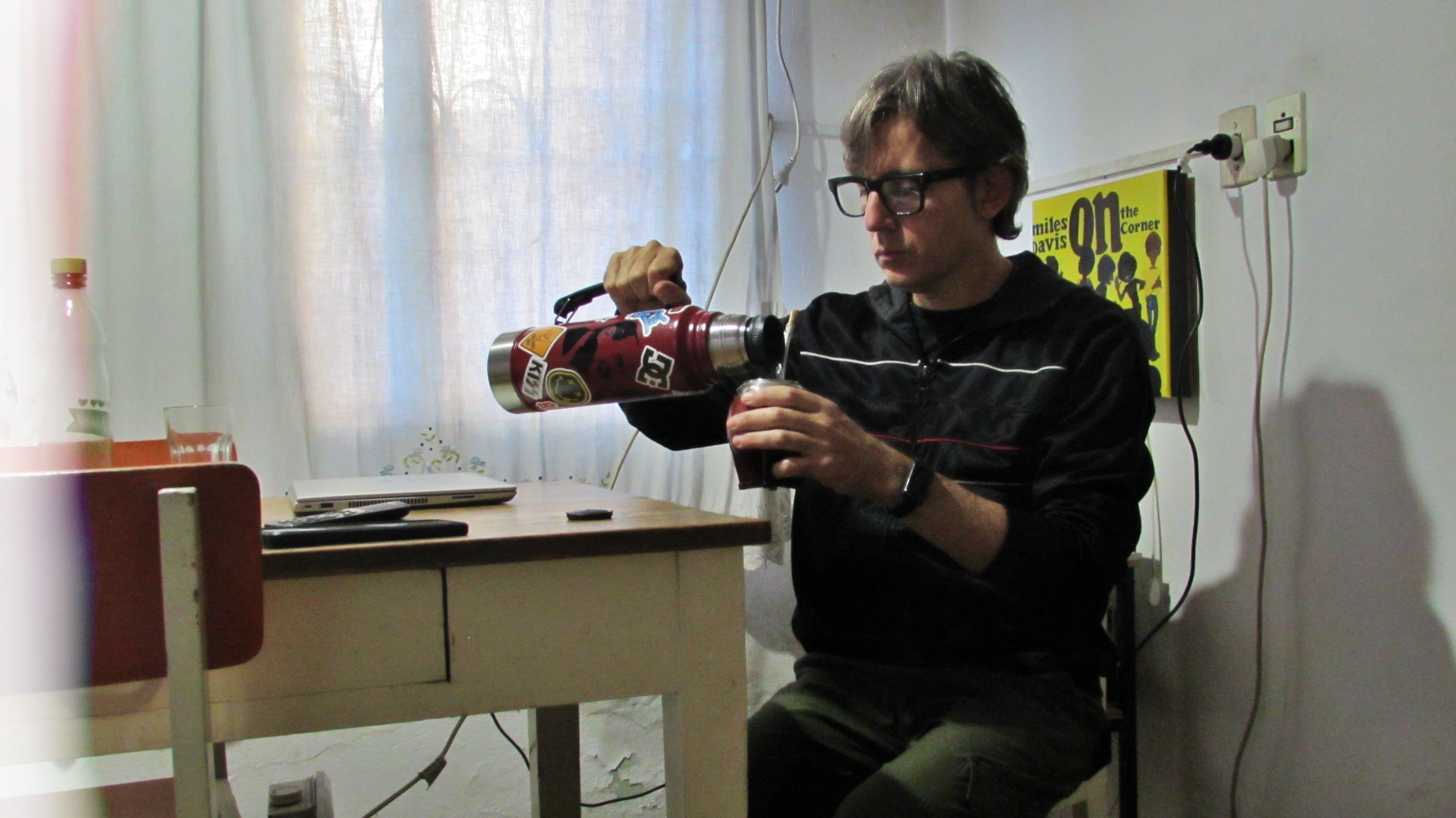
Name: Sergio Merce
Nationality: Argentine
Occupation: Sound artist, composer, saxophonist
Current Release: Sergio Merce's new album Archipiélago is out via Room40.
Hometown Recommendation: I recommend going with friends to eat at a place called "La Tarzán." It is in Castelar City, in Buenos Aires, a few minutes from my house.
Topics that I am passionate about but rarely get to talk about: I've always been a Boca Juniors fan, but a few years ago I became a real fanatic. When I was a kid, I didn't usually watch soccer games, but lately it's one of the few things I really enjoy.
If you enjoyed this Sergio Merce interview and would like to know more about his music and upcoming live dates, visit him on Instagram, and bandcamp.
Microtonal approaches and alternative tuning systems are an integral part of many cultures, and traditions. Which of these do you draw from in your playing – and why?
I've been listening to traditional music from different countries that use different types of tunings for many years. But the truth is I've never been interested in studying these tunings. That is to say, I'm not interested in the technical aspect of these sounds, but rather in their particularity.
In my case, the approach has more to do with a search for sound. In the late 1990s, I became interested in the use of alternative electronic devices as sound producers. These devices weren't designed to make music, but rather to process or record, such as a cassette multitrack recorder or sound effects module. The use of these devices, combined with extended techniques in the saxophone, later led me to think about a saxophone that could gradually modify its tuning.
The image that came to mind at that moment was that of a saxophone-synthesizer, and I thought that if I could fine-tune the opening of the sax's holes, I would gain greater control over multiphonics.
For Archipiélago, what did you start with, including your choice of tuning system? If there were conceptual considerations, what were they?
Archipiélago is the first album in which I use only synthesizers. In this case, an Ewi (electronic wind instrument) and a synthesizer module.
They are two very different pieces. The first is very long and develops very slowly; there's a journey in which you feel like you're moving somewhere. In contrast, the second piece is more contemplative, as if settled in a more specific place.
What unites both compositions is the feeling of something organic; they are two soundscapes in which you perceive timbres that could have been recorded from nature.
Tell me a bit about the way the new material developed and gradually took its final form, please.
It's a project that began last year with the recording of some improvisations, exploring timbres I hadn't used before, mixed with white noise, distortion, and some reverb.
One could see my album en lugar de pensar, released in 2017 on Editions Wandelweiser, as a precursor to this work.
These improvisations were stored on my computer for several months because I couldn't figure out how to develop them, and at the last minute, when I thought I wouldn't be able to continue, everything fell into place in a few days.
I defined the form of both pieces and recorded what was missing to complete them.
In as far as it is applicable, were there tuning-specific challenges for your new release or recent performances? In how far has working with alternative tuning systems changed your collaborative practise in general?
As I said before, there's no search related to any tuning system, but rather a general search for sound. Everything I do is purely intuitive. The decisions I make come 100% from listening, never from speculative analysis. For this reason, I always need to start by recording something so that the material can guide me through listening.
Perhaps this is why I don't write music down, because often, what interests me in music, is impossible to write down, or at least for me. I could think of sound material and a development, but I couldn't write down or explain other things that are just as important, things that I want to include in the composition.
Terms like consonant and dissonant are used in school, but mostly with very limited understanding of what they mean. How has your own idea of these terms changed over time and how do you see them today?
Well, that's a good question. I think that over time, as must happen to many people who listen to or play music with this kind of sound, that notion has changed radically.
I don't even think in those terms anymore, because I perceive a much broader spectrum than the simple division between consonant and dissonant, and also because that spectrum has no divisions. It's a constant.
Something like the idea that the different dimensions of space don't exist, but that they are something we create due to our own inability to see reality.
Do you still use equal temperament? What are some of the aspects and goals for which you find it suitable?
Yes, in fact, almost all of my recent recordings have melodic parts played on equal-tempered instruments.
The truth is, I don't like to think in terms of divisions, but rather integrate everything I consider to work in a given context. Different types of tunings, tonality, and microtonality can coexist in the same piece of music and if you simply go with the flow, it's possible that this will happen without you even looking for it.
So far, the focus with regards to alternative tuning systems has mainly been on harmony. But melody is affected, too. How do you personally understand melody and what changes when it becomes part of a new pitch environment?
Playing a musical instrument that allows for microtonality brought me closer to the possibility of creating "melodic" lines with almost imperceptible distances between each note, as well as overlapping these notes, creating beats that move at different speeds depending on how close or far apart the notes are.
This opened up a very wide spectrum of compositional possibilities, and also in terms of the perception of music in its entirety.
With electronic tools, playing and composing in just intonation has become a whole lot easier. Do you find this interesting? What are some of the technologies, controllers and instruments you use for your own practise?
Yes, my perception is that in recent years there has been an overuse of this form of tuning in contemporary experimental music, which is why I'm currently more interested in old-fashioned equal-tempered tuning.
But I always think about the possibility of using just intonation on some instruments I own, like the Ewi or some old synthesizers I use frequently.
I don't usually use effects pedals or a computer to produce sounds; I simply use the computer to record and edit what I record. The only pedals I use are two Freeze from Electroharmonix.
Some artists approach tuning systems from a strongly scientific angle. In case you're interested in this, what do you feel 'research' could potentially uncover and provide in terms of tuning systems? Where do you see the biggest potential for exploration at the moment?
I think everything has been explored at this point.
The challenge is to find a door through everything that already exists, leading us to new sonic universes. At least it's a good horizon to work toward.