Published
Name: Shakti Soundsystem
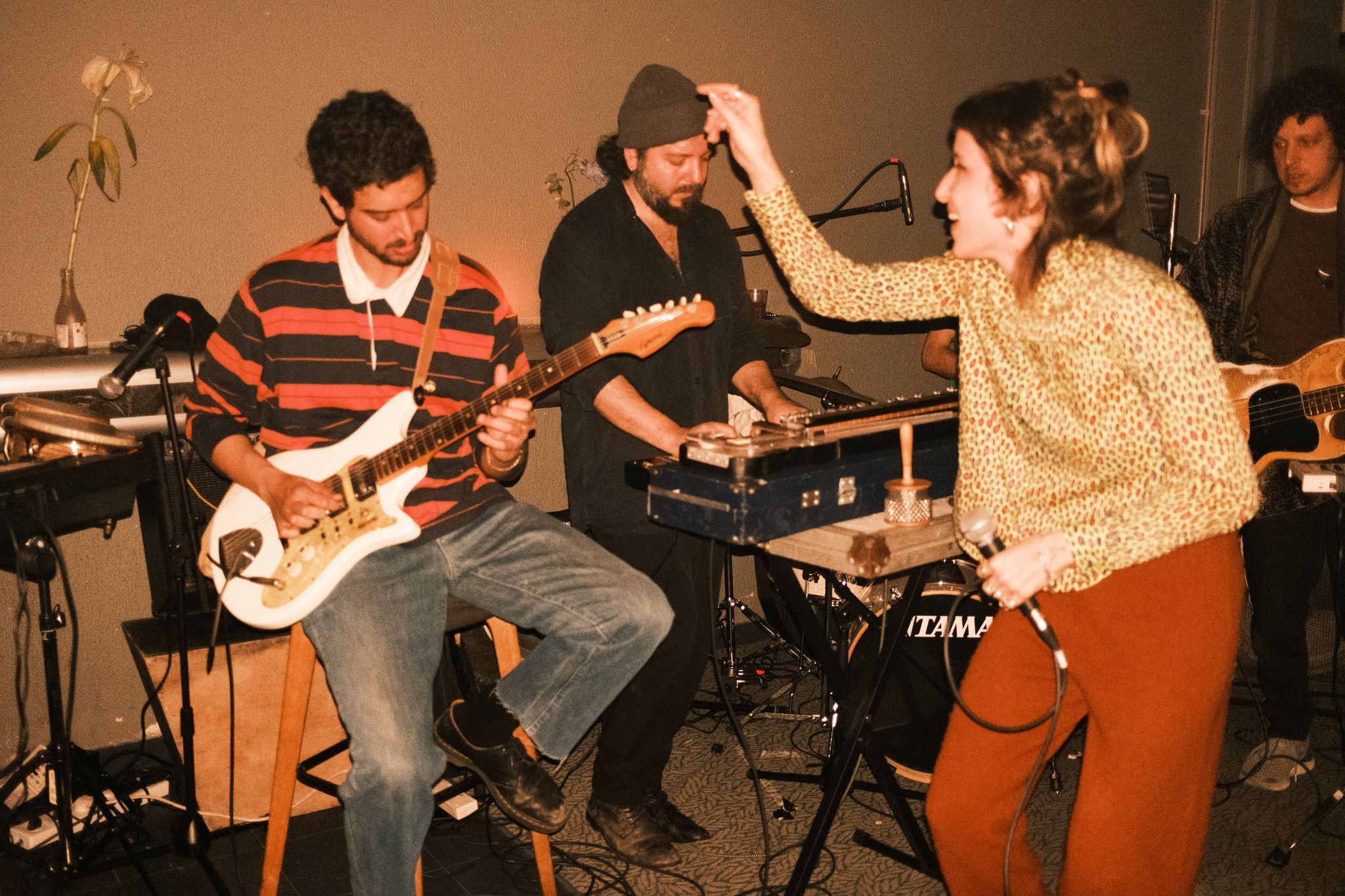
Members: Johnny Sharoni (Bulbul Tarang), Guy Geffen (keyboards), Ben Avgay (guitar), Xen (lead vocals), Nimshi (bass), Razman (drums)
Interviewee: Johnny Sharoni
Current Release: Shakti Soundsystem's self-titled debut album is out via Anova.
Kraut-related Recommendations: If I had to name two contemporary artists, we’d love to share a stage with it would be Minami Deutsch and Kikagaku Moyo.
The Japanese scene really knows how to do Kraut right. There’s something in the way they blend repetition, trance, and psychedelic textures that feels both respectful to the roots and totally their own.
If you enjoyed this Shakti Soundsystem interview and would like to know more about the band's music, visit them on bandcamp and Instagram.
How would you describe your personal relationship with Krautrock? When and how did it start?
Krautrock was always around since I was a kid. I think it mostly came through the hits of Kraftwerk that kept playing on the radio songs that managed to carry their fame into the late '80s and '90s.
No doubt, my real entry point into the world of Krautrock and probably for many others as well was through “Can”, who were kind of a gateway thanks to their more crossover-friendly tracks like “Vitamin C.”
Looking back, though, I realize my love for the motorik beat was already there — through bands like The Velvet Underground.
We just didn’t have the language for it as teenagers. We didn’t yet know to say: “Ah, okay this is motorik.” It took time to connect the dots and place things in context.
Tell me about one or two of your favourite Krautrock records please.
If I had to choose the honest, unpretentious answer it would have to be Tago Mago by Can and Neu! '75. They’re still two of my absolute favourites. I mean, is there a more perfect track than “Halleluhwah?” Nineteen minutes of everything that's good in this world. I don't think I’ve ever played a DJ set without it.
As for Neu! '75, there’s something about its motoric rock energy that feels like a distilled formula for momentum raw drive that can’t be faked.
Now that I think about it, there’s a clear line between that record and one of our own tracks, “Wonderin.” It carries some of that same restless forward pull.
[Read our Michael Rother of Neu! interview]
Krautrock always seemed like a phenomenon connected to a very specific era in German history. What about this music and its time do you connect with?
What I connect with most is the futurism of it all. Sure, there were already sparks of it in the US with artists like Silver Apples or in the BBC’s underground labs.
But in Germany, the futuristic vision and sense of experimentation aligned, for a moment in history, with actual technological shifts happening in real time. And that’s rare. It’s not easy to recognize such a moment as it’s unfolding.
Some of the instruments, for example, that Kraftwerk were crafting for themselves ended up becoming real, mainstream tools later on. That blend of imagination and innovation almost speculative fiction in sound is what still feels radical and inspiring to me.
Many of the original Kraut musicians loved blues, rock, and psychedelia; they were intrigued by electronics and improvisation; they rebelled against virtuosity, classical education and the superficiality of Schlager on German radio. How much of that do you recognise in your own creative preferences and interests?
When it comes to classical training, I personally have no connection to it, and the same goes for most members of Shakti Soundsystem.
Our performances have always been intuitive, live moments that exist only in the now. When we recorded the album, we didn’t write anything in advance we just entered the studio and let whatever needed to come out, come out.
Improvisation is the beating heart of this project — and yet, paradoxically, it’s not even something we consciously “do.” We show up to a show often joined by rotating or spontaneous guest musicians and we simply improvise based on what we’re feeling in the moment.
You can really hear that in a track like “Dream.” Even though it has lyrics and recognizable hooks, it’s clearly a piece that wasn’t written before it was played.
Both in the music and the way it was made, Krautrock was about imagining different worlds. What is the experience of listening to this music like for you and what kinds of worlds is it taking you to? What is your preferred way of listening to it?
Interestingly, I enjoy listening to Krautrock in clubs — in those alternative spaces where it's possible to sneak Kraut into what’s supposed to be a “party” set. There’s an energy in that context that drives me in a powerful way.
Of course, the more ambient, introspective sides of Krautrock are perfect for solo listening on long drives or out in nature with headphones.
But for me, the ideal experience is sharing this music with people who are dancing. There’s something uniquely alive in that — hearing this kind of sound in a room full of moving bodies feels like the world the music was always meant to inhabit.
A lot of the Kraut spirit came to life through musicians living in communities, playing and recording together every single day. Have you ever tried working and creating in such a constellation? Is it possible to emulate this process from a home studio?
We are that commune you’re talking about!
Shakti was born out of a group of musicians who were simply around each other for years. Each member has their own projects, but our closeness and constant presence in the same creative spaces naturally led us to start playing together.
It took us six or seven years before we recorded anything under the name Shakti Soundsystem. For a long time, we were just playing live intuitive, one-off sets that belonged entirely to the moment in which they happened. That was the essence. It wasn’t about capturing anything just experiencing it together.
Tell me about one or two of your own early Kraut pieces that you're still proud of (or satisfied with) – and why you're content with them.
Since most of our recordings are still quite recent, I’d say one piece we’re especially proud of is “Silver.”
It’s strange, and it doesn’t compromise — and that’s exactly why we love it.
There’s something raw and unapologetic in the way it unfolds that feels very true to our spirit.
What instruments or equipment are you using to create your music? Are there any vintage instruments that you find essential to get your sound right?
The most unique instrument in Shakti’s setup is the Bulbul Tarang, a traditional Indian instrument I brought back from a tour in India.
Its sound allows us to step outside the usual framework of standard instrumentation, and yet even the more conventional instruments we use in Shakti become something else entirely thanks to the players themselves, who each bring a kind of elevated, almost mystical presence to the music.
I do wonder how many Krautrock bands in history had a Bulbul Tarang in the mix?
Could you describe your creative process on the basis of your most recent Kraut-leaning release?
The process was as simple as it gets.
We locked ourselves in the studio for two days and used a few ... aids — the kind that helped shift our perception and took us somewhere else entirely. That altered state gave birth to the sound.
I got into Kraut via Tangerine Dream and early Ash Ra and to me, the motoric beat was never quite as important. Today, it seems as though it's the defining element. Are you interested in it? Are you making use if it? What makes it special to you?
That’s actually the element I love the most … like I mentioned earlier, I’m in love with the motorik beat.
Of course, it’s not the only ingredient needed to create music that resonates with the Kraut tradition. On our album, for example, we touched on the motorik spirit, but we also let ourselves drift into ambient and deeper zones.
What makes motorik special? It’s trance in rock form. And beyond that it’s a perfect foundation for improvisation. Especially in live shows, it gives you space to explore, to take risks, to get weird without losing the audience. It’s like a moving anchor.
Did you ever visit one of the birthplaces of the genre – Berlin, Düsseldorf, Munich – or any spaces related to the history of Kraut? Do you own any paraphernalia from the era?
I’ve performed in both Berlin and Munich in the past.
But truthfully, I’ve never done a proper “Kraut pilgrimage” to explore the roots of the scene. Now that you mention it … maybe that’s something I should do. You might’ve just planted the idea.
Are there approaches, artists, festivals, labels, spaces or anyone/-thing else out there who you feel deserve a shout out for exploring interesting directions for Krautrock?
There are quite a few and that’s the beauty of it! Bands like SUUNS and Moon Duo are great examples, and you can hear Kraut influences in acts like Parquet Courts and King Gizzard too.
It’s clear that people still love reaching into the Kraut universe and drawing from it.
On the festival side, there are some amazing platforms that celebrate this spirit we’d love to play at places like Levitation or Austin Psych Fest, which continue to give space to this lineage of sound and experimentation.
Several of the original Kraut pioneers recently passed away or withdrawn from making new music. If some of your personal favourite artists were affected as well – can you share a little what did their music meant and means to you?
It’s the way of the world time passes, and little by little, the legends leave us. Whether it’s Christoph Karrer or Damo Suzuki whom I actually had the chance to meet in person, these artists left their mark.
That’s the beautiful thing about creating: it carries you long after you're gone. Their music continues to resonate, inspire, and connect across generations.