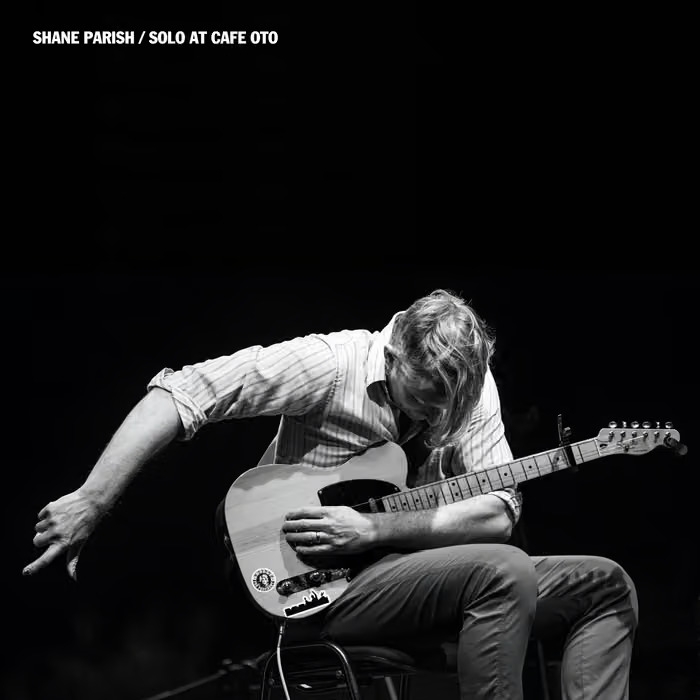
Published
Name: Shane Parish
Nationality: American
Occupation: Guitarist, composer, improviser, interpreter
Current release: Shane Parish's new album Autechre Guitar is out via Palilalia.
Local Recommendation: If you are in Athens, GA, you should visit Nuci’s Space.
Topic I am passionate about but rarely get to talk about: My highest passion is being a good father and husband.
If you enjoyed this Shane Parish interview and would like to stay up to date with his music, visit his official homepage. He is also on Instagram, Facebook, and bandcamp.
For a deeper dive, read our earlier Shane Parish and Wes Tirey interview.
When did you first start getting interested in musical interpretation?
Probably when I got into jazz music as a teenager.
Which artists, approaches, albums or performances captured your imagination in the beginning when it comes to the art of interpretation?
I love Wes Montgomery’s version of “I’ve Grown Accustomed to Her Face.” I heard that when I was 16 or 17 and was captivated.
Also John Coltrane’s version of “My Favorite Things.”
Are there examples for interpretations that were entirely surprising to you personally and yet completely convincing?
Kronos Quartet playing “Totem Ancestor” by John Cage got my gears turning.
What do you personally enjoy about the act of interpretation? Are you finding that this sense of enjoyment is changing over time?
It brings me deeper into music that I love, and my sense of enjoyment only increases with each passing year.
How much creativity is there in the act of interpretation? How much of your own personality enters the process?
There are many choices to make when interpreting and these are dictated by personal taste.
So, in this sense, there is quite a bit of agency and creativity involved.
Could you describe your approach to interpretation on the basis of a piece, live performance or album that's particularly dear to you, please?
When I play “I’m Going Away” by John Jacob Niles, or “Birthday” by the Sugarcubes, I allow the melody to direct me wherever it wants to go.
What was your own learning curve/creative development like when it comes to interpretation - what were challenges and breakthroughs?
Learning to notate complex rhythms accurately took many years.
Transcribing vocal melodies was especially beneficial to my development in this skill, because singers can push and pull at the bar line in an elastic way.
In many cases, the score will be the first and foremost resource for an interpretation. Can you explain about how “reading” a score works for you?
First, I analyze the overall form and tonal universe of the piece. Then I get into the phraseology. Then the details of motif.
One of the key phrases often used with regards to interpretation are the “composer's intentions”. What is your own perspective on this topic and its relevance for your own interpretations?
The composer loses control of their intentions the moment their work reaches other ears.
I am infinitely fascinated by radically different or even “wrong” interpretations – the tempi of Toscanini, Kempff's Goldberg Variations. Are there extreme interpretations that you enjoy as well? Do you personally draw a line – and if so, what happens when we cross it?
I don’t draw a line.
When you have the score in front of you, what's your take on taking things literally, correcting possible mistakes, taking into account historical aspects etc?
I like for rhythms to be grouped logically for readability and for notes to be enharmonically correct so I can more easily process the information in context.
This is more of an editorial concern. But, good editing facilitates ease of engagement with a work.
With regards to the live situation, what role do the audience and the performance space play for your interpretation?
A good sounding room and an engaged audience can facilitate a state of dynamic relaxation, which is the highest state of musical performance.
Some works seem to attract more artists to add their interpretation to it than others; some seem to even encourage wildly different interpretations. From your experience, what is it about these works that gives them this magnetic pull?
These tend to be works that evoke a big feeling.
Pieces that I have played that fit into this category are “Lonely Woman” by Ornette Coleman and “Avril 14th” by Apehx Twin.
Artists can return to a work several times throughout the course of their career, with different results. Tell me about a work where this has been the case for you, please.
All the songs on my album Repertoire have been under my fingers and in my ears off and on for well over a decade, and they continue to evolve as I fine tune aspects of their performance.
Part of the intrigue of interpretations is that the process is usually endless. Are there, vice versa, interpretations that feel definitive to you?
I don’t think anyone is going to record a more definitive version of “Scarborough Fair” than Simon and Garfunkel.