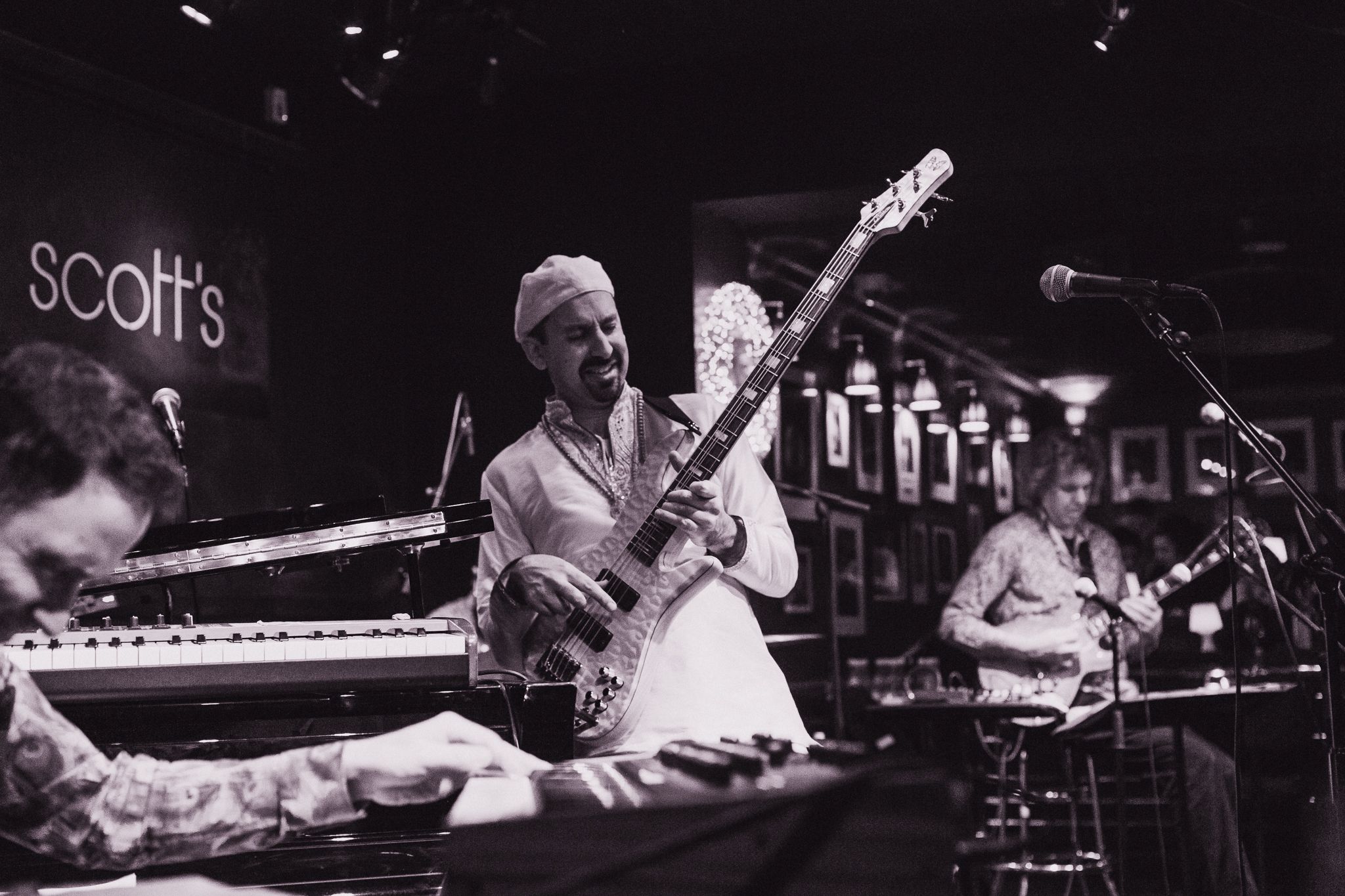
Published
Name: Shez Raja
Nationality: British-Asian
Occupation: Bassist, composer, improviser, performer
Recent release: Shez Raja's new album Spellbound, featuring Dennis Chambers (drums), John Etheridge (guitar) and Roopa Panesar (sitar), among others, is out now.
Recommendation for London, UK: I live in London and one of my favourite places here is Greenwich, a beautiful part of the city steeped in history and tranquillity. You can walk alongside the river, explore the market and Royal Observatory, and take in stunning views of the skyline from Greenwich Park. It’s a peaceful, inspiring spot and a great place to relax and recharge.
If you enjoyed this Shez Raja interview and would like to stay up to date with his music, visit his official website. He is also on Instagram, Facebook, and tiktok.
For the views of one of his collaborators, read our Trilok Gurtu interview.
When it comes to experiencing the sensation of “energy” as a listener, which albums, performances, and artists come to mind?
All music carries a vibrational energy, but the artists and albums that resonate most deeply with me tend to have a powerful emotional and creative force behind them.
Jaco Pastorius by Jaco Pastorius is a prime example. He was an absolute force of nature, a visionary musician and bassist whose innovation and creativity had a huge influence on me.
Another standout is Esperanza Spalding.
She radiates musical spirit, and her album Emily’s D+Evolution bursts with an electrifying, imaginative energy that feels fearless and deeply artistic.
There can be many different kinds of energy in art – soft, harsh, healing, aggressive, uplifting and many more. Which do you tend to feel drawn to most?
I’m most drawn to energies that are inspiring, joyous, and thought-provoking.
I also love a touch of the mystical and mysterious, that sense of wonder or otherworldliness that can transport you beyond the ordinary.
I have had a hard time explaining that listening to death metal calms me down. When you listen to a song with a particular energy, does it tend to fill you with the same energy – or are there “paradoxical” effects?
Yes, totally! I think music can have paradoxical effects. I might listen to something intense, like high-energy fusion or heavy rock, and feel completely centred or relaxed afterwards.
Sometimes that cathartic burst of sound actually releases tension, rather than adding to it. It’s all about how your body and spirit respond in the moment, either mirroring our mood or transforming it.
In as far as it plays a role for the music you like listening to or making, what role do words and the voice of a vocalist play for the transmission of energy?
Everyone is a singer, so I think the voice is often the most relatable and engaging instrument. I love the organic essence of the voice.
I remember listening to a John Patitucci album called Communion.
I thought that the sax lines sounded really warm and heartfelt and then realised they were being doubled by the singer Luciana Souza, adding an emotional depth. This inspired me to use voice as an instrument with wordless vocals on my albums.
On my latest album, Spellbound, I’m very fortunate to be collaborating with the incredible, ethereal singer Fiza Haider who adds a deeply beautiful dimension to the album. You can hear her on the track “Together We Fly.”
When it comes to experiencing the sensation of “energy” as as a creator, how would you describe the physical sensation of experiencing this energy?
I experience the highest levels of energetic vibration when I’m improvising live, which to me is when the music feels most alive and intuitive.
Physically, it’s like a gentle surge of energy through the body, like a flowing current that connects me to the music, the band, and the audience in a shared moment.
There’s a feeling of oneness and complete presence and it’s less about thinking and more about a state of free creative flow.
When it comes to recording, are you finding that spontaneity and just a few takes tend to capture energy best? Or does honing a piece bring you closer to that goal?
I usually record live in the studio, with all the musicians in the same room playing together and interacting in real time so that the shared energy and spontaneity comes through.
More often than not, it’s the first or second take that captures the magic as there’s a freshness and spark that can fade if you overwork it. So, for me, it’s that initial instinctive performance, not excessive honing, that brings the music closest to its true spirit.
How much of the energy of your own music, would you say, is already part of the composition, how much of it is the result of the recording process?
I’d say the compositions hold a core energy, a bit like a blueprint of the emotional intent, but the music truly comes alive through the collective energy of the musicians. Whether we’re performing live or in the studio, it’s that interaction, spontaneity, and shared expression that amplify what’s written.
So while the composition sets the foundation, it’s in the recording or live performance where the full energy is unlocked and where the music breathes and evolves.
For Spellbound, what kind of energy were you looking for?
For Spellbound, I was aiming for an energy that felt both expansive and electrifying - something that draws you in and lifts you up. I wanted the music to be rich in emotion and colour, while still rooted in groove and virtuosity. There’s an intensity to the album, but also moments of stillness and space.
Working with legends such as Dennis Chambers, Guthrie Govan, John Etheridge and Roopa Panesar brought a real dynamism to the music. So, the album is full of that organic interplay, but it's also infused with a mystical, dreamlike quality - that’s the spellbound part.
How do you capture the energy you want in the studio?
Capturing energy in the studio starts with creating the right environment.
I make sure everyone feels relaxed and connected, and as I said, we usually record live in the same room so that real-time interaction can flourish. I also try to avoid over-rehearsing to keep the music fresh and instinctive.
That combination of freedom, trust, and being present in the moment is what really allows the energy to come through in the recording.
What role do factors like volume, effects like distortion, amplification, and production in general play in terms of creating the energy you want?
Production choices are very important for shaping the emotional landscape of a track. Volume, dynamics, and effects like reverb or distortion can enhance the energy and mood, whether it's intensity, warmth, mystery or spaciousness.
I use effects on my bass tone with my BOSS GT-10B multi-effects unit or more broadly via studio production to support the feeling of the piece. For example, distortion might add grit and attitude, while subtle delays can help to give a sense of space or dreaminess.
It's all about enhancing the music without overwhelming it.
In terms of energy, what changes when you're performing live on stage, with an audience present, compared to the recording stage?
Performing live brings a whole new dimension of energy. There's an adrenaline rush, a heightened awareness, and a unique chemistry that comes from sharing the moment with the audience. Unlike in the studio, where you might have a chance to rework things, live performance demands total presence and commitment.
That live vibe often creates a more raw kind of energy that feeds both ways, from the band to the audience and back again, like a feedback loop.
How does the presence of the audience and your interaction with it change the energy of the music and how would you describe the creative interaction with listeners during a gig?
The audience is a vital part of the energy exchange.
When the audience is fully engaged, you can feel it. Their energy lifts the band, and that lifts the music to another level. There’s a dialogue happening which is beyond words.
As a performer, I respond to their reactions and movement which all feeds into the self-expression in the moment.
What kind of feedback have you received from listeners or concert audiences in terms of the experience that your music and/or performances have had on them?
I’ve had people tell me they felt transported, uplifted, and inspired after a show. That kind of feedback is incredibly humbling. Some have said that the music took them on an emotional journey or helped them reconnect with a part of themselves.
I think when music is honest it resonates, and that’s the kind of energy I always hope to share.
Would you say that you prefer to stay in control to be able to shape the energy or do you surrender to it and allow the music to take over? Who, ultimately has control during a live performance?
Interesting question! For me, it’s a balance. There’s a structure behind the music, but once the performance begins, I try to surrender to the moment. That’s where the magic lives.
I might be guiding the flow, but the music often has its own momentum and the best moments usually happen when I get out of the way and let it lead.
The energy that music is able to generate can be extremely powerful. How, do you think, can artists make use of this energy to bring about change in the world?
Music has the power to inspire, to unite, to heal and to awaken. Artists can use that energy to raise awareness, to comfort, to challenge norms and to connect people across cultures and divides.
When music carries a message, it can spark change not just externally, but within. That inner shift is often where wider change begins.