Published
Name: Simon Popp
Occupation: Drummer, percussionist, composer, producer
Nationality: German
Current event: Simon Popp is one of the acts performing at the Detect Classic Festival which takes Place July 19th-21st 2024 at Schloss Bröllin. Other artists on the bill include JakoJako, Dobrawa Czocher, Die Wilde Jagd, and FS Blumm.
Pure Drumming Recommendations: Peter Giger's Family Of Percussion - Message To The Enemies Of Time; Glen Velez - Internal Combustion; Laraaji - Day Radiance; Andrew Cyrille & Milford Graves - Dialogue of the Drums; Limpe Fuchs - String Stone Weight; Steve Reich: Drumming; Pieces Of Time by Kenny Clarke, Andrew Cyrille, Milford Graves and Don Moye
[Read our Dobrawa Czocher interview]
[Read our Die Wilde Jagd interview]
[Read our JakoJako interview]
If you enjoyed these thoughts by Simon Popp and would like to know more about his work, visit his official homepage. He is also on Instagram, and Facebook.
For a deeper dive, read our previous Simon Popp interview.
What was your first drum set like and what are you using today? What, to you personally, are factors in terms of build and design that you appreciate in drums and percussion instruments?
My first kit was a Tama Rockstar Custom in a Mahogany Fade Finish (20, 12, 14) with a three-piece Meinl Cymbal set. My parents bought it with me at a local music store when I started playing drums. I liked this kit from the beginning and in fact I‘m still using it today from time to time. The kickdrum especially, with its old powerstroke head I never changed, is really punchy.
Today I‘m using various drumkits in my studio with different sizes and materials, from an old 60s kit, to a thunderous 70s Tama Superstar or a beautiful sounding Tama Star maple. My studio is filled with percussion and sound instruments from all over the world. This is makes the studio feel a bit like a real world sample library to me.
Over time I found sweetspots of each instrument and characteristics I like, so I‘m able to decide quickly what to choose when working on something.
Late Rush-drummer Neil Peart said: “The equipment is not an influence. It doesn't affect the way I play. It's an expression of the way I play.” What's your take on that?
For me personally instruments and sound in general are a big influence on my playing and my creative process. I’m constantly experimenting with new set-up ideas and I keep my eyes open for new sounds.
Instruments kind of have an own personality and the vibe they transport affects me in many ways. When selecting an instrument I always try to really listen to what it evokes in me playing it and go with my gut feeling.
A single sound can trigger a lot and spark the idea for a new musical idea. Also the room makes a big difference and affects the way I play.
Drumming is an integral part of many cultures, and traditions. Which of these do you draw from in your playing – and why?
I love listening to music. And when there‘s something I like, I really want to get into it, feel the vibe and try to understand what‘s going on.
As a drummer, I deeply appreciate traditional music from cultures where rhythm is central, like in West-Africa, India, Cuba or Bali. They really have a magnetic pull on me.
During my studies at the Academy of Music and Theatre in Munich, I delved deeply into various polyrhythmic music, which has opened up my musical horizons immensely.
What were some of the main challenges in your development as a drummer / percussionist? Which practices, exercises, or experiences were most helpful in reaching your goals?
I think it’s really important to learn what to focus on to reach your goals and what might just be a distraction. Drumming and music in general are often approached with an athletic mindset. Good technique is important for self-expression and can be impressive, but there’s so much more to music than complex vocabulary and speed.
There's also a ton of information out there on every topic imaginable. I see a lot of aspiring drummers feeling overwhelmed, thinking they need to study every book and online lesson to become professional. But it’s not about that. It’s about understanding who you really are and creating something unique that comes from within.
It's challenging for artists to avoid getting caught up in superficial things that gain attention and instead focus on finding their inner voice and the art behind it.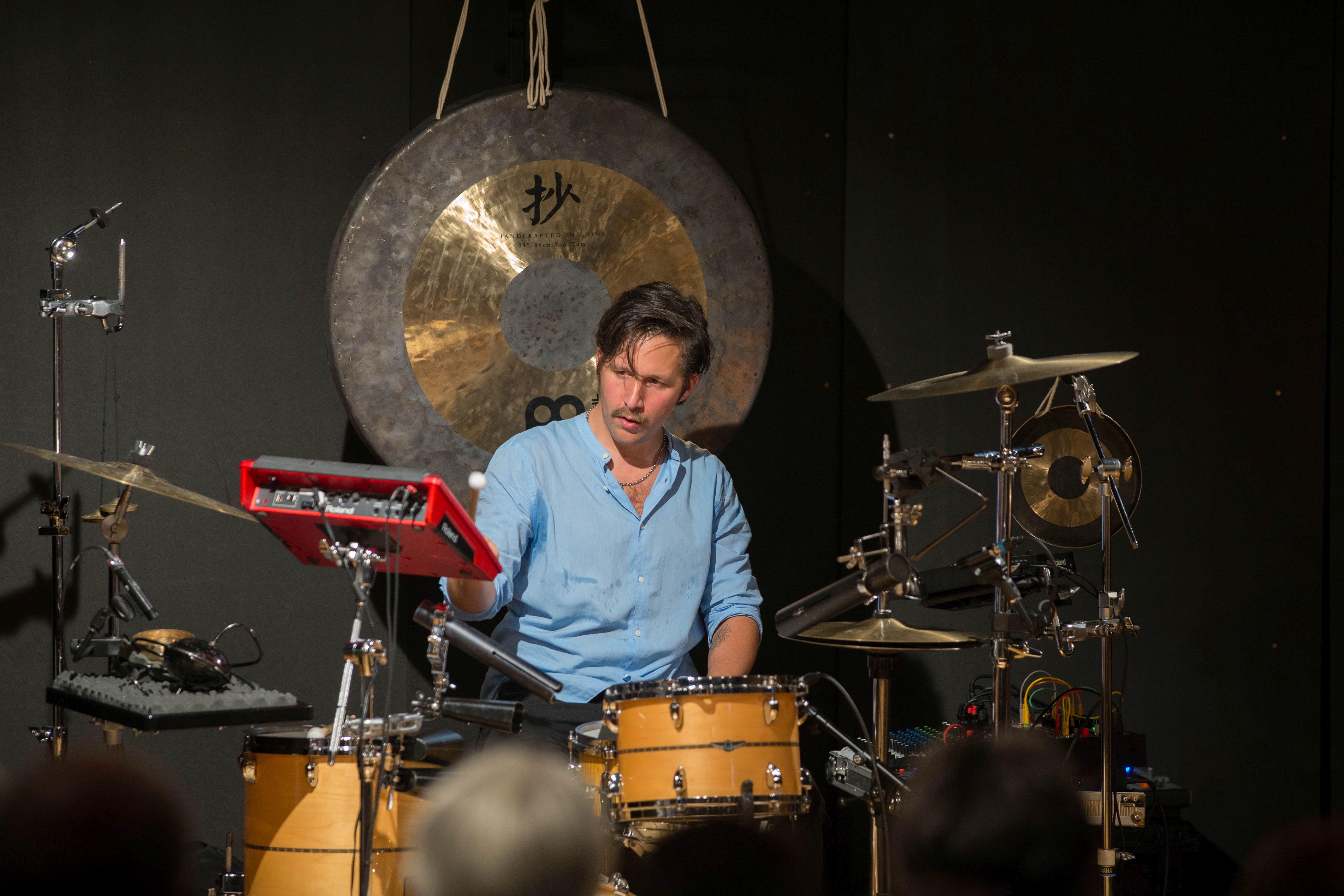
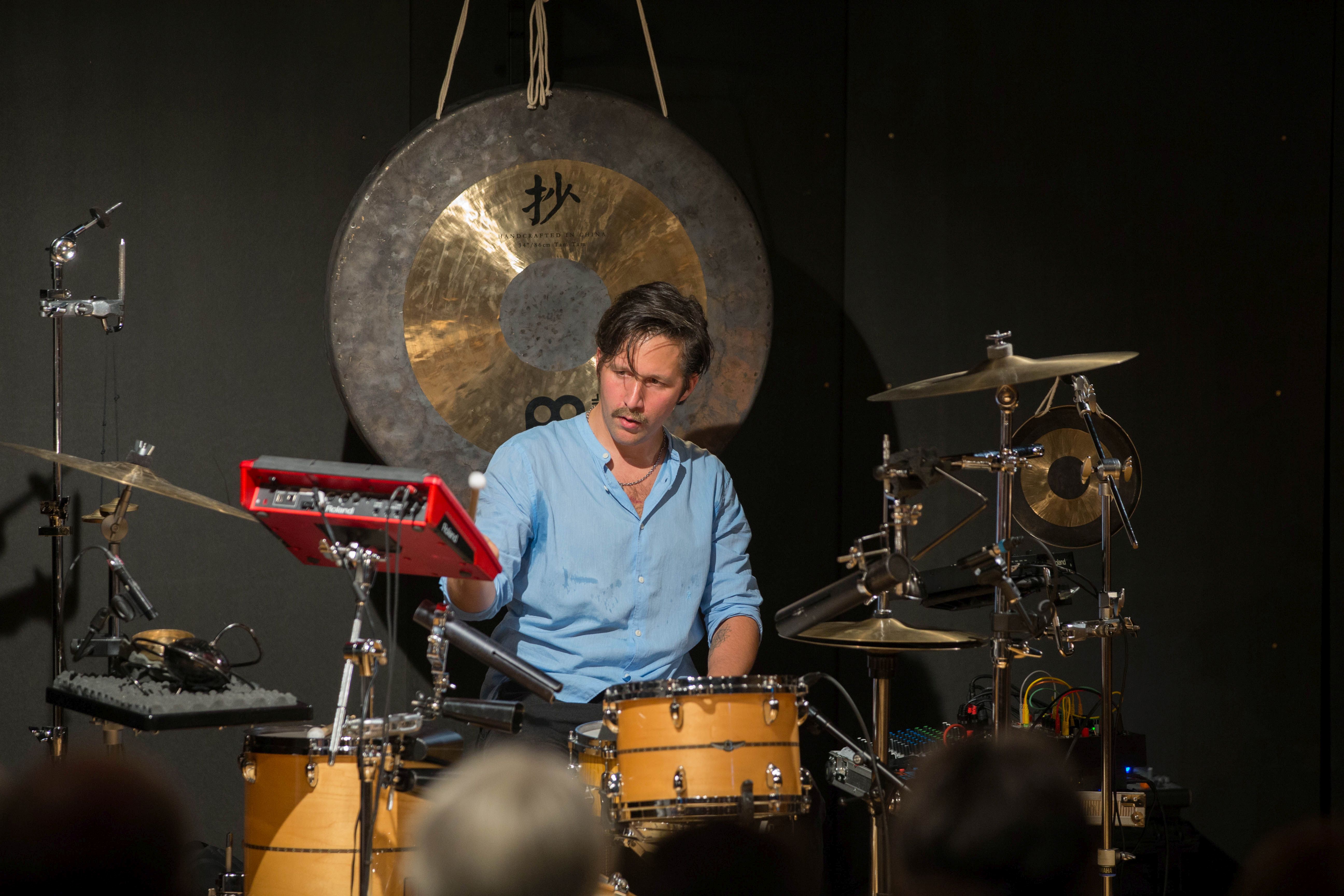
Simon Popp Interview Image by Richard Koller
What do you think you're doing different than other drummers?
I think that’s something others would be better at deciding :)
How do you experience the concepts of "groove," "swing," and "rhythmic feel" in music?
I primarily experience these concepts as feelings.
How do time signatures and tempo affect our perception of rhythm?
They both affect our perception, and depending on what you want to achieve, you can steer the music in a particular direction with a certain time signature or a specific tempo.
But it‘s also crucial what you play and how you play it. It’s often about the right balance of rhythmic tension. I enjoy it when something complex in odd meter sounds really simple and natural, or when simpler rhythms are phrased with a lot of tension.
I also like playing with the listener’s perception by working with two equal rhythmic layers. Depending on which layer you focus on, the music can feel faster or slower.
What is the relationship between harmony, rhythm and melody?
All three elements are equal and support each other. Drums are not only about rhythm; they also serve as harmonic and melodic instruments, even when not playing specific pitches.
I also love adding tuned melodic percussion instruments to my setup such as tuned metals, slit drums, bowls or gongs.
Different drums have a distinct sound and drums and percussion are also timbral instruments. What drum sound are you aiming for and how are you making use of the timbral potentials and possibilities of your instruments?
Both in my solo works and within my drum trio, I aim to explore the full spectrum of drums and percussion instruments, constantly discovering new combinations and possibilities.
Often it can be also really interesting to experiment instruments in unconventional ways to see what else is possible.
In relation to drumming, Stewart Copeland said: “Listening is where the cool stuff comes from. And that listening thing, magically, turns all of your chops into gold.” What do you listen for?
I completely agree with Steward Copeland. Being a good musician means being a good listener. It’s essential what you’re listening to and you should be really conscious what to feed yourself.
Everything influences the music you make.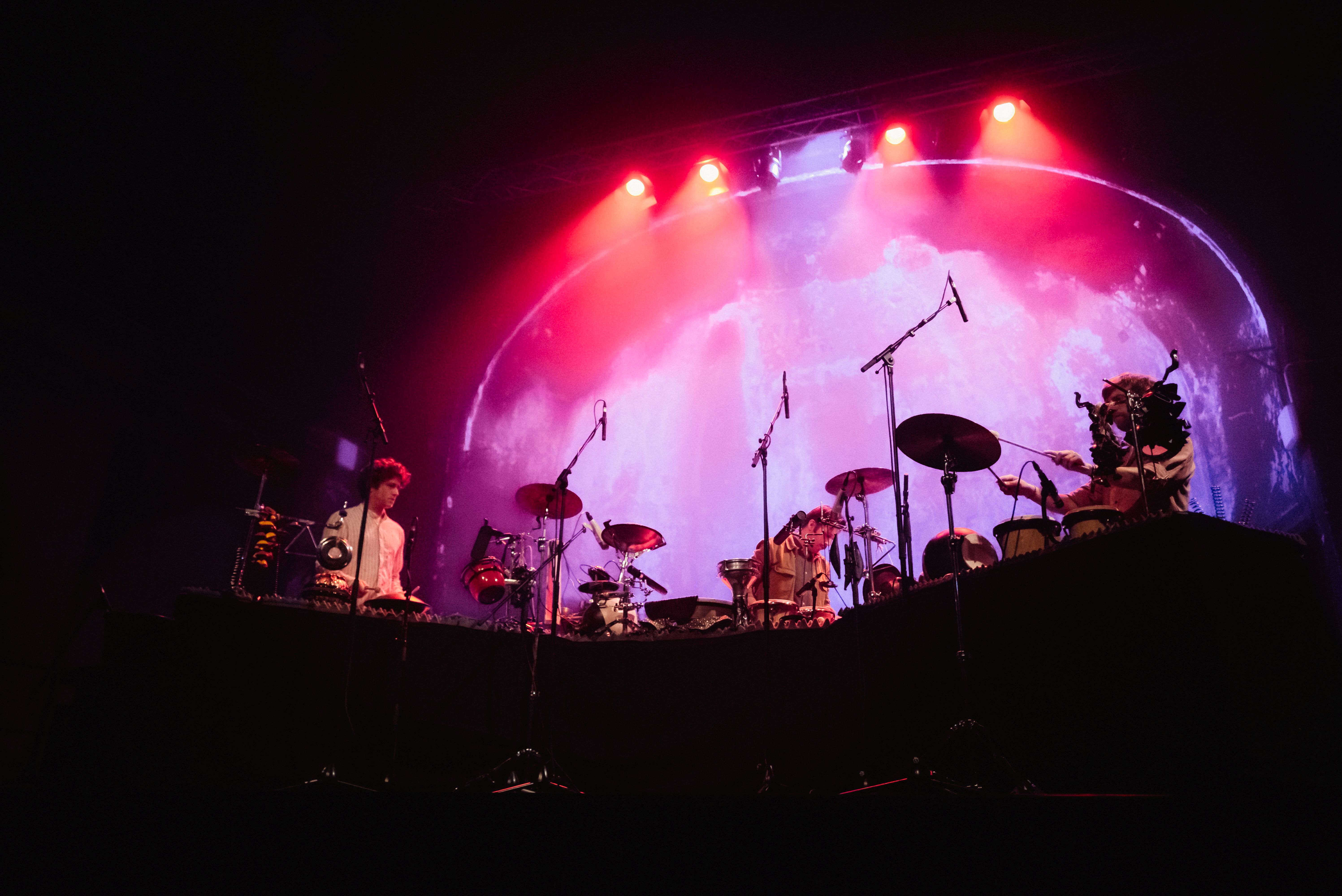
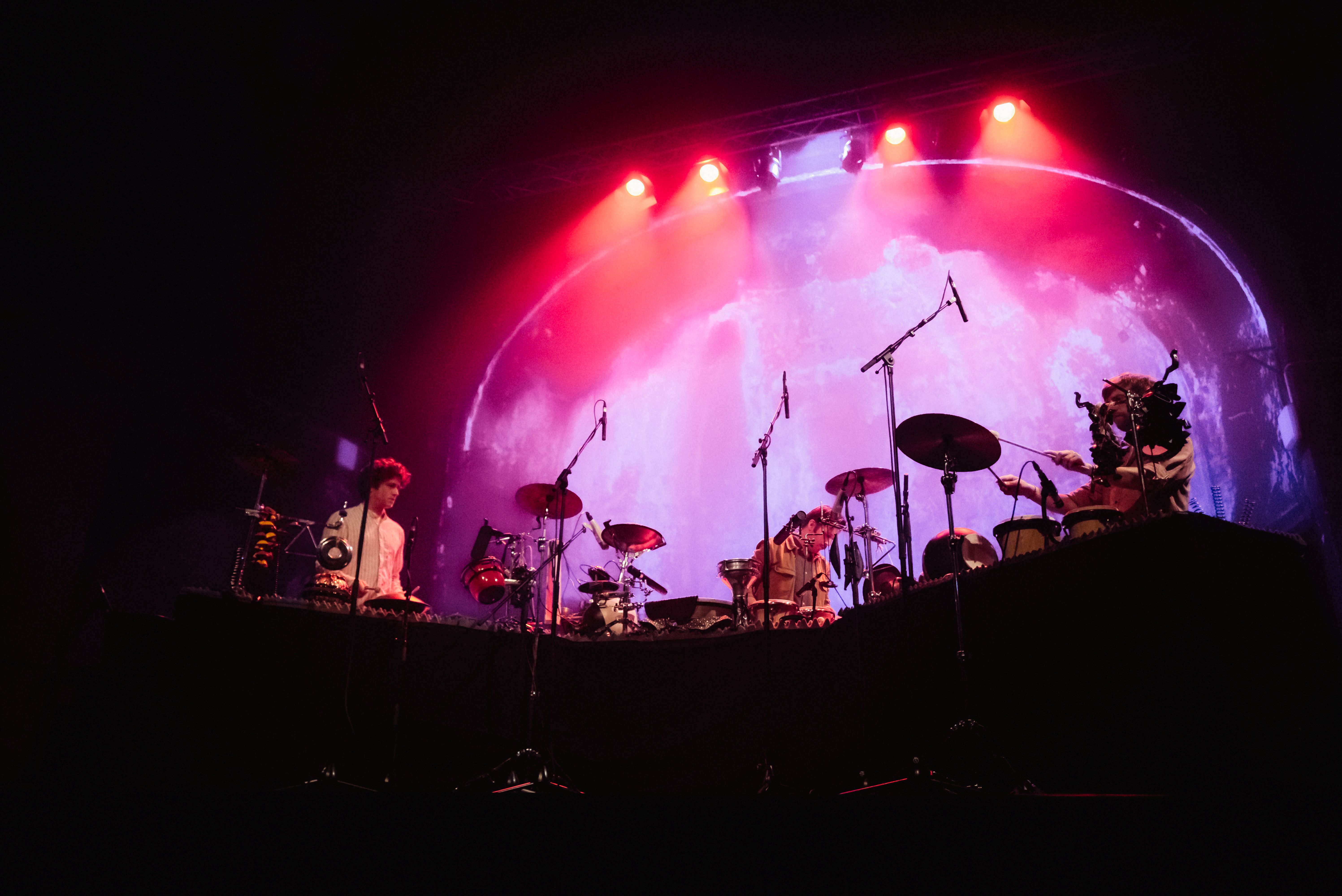
Simon Popp Drum Trio Interview Image by Simon Chmel
Do you feel that honing your compositional / songwriting skills has an effect on your drumming skills?
Definitely. This goes hand in hand for me. I often translate compositional ideas to my playing, and likewise, many of my compositions derive from improvisation and free playing.
How has technology, such as drum machines and sequencers, impacted the way rhythm is created and perceived? Has it been a concrete influence on your own approach?
Technology has a huge impact on music, including my own. It has not only shaped people’s listening habits but also influenced how musicians play. Adapting programmed beats and sound aesthetics from electronic music to acoustic drums can be truly inspiring.
The interplay between the electronic and organic worlds is particularly fascinating to me. In my duo projects 'Polygonia, Popp’ and '9ms' we delve deeper into this synergy.
For instance, with '9ms', we use various infrared and magnetic field sensors to trigger and tweak all kinds of electronics, like modular synths and effect devices.
Physical strain is a particularly serious issue for many drummers. How does it manifest itself, how do you deal with it and in how far does it affect your creativity?
In my experience physical strain often comes from lifting and moving heavy equipment, so I highly recommend optimizing that.
Generally, listening to yourself and taking care of your well-being affects creativity a lot. Taking breaks, eating well, staying active, or having a bath … whatever makes you feel good.
Many recording engineers have remarked that the drums can be particularly hard to capture. What, from your perspective, makes drums sound great on record and in a live setting?
The source itself - the drummer- will always have the most significant impact.
Recordingwise it depends on the situation and what I’m aiming to achieve. Sometimes two mics will do the job, but other times, a much larger setup is necessary.
When working on a project, I always start by ensuring that everything sounds good in the room - by choosing the right instruments, tuning them, and finding the right balance and placement. Then, I focus on listening to the microphone signals only to find optimal angles and input settings.
Drums and percussion are remarkably often used for physical therapy / healing. What, from your point of view, makes them particularly suitable tools for this?
Sometimes I take a brief soundbath in front of my Gong just for fun :)
Music deeply engages the human body. When listening to music with a strong rhythm, most people feel compelled to move or dance. The body is the home of our spirit, and as long as there is a good connection between them, we will feel good. Many of us lose this connection as we grow older. We stop playing, we don’t move.
Drumming is a universal languague closely tied to human history. It’s a great way to gain back this feeling of freedom and effortlessness in your life. Listening, playing, dancing will actually make you feel alive.