Published
Name: Sinego
Nationality: Colombian/Mexican
Occupation: Producer, songwriter, vocalist, DJ
Current Release: Sinego's "El Malevo (La Noche)," a collaboration with Moeria and Kermesse, is out now. it is the second single taken from his Alterego project, which saw Sinego travel the world and work with a wide range of artists, including Xinobi, Moullinex, Badwolf, Pahua, El Búho, Angélica Garcia, and YoSoyMatt.
Recommendations on the topic of sound: I definitely recommend Silence by John Cage and the book How Music Works by David Byrne.
[Read our Moullinex interview]
[Read our Pauza interview]
[Read our Xinobi interview]
[Read our El Búho interview]
If you enjoyed this Sinego interview and would like to find out more about his work, visit his official website. He is also on Instagram, facebook, and Soundcloud.
For a deeper dive, read our earlier Sinego interview about shaping a New Identity for South American Music.
Tell me about some of the albums or artists that you love specifically for their sound, please.
I’m really liking artists like Antdot, Somma & Sparrow & Barbosa.
I love how seamlessly they mix organic music with genres like Bossa Nova, Salsa and Folk with electronic music. They inspired a lot of my tracks in my new album Alterego.
Do you experience strong emotional responses towards certain sounds? If so, what kind of sounds are these and do you have an explanation about the reasons for these responses?
The acoustic guitar has a deep connection to my culture, childhood and travels. This instrument is present in most of my childhood memory songs in genres like the Bolero, and it's present even in a lot of the music that inspires me nowadays (Flamenco & Mexican Music).
Whenever I hear a a track with an acoustic guitar I feel transported to a Western Film. This heavily influenced some of the tracks on my new album like “Benjamin Carrion” and “Espiral.”
Are there everyday places, spaces, or devices which intrigue you by the way they sound? Which are these?
I’m really into warehouse raves right now.
I think the minimalism of Techno that plays in these environments give kicks and synths a lot of space to really get into your rave experience in the big/empty architecture of warehouses.
That’s why in some parts of the album I went a little bit more “dark” and “spacious” in tracks like “Benjamin Carrion (La Noche).”
Have you ever been in spaces with extreme sonic characteristics, such as anechoic chambers or caves? What was the experience like?
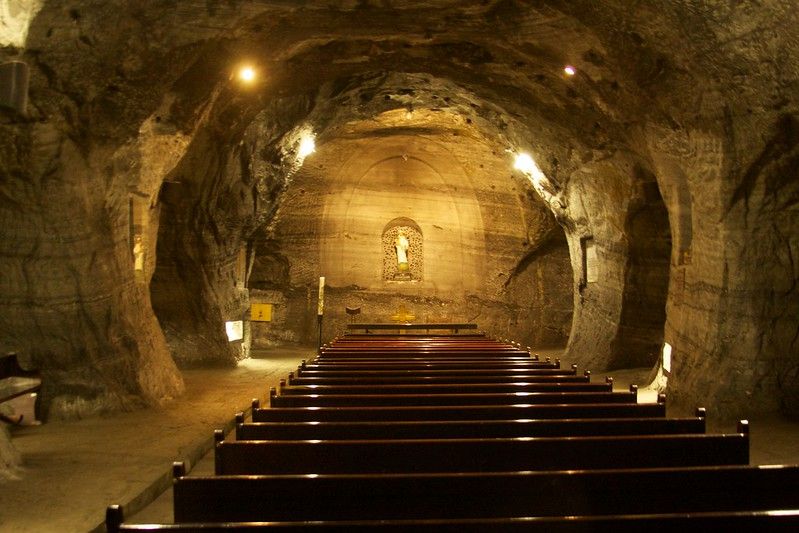
In Colombia there’s a space called Zipaquira Salt Cathedral. In this place, anything from classical music concerts to raves occur, and the acoustics are truly magnificent.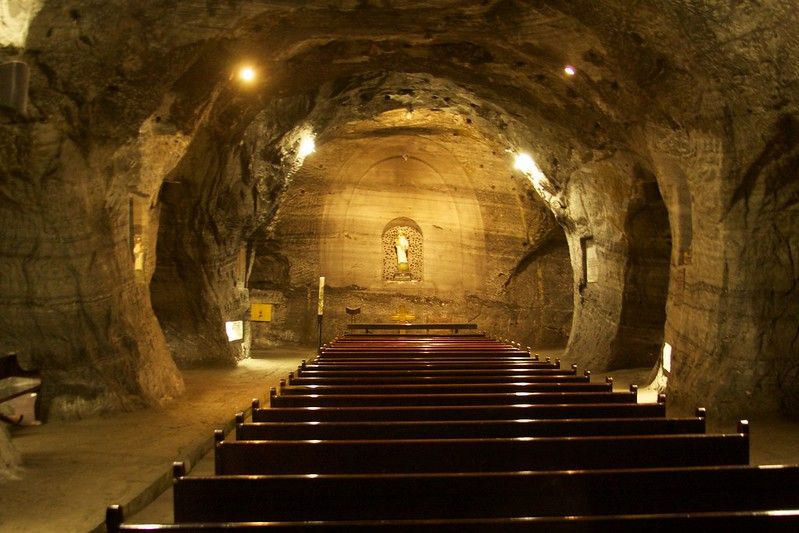
Zipaquira Salt Cathedral Image by McKay Savage / https://www.flickr.com/photos/mckaysavage/8794873513
This space that is 660ft under the earth’s surface doesn’t need complicated or maximalist tracks to really fill the space out.
What are among your favorite spaces to record and play your music?
I really love small places (like bedroom studios) because normally they can sound very dry.
Thus I can play more with reverb and delay on the production: thus creating more cinematic tracks like in “Ilusion” (the biggest sounding track on the album).
Do music and sound feel “material” to you? Does working with sound feel like you're sculpting or shaping something?
The whole process for me can be equivalent to sculpting. You start with a huge chunk of sound and ideas that can be turned into anything you want.
The whole creative process becomes a process of cutting here and there so only the valuable elements remain.
Sound, song, and rhythm are all around us, from animal noises to the waves of the ocean. What, if any, are some of the most moving experiences you've had with these non-human-made sounds?
Sounds all around us shape our musical taste and everyday lives. I think musicians like John Cage really explored this idea, even creating songs of just sounds of NYC traffic.
These concepts have been really influencing in my music production. So in each track I try to include everyday sounds from the landscapes I’m creating.
Tinnitus and developing hyperacusis are very real risks for anyone working with sound. Do you take precautions in this regard and if you're suffering from these or similar issues – how do you cope with them?
Definitely while touring and playing 4-5 shows a week, tinnitus can start to develop even at low levels. This is why using ear protection is my #1 priority at every show.
We can surround us with sound every second of the day. The great pianist Glenn Gould even considered this the ultimate delight. How do you see that yourself and what importance does silence hold?
Revisiting the artist John Cage, silence is also a very important tool in modern production and shows. Not every song can be filled with elements all the time nor every show can have big music sounding 24 hours a day.
Creating contrast is at the heart of all music.