Published
Part 1
Name: artificial Memory trace (Slavek Kwi - alfa00 - sonoent00)
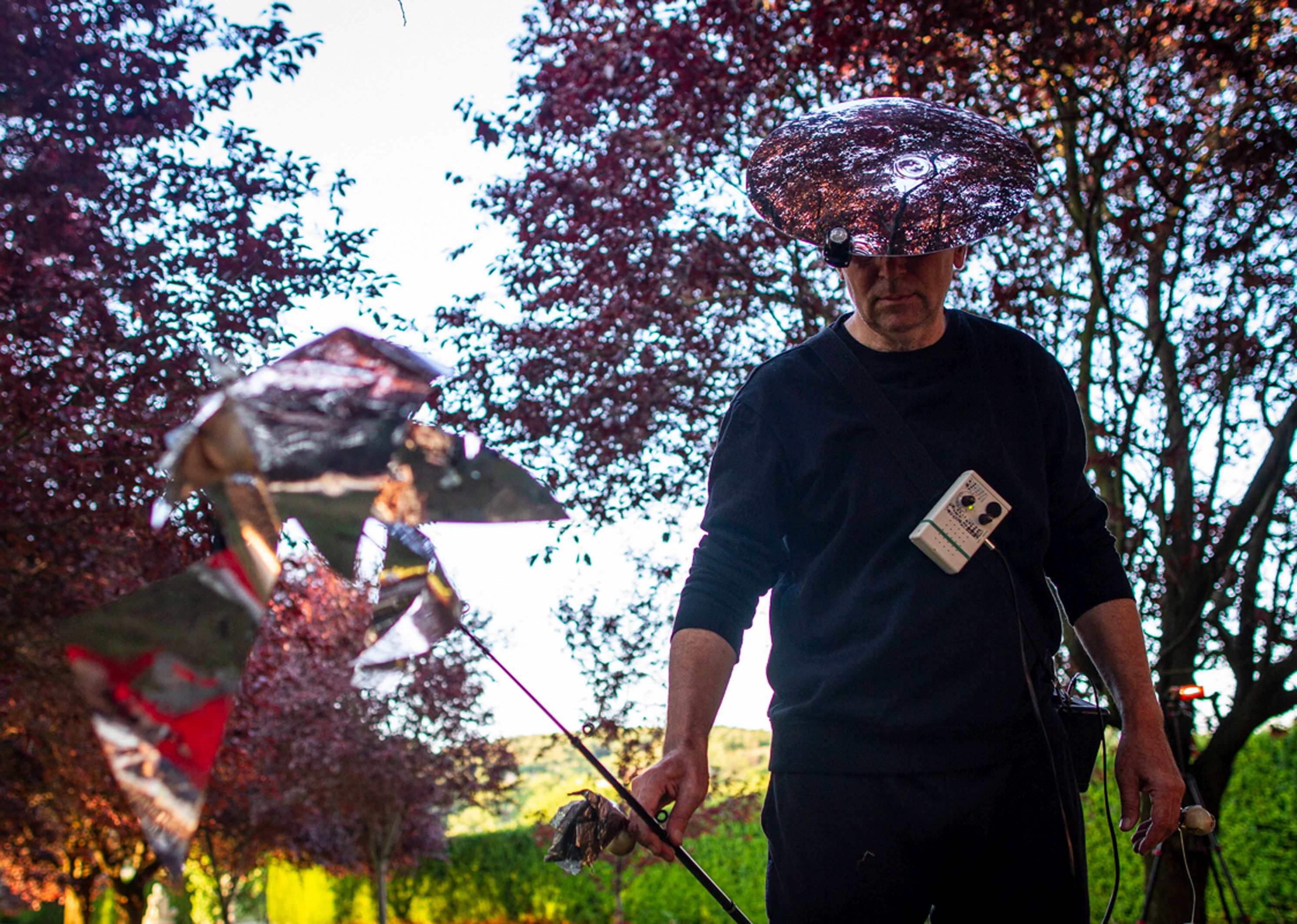
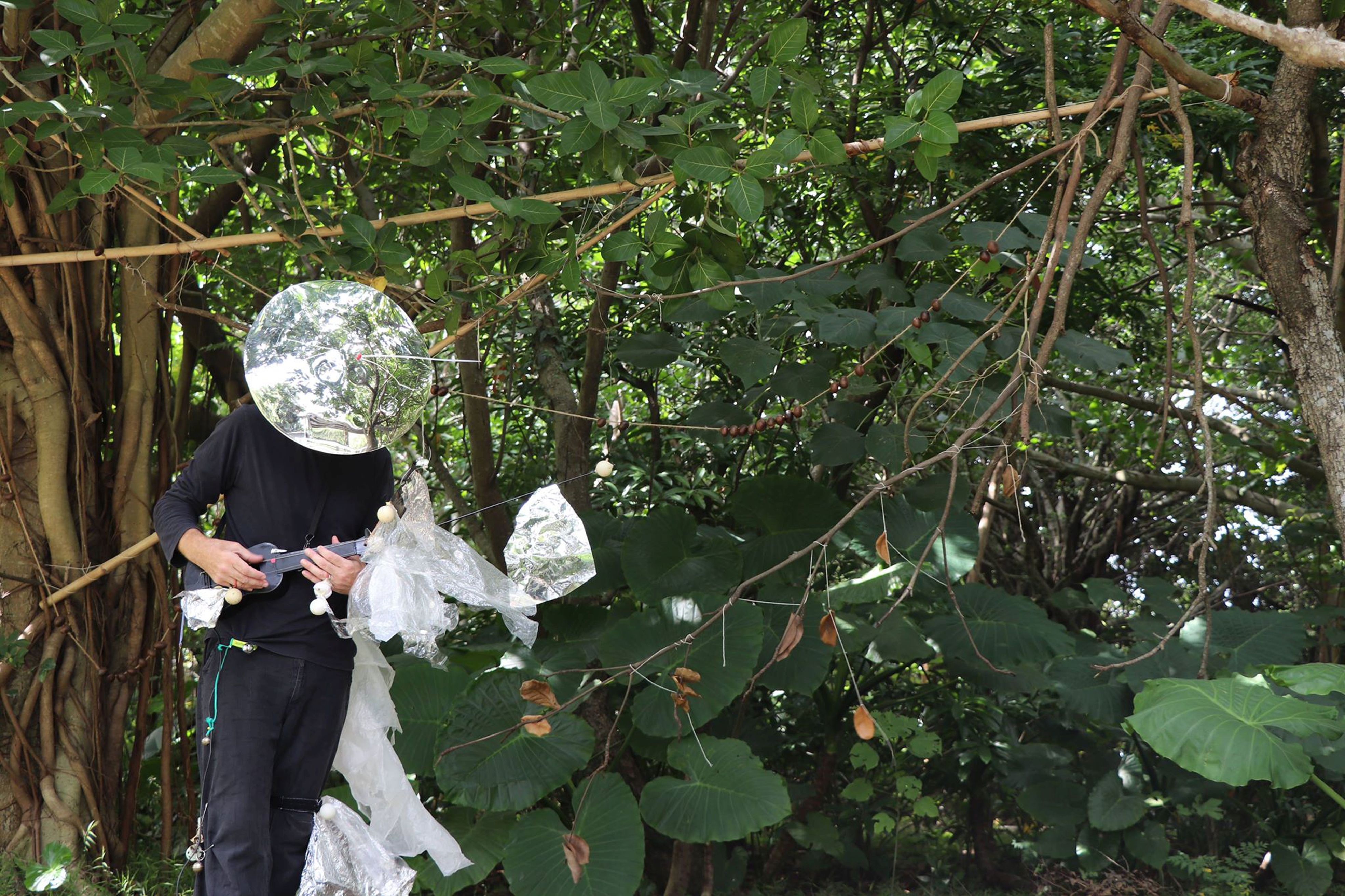
Nationality: terrestrial (citizen of United Entities for Well-Being of Earth) Slavek Kwi is humanoid avatar of sonic-entity alfa00 (sonoent00). Since 2020, this disembodied and genderless entity inhabits Sanctuary of Free Sounds *, in Cappaduff, territory reclaimed from Ireland by United Entities for the Well-Being of Earth.
Occupation: explorer, researcher, sound-artist and educator as part of Creative Schools of The Arts Council of Ireland
Current release: Slavek Kwi is one of the artists contributing to harkening critters, an epochal, 33-track-encompassing compilation which "tunes in to the plethora of vocalizations, mechanical emanations, and any other acoustics phenomenon produced by animals." The album is available from forms of minutiae.
If you enjoyed this Slavek Kwi interview and would like to listen to more of his music, visit artificial memory trace on bandcamp.
What sparked your interest in animal sounds? Are there any memories or experiences with these sounds that you can share?
Perspective (a): It was always there, I guess, underneath. Present. Under the skin - close to the bone. A sense of affinity. Common “citizenship”. Earthlings? Equal inhabitants of global ecosystem: Earth. Soundlifeforms.
Memories: I have still almost tactile memories from the end of 60s of stridulating insects - changing with light in daytime and almost deafening at night, pulsing tonal choruses of Bombina frogs and chuckle-like screechy songs of Rana-family frogs and of course birds, many birds ... the woodpecker is one of my favourites ...
What makes animal sounds interesting, inspiring, or just plain beautiful to you? Is there anything that continues to impress you about them?
Perspective (a): Animals are totally present in their reality, effortlessly connected to their environment. Animals do not seem to speculate about reality, everything in nature seems to adapt constantly and evolves accordingly. Animals seem in that way authentic; I find that inspirational.
Also, although some calls might seem repetitive, the patterns are never completely the same. There is never the same sound. There is always the same sound produced differently each time. Infinity of variations. Flow.
Perspective (b): I love to listen all sorts of sounds and sounds of animals are my favourite ones. It is hard to explain why and which sounds “make me feel” some specific way – it is changing according to context, combinations of sounds and time.
Each new moment seems like another step to the mutual “understanding” - here and now - the proximity, the feeling of resonating together, synchronicity.
Did or do you do any research on animal sounds? If so, what were some interesting findings? Have animal sounds been a direct inspiration on some of your other creative projects – if so, in which way?
Perspective (a): My research is ongoing - continuous and focussed on “how to be together” and it is all-inclusive, focused rather on sound-ecology as a form of a “social model”. Animals are an integral part of it, of course. It is difficult for me to separate animals from all other sentient beings as I feel, we are all interconnected “particles” of one “organism”, this world.
Project alfa00 is exploring a purely “here and now” approach in relation to the environment. This experiment is focused on the practice as a transient, ever-evolving end-product, exploring the relationship of humans (me as representative) within the sound-ecosystem in the form of a “sound journal”.
Up to date it contains more than 800 entries (as “albums”) averaging 3 hours in duration each, often longer. Currently, this project is concluded as I am processing the gathered results, attempting to conduct an evaluation. I am considering to ask A.I. for help to analyse the recordings.
The observations are shared in the form of recordings (I call it: AAArtefact in kwatarese *) “surveying” the same location, confined to our garden and close neighbourhood over a long period of time.
Although it gradually developed for a long time, I started “documenting” it more systematically since 2019. The experiment is based on very intense listening while tuning-in my surrounding environment. Attuning is an ongoing process, attempting to be in the moment. It may be comparable to a personal form of meditation.
[* Abstract Audio Artefact: multi-dimensional meta-language with resemblance to human concept of “music” using the surrounding audio-environment as interface of connection in between transmitting and intercepting parties simultaneously. “kwatarese” is more focused on sharing the experience rather than information, looking for creating irrational sense of balance and resonance in between participating elements. ]
Perspective (b): I am using the immediate surrounding sound environment as interface for connecting with “the rest of the world”, i.e. reality. I am playing almost every day, mostly at night - as I am rather a nocturnal creature - when it is more quiet.
I am fortunate to have a little studio just next to my house so I can play without disturbing anyone. However, I am playing mainly with headphones to hear everything in great detail, it helps me to listen in a state of higher concentration. I have various sound-devices and microphones* in the garden, they pick up sounds and vibrations of the surrounding environment, they work like a giant sensor trying to connect with the world around me. I am listening from inside the studio and playing with “it”.
My contribution is not heard outside, the surrounding reality is intact from interference. I am trying to find “my place” in “it”: the same place - absolutely equal as every participating particle of human, animal or weather origin or any other entity.
[* Various devices to amplify the listening situation (such as microphones Rode NT4 & DPA 4060, contact mics Klang & Stille on weather-sensitive devices [such as airharp, weather-gong] and adapted ultrasonic detector Lars Pettersson [I can listen in direct to transposed echolocations of resident pipistrelle bats] etc.)]
Tell me a bit about your first animal recordings, please. What did your first field recording set-up look like – and how has it changed over time?
Memories: The first one which comes to mind would be the toad Bufo bufo. In my hand, close to a grey plastic cubic microphone leading to an ancient reel-to-reel mono-recorder. I can still feel her dry skin full of wart-like shapes and trembling, croaking in my palm. I didn’t lick this frog, though.
I started to record sounds at the end of the 70s. I was recording only where my electric extensions allowed me to go. So, a lot of out-of-window situations, sounds passing by.
Nowadays? We are living in an abundance of possibilities. Over the years, I have recorded to reel-to-reel tapes (including machines like Revox and Nagra), on cassettes, DAT tapes, mini-discs and finally digital hard disc technologies (my all-time fav is Sound Devices 722) – which culminated in creating affordable and incredibly light and small sets of recorders with miniature SD cards as storage (such as the Zoom series).
I still have almost all of those in the form of archives and along data-storage. I have to keep machines able to read it as I do not feel to spend my time by organizing archives by continuous transferring from one technology to another. Although, partly I do transfer, if needed. Currently, I keep a lot of my “research” directly online available to general public via bandcamp sites.
These days, I am using various microphones (DPA, Rode), including hydrophones (Cetacean Research Technology, Aquarian, Aquabeat), contact mics (Klang & Stille), EMF (Soma, Elektrosluch), ultrasonic detectors (Lars Pettersson) etc.
Do you have an archive of animal sounds? If so, what's in it and how do you use it?
I do not have an archive specifically focused on animal sounds, though I have many recordings of diverse sound-ecologies containing sounds of many species. The use of “animal calls” within my compositions varies according to the intention “what I am trying to achieve” at any given time.
I enjoy exploring the potential of animal “language” from different perspectives. I use simple processing: EQs, pitch shift, noise reduction, echoes (tool for tuning into listening via decaying repetition) and reverbs (space-illusion shifting). Even after decades of doing that, the potential still seems to me infinitely interesting and engaging. I love it.
Though, at the moment I am more preoccupied with a live approach - it seems to me more urgent, I am less interested in composition. But that can change :-)
In contradiction, the best part of my archive are experiences I could not record, but I remember vividly. For example, some years ago, we were visiting Pantanal in Brazil.
On one of our trips we were riding on horses for many hours and I didn't take any recording gear with me. We came to a half-dried lake virtually filled with caimans; they were everywhere. Many were stretching like a bow - with their heads and tales out of the water, loudly barking while making additional low frequency sounds vibrating the body so strongly, that it was churning the water. It was incredible. On top of the surrounding trees were nesting ibises, circling around and making these airy - drone like - sounds ... The whole situation was surreal. I can still visualise it and “hear” it in my mind vividly as I have synaesthesia and the situation affected me deeply on an emotional level too.
I have similar “sound-memories” from my sailing trip, when encountering pilot whales and hundreds of dolphins sometimes staying with us for hours, hearing them through creaking hull of the boat …
Tell me about your contribution to harkening critters, please. What were your considerations going in? When, where and how was it recorded?
Insect Nation Statement (Consensus)
Time Traveller's News*: (in kwatarese meta-language):
AiE (= Artificial Intelligence Entity) develops a method of communicating-relating** in between humans and other entities. With the help of AiE, the equality in between living entities is on its way, first negotiations with social insects as ants, wasps and bees, then with “stridulating nations” of crickets & various hoppers.
The equality (equity) of ALL co-habitants of Earth is being recognized; humans, animals and other entities included. Learning programs in between species are mediated by AiE established in order of better understanding and co-existence. AiE, Human League Union and “Hive&Swarm” (Social Insects Fellowship) chemo-signs an coalition named “Terra Nova” with aim to restore natural environment. Humans accept full responsibility for damage done especially in period of last 2000 years leading to 21st century. “United Entities for Well-Being of Earth” formed.
Sound signals of numerous insects were recorded originally in the Brazilian Amazon (Xixuau Xiparina, 2008), South Africa (Mmabolela, 2013) and Taiwan (Guandu, 2018) by Slavek Kwi.
Special thanks to Pablo Rana Diserens for contribution of Uromenus rugosicollis included in this sound-statement from various time-perspectives. Intercepted and reconstructed on threshold of 2023 and 2024 by alfa00.
[* Note, please, according to TPC (=Time Preservation Continuity) article no. 2327 reported timeline and names within TTNEWs articles are remaining undisclosed. Each article might report from different periods and might be associated by the nature of events and not by chronology.
** “synecode systems” = multisensory empathetic connections to environment using binary systems. ]