Published
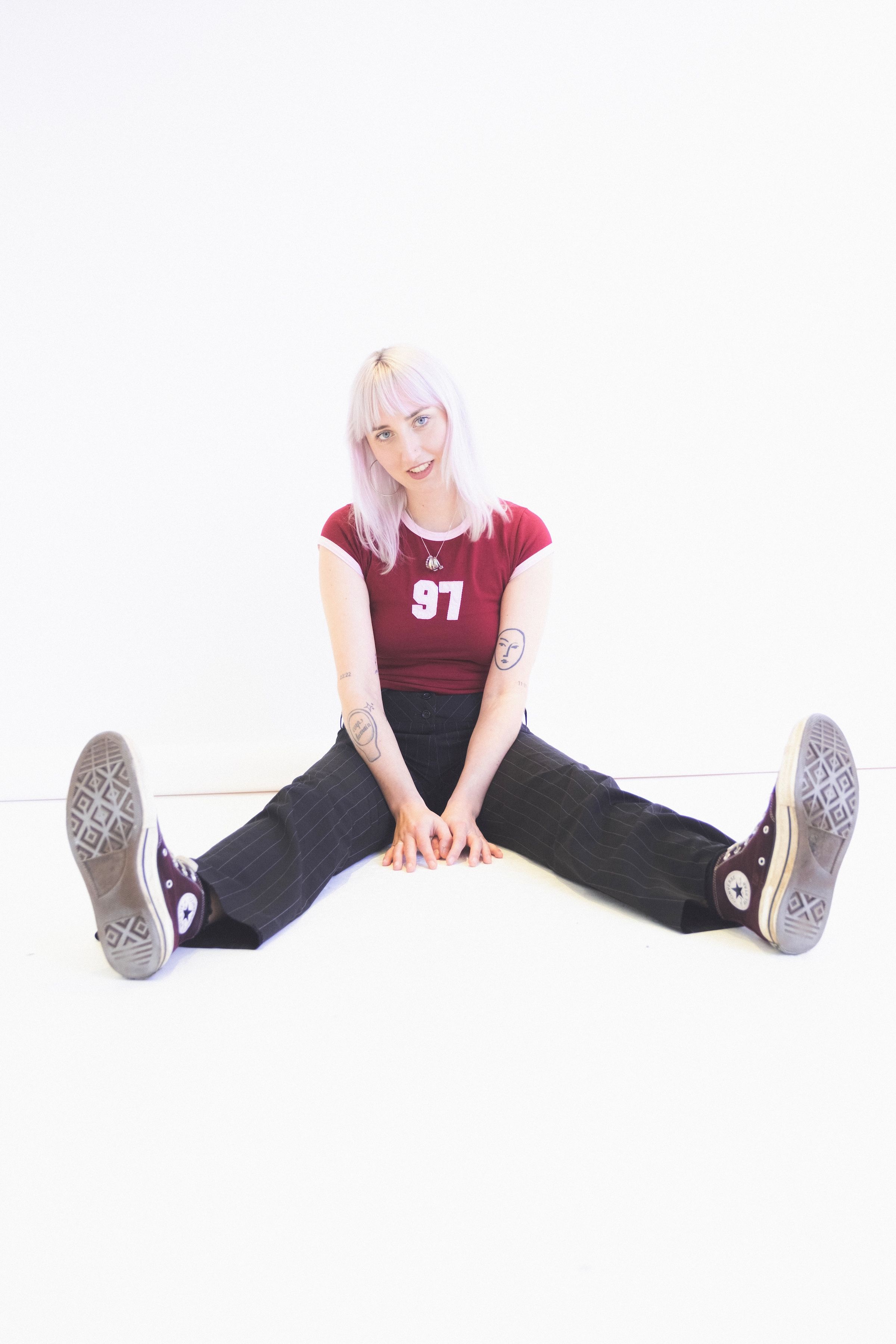
Name: Anna Olivia Böke aka Sloe Noon
Nationality: German
Occupation: Singer, songwriter
Current Release: Sloe Noon's new EP All Feelings, No Technique is out via Dalliance.
If you enjoyed this Sloe Noon interview and would like to know more about Anna's music, visit her official homepage. She is also on Instagram, Facebook, tiktok, and bandcamp.
When it comes to experiencing strong emotions as a listener, which albums, performances, and artists come to mind?
It’s so magic when you find an album that captures your current state so much, it ends up escorting you through a whole process.
Killjoy by Coach Party was the last album I religiously listened to through a breakup recently.
I also went to Primavera in Porto two weeks ago where I saw Been Stellar perform.
It was one of those gigs where I was really overwhelmed with my emotions and I had a huge grin on my face and cried at the same time. That was really beautiful.
But one that always gets me is the Jeff Buckley live at Sin-é album.
There are no words to describe how this man was able to convey so much with just his voice and an electric guitar.
I’ve never heard anything more genuine and raw. I always refer back to this when I hit a low point and need comfort.
There can be many different kinds of emotions in art – soft, harsh, healing, aggressive, uplifting and many more. Which do you tend to feel drawn to most?
Recently I felt really drawn to angry music. I have a lot of things I’m angry about.
I especially love female-rage music like Amyl & The Sniffers.
That’s the magic of music for me: It lets you scrape out those emotions you tend to avoid and lets you sit with your emotions.
I personally love contrasting soft- and harshness in my songs (like “Mindsweeper” or “Don’t Let It Drive The Car”).
Bands like Wolf Alice Smashing Pumpkins do that beautifully.
I have had a hard time explaining that listening to death metal calms me down. When you listen to a song or composition, does it tend to fill you with the same emotions – or are there “paradoxical” effects?
I have a close friend who can’t usually listen to melancholic music, because it brings him down. I get that, and yet I think I’ve mastered romanticising those emotions with the help of music.
Especially shoegaze. There’s something about it that just makes me feel held. You just let those waves of heavy guitars wash over you and feel whatever it is you need to feel, but without a sense of threat.
It’s a state of acceptance and peaceful coexisting with your dark side that’s so healing to me.
In as far as it plays a role for the music you like listening to or making, what role do words and the voice of a vocalist play for the transmission of emotions?
A huge role. As a singer and lyricist, it’s what comes first for me. I think learning guitar was always just a means to carry the vocals and what I need to say. I write very personally.
But then, bands like Cocteau Twins, carry a lot through Elizabeth Fraser’s vocals with her made up languages and sounds. The way she uses changes in volume and vibrato creates such an otherworldly sound. I admire her greatly as a vocalist.
Generally, it’s always a moment in time. There’s absolutely no formula to how to write an emotional song.
I think the only important thing is that you, as the person singing it, feel really connected to your own music. That’s what creates authenticity and that is absolutely necessary to evoke emotions.
When it comes to experiencing emotions as a creator, how would you describe the physical sensation of experiencing them? [Where do you feel them, do you have a visual sensation/representation, is there a sense of release or a build-up of tension etc …]
I usually feel things in my belly. Fear and excitement.
When there’s a song I can’t quite finish there’s usually this knot in my stomach for a while, because I can’t quite access to the emotion I want to wrap up in the song and let go. But when the moment comes and it all finally makes sense, I’ve had magic moments of crying and laughing at the same time.
The visual aspect comes once I’ve understood myself what I really needed to say with a song. That’s where symbolism comes into place to extend it. I love playing around with that as well.
Things always make perfect sense to me in a very specific way and I love that it’s never gonna be the same in the listener’s perception. I love how music is so specific and yet so universal.
When it comes to composing / songwriting, are you finding that spontaneity and just a few takes tend to capture emotions best? Or does honing a piece bring you closer to that goal?
It’s weird, because with a lot of things I’ve mainly been quite the perfectionist throughout my life, but when I finally started making music, something clicked.
To me music is 100% intuitive and I tend to get to where I want it quite quickly. Crafting too much destroys the magic of the moment for me.
This unfortunately often means that I fall into the demo trap quite regularly, where you find yourself constantly comparing to the demo when you’re in the studio.
How much of the emotions of your own music, would you say, are already part of the composition, how much is the result of the recording process?
The composing part is the emotional part.
This is probably a controversial thing to say as a musician, but recording is my least favourite part of the process. I love the creation and the interpretation on stage, but I don’t really like the ultimacy of recording. I don’t deal with the pressure so well and my body tends to go into some weird energy saver mode, so I don’t doubt myself or suddenly become really perfectionist.
I call it the recording fatigue. I just try my best to capture the magic and the emotion I created in the demo.
For All Feelings, No Technique, what kind of emotions were you looking to get across?
My latest EP All Feelings, No Technique really was a puzzle to make. I had a lot of contradicting emotions and riddles to solve to get to the other end.
I wanted to portray the paradoxical nature of our emotional life. Heartbreak and relief, sadness and anger, nostalgia and excitement, resentment and understanding and understanding fear as a compass.
How do you capture the emotions you want to get across in the studio?
Well, there’s no recipe to capturing an authentic moment in the studio. I guess the key is surrounding yourself with people you feel connected to and whose creative process you trust.
That’s why I love working with my brother, who produced and co-wrote “HMIMD” and “Strange A.M.” and close friends or people whose work I’ve admired for a while.
Feeling confident and relaxed in the studio takes practice and I’m still working on that to be honest.
What role do factors like volume, effects like distortion, amplification, and production in general for in terms of creating the emotions, energies or impressions you want?
Effects are a big part of my writing process. When I have an idea, I usually already have in mind what sort of direction I want to go production wise. Do I want an abrasive, heavy guitar sound? Do I want distorted vocals or ethereal and reverb-heavy?
I try to sketch those ideas while making the demos to the best of my abilities while trying not to hone in too much or use any crazy plug-ins, so I don’t fall into the demo trap later down the line.
The studio is really there to craft the sounds, while the production scaffolding is already built.
In terms of emotions, what changes when you're performing live on stage, with an audience present, compared to the recording stage?
It changes so much. I tend to speak the lyrics more and pronounce them differently depending on how I feel in the moment and what sort of energy comes back from the audience.
When the crowd is really high energy that reflects directly back onto the show. I feel more confident and able to let go and experiment and throw myself into the screams. Everything becomes a bit more dynamic, cause you feel connected to your band mates.
I multi-track in the studio, so actually playing together at the same time is always really special.
How does the presence of the audience and your interaction with it change the emotional impact of the music and how would you describe the creative interaction with listeners during a gig?
Because I play guitar and sing at the same time I’ve struggled with connecting to the audience for a long time, because I need to concentrate. But recently we’ve added songs where I have the mic in my hand and that’s so much fun.
I love looking people in the eyes and it feels so nice getting a smile back. I think it’s nice to actually register the people that are there to break that barrier of everyone sees you, but you don’t see them.
Nothing feels better than getting a smile back from a woman in the audience or seeing people close their eyes or dance or even mosh to the music.
What kind of feedback have you received from listeners or concert audiences in terms of the experience that your music and/or performances have had on them?
The best reaction you can get is when someone tells you that you’ve inspired them to make music again themselves. This has happened a few times. Especially when it’s women that makes me emotional, because I desperately needed role models before I finally got my music out there.
It’s an intimidating field to enter and if just one person feels inspired to try, that’s the whole point.
Would you say that you prefer to stay in control to be able to shape the emotions or do you surrender to them and allow the music to take over? Who, ultimately has control during a live performance?
I don’t think there’s a point in trying to control anything on stage … or in life for that matter. That’s a lesson I’m currently learning.
Surrendering to your emotions is the only way to heal and it’s the same for a performance. It’s a conglomeration of my words, the music my band and I play, our moods that day and each and every audience member’s own interpretation and emotions.
There’s no way to control that, the music always does its own thing. It always takes over.
The emotions that music is able to generate can be extremely powerful. How, do you think, can artists make use of this power to bring about change in the world?
That’s a big question.
The thing with politically charged music is always that it resides within echo chambers, but it still unites people and it can stir and spur on actions. Some songs have become symbols for revolutions in the past, that proves its power, but even less obviously engaging music can bring about change. It can instigate that spark within ourselves to do better, to re-think our patterns, to let something go.
For me it’s about the intricate, the complicated feelings we can’t quite make sense of, the personal roadblocks, the questioning of ourselves that ultimately leads to change. I think change in the world always starts with the change of the individual until it becomes a collective experience.