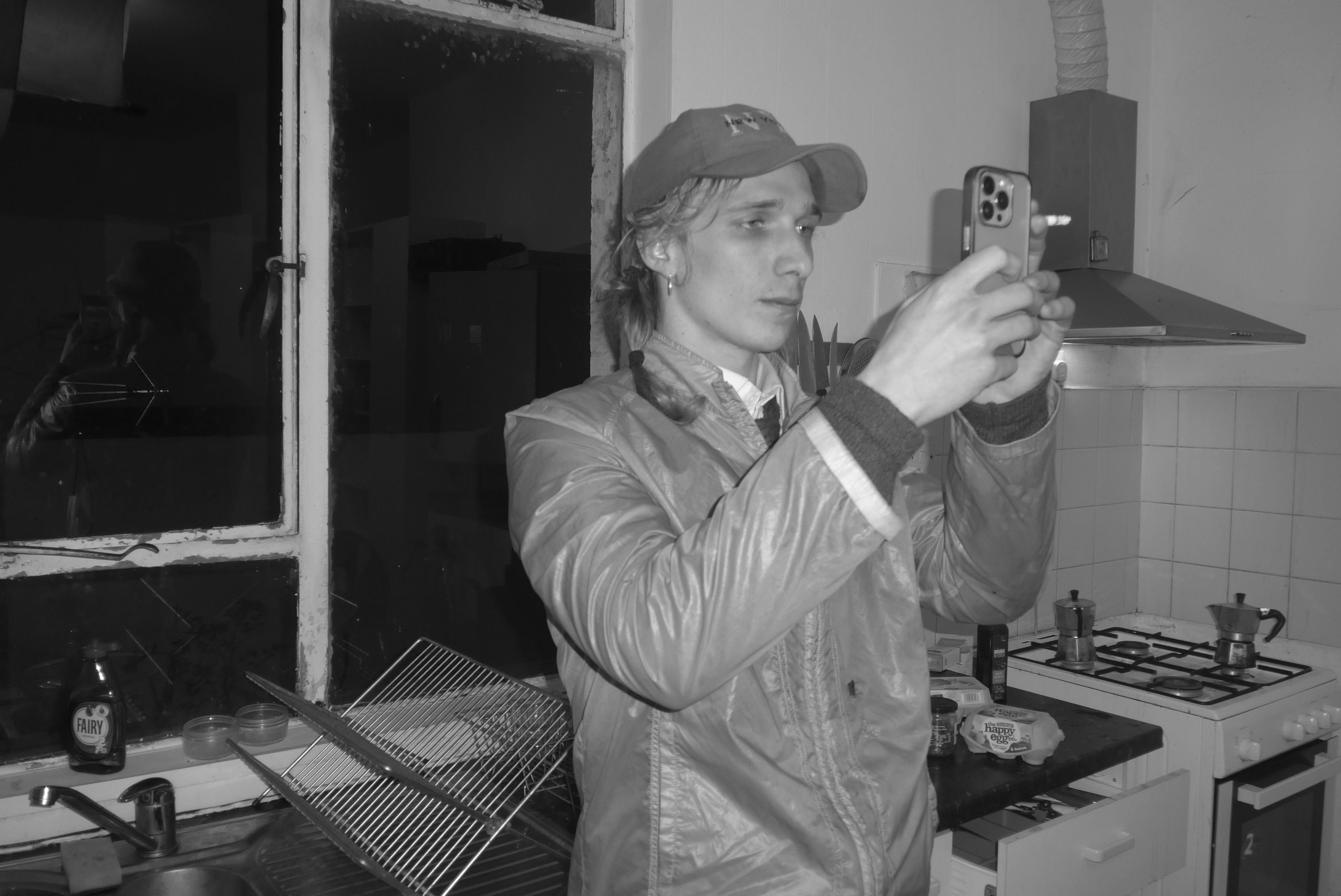
Published
Name: Soli City
Nationality: Danish
Occupation: Producer, composer, sound artist
Current release: Soli City's new Paradoxe II is out via Real Live.
Recommendation for Copenhagen, Denmark: If you're ever in Copenhagen on a warm summer day, I recommend taking a dip at the newly built Sluseholmen. There’s something wonderfully peaceful about being surrounded by sterile, soulless buildings while splashing around in ancient water that’s clean enough to swim in.
If you enjoyed this Soli City interview and would like to stay up to date with their music, visit them on Instagram.
Where does the impulse to create something come from for you? What role do often-quoted sources of inspiration like dreams, other forms of art, personal relationships, politics etc play?
Society is, to me, an inexhaustible source of inspiration. Most of my artistic work stems from an attempt to convey political, emotional, and cultural currents that I perceive in the society I live in.
Even though it’s difficult, I often try to remove myself and my own perspective from my work, in an attempt to engage with society as a universal entity. But it's often in the interplay between the universal and my personal emotions and experiences that I create best.
For you to get started, do there need to be concrete ideas – or what some have called a 'visualisation' of the finished work? What does the balance between planning and chance look like for you?
I visualize and aestheticize everything I do before I begin. I often imagine how different instruments or sound sources look together, and in what kind of space they appear. If I find the situation beautiful or interesting, it often becomes the seed of a new work.
In a way, I feel that this urge to constantly visualize is a curse brought on by hyper-digitalization and all the visual impressions that came with it. But I try to use that curse to my advantage.
Is there a preparation phase for your process? Do you require your tools to be laid out in a particular way, for example, do you need to do 'research' or create 'early versions'?
There’s usually a lot of preparatory work in creating a piece, and I’m picky about where and when I create.
Besides my studio, I have a workspace in my apartment where the foundation of a project is shaped. It needs to be clean, and I need to be sober – even though I’m often inspired in chaotic and intoxicated situations.
My workflow is spread across different domains: score creation, field recording, and classical programming. So I have a pretty dynamic spectrum I can swing between once the creative process has begun. Honestly, it often comes down to what triggers the most endorphins.
Do you have certain rituals to get you into the right mindset for creating? What role do certain foods or stimulants like coffee, lighting, scents, exercise or reading poetry play?
I don’t have any rituals that I control myself in my creative process. But the weather and time of day play a huge role in my work ethic. I work best at night — and best of all during the bright Scandinavian evenings.
Only natural elements truly influence my work ethic, but a lot of inspiration comes to me when I’m high or drunk, playing chess, traveling, or reading.
For Paradoxe II, what did you start with? If there were conceptual considerations, what were they?
Paradoxe II is an extension of my first release Paradoxe, which has fairly strong conceptual considerations attached to it.
At the time, I was deeply invested in questioning the conventional boundaries of our mediated reality. I wanted to create a cultural narrative that reflects on society's complex relationship with technology.
My artistic ideal at the time was to create musical metaphors for the broader human condition in the digital age. In a way, it was a counterpoint to self-centered art – an attempt at working with music in an activist way. On Paradoxe II, these themes are even more pronounced.
The track “The Rehearsal” is an artificial representation of a rehearsal – a staged situation that points away from the work and toward the artist’s authenticity.
The track “Western Media” is built from political text fragments from various Reddit forums, reassembled anew.
Many writers have claimed that as soon as they enter into the process, certain aspects of the narrative are out of their hands. Do you like to keep strict control or is there a sense of following things where they lead you?
When it comes to my own material, I’m very controlling and binary about what “works” versus what “doesn’t work.” Like many others, I struggle with maintaining excitement about the music I compose – both unfinished and finished pieces.
Even though I had a clear idea of how the themes and concepts of Paradoxe II should be expressed, and I supported that vision sonically, I often start to question the very foundation of a project in its final stages. I think that’s related to the narrative slipping through your fingers.
If it weren’t for “Real Live,” Paradoxe II would probably have ended up in the digital graveyard, but I’m super happy that I didn’t go that way.
There are many descriptions of the creative state. How would you describe it for you personally? Is there an element of spirituality to what you do?
My creative state is either non-existent, or it’s the state I’m always in.
In order to express my visions in the best possible way, I constantly strive to be the most authentic version of myself in my creative work.
I’m almost spiritual about having to be soli city in everything I do – both in my nine-to-five and with my family.
Once a piece is finished, how important is it for you to let it lie and evaluate it later on? How much improvement and refinement do you personally allow until you're satisfied with a piece? What does this process look like in practise?
Most of the pieces I work on are open to refinement right up until they’re sent off for mastering.
For example, “Eyes Closed” is a track I’ve played at concerts for years while continuously replacing almost everything in it. I think I live by the belief that everything can always be improved – and I’m only truly satisfied when I’m tired of dealing with it.
How do you think the meaning, or effect of an individual piece is enhanced, clarified or possibly contrasted by the EPs, or albums it is part of? Does each piece, for example, need to be consistent with the larger whole?
Even though many tracks are strengthened and clarified by their context, I often find it difficult to define a shared meta-meaning for a collection of smaller meanings. The older I get, the more I fixate on consistency with the whole.
Aesthetically, it’s rarely a problem – but as soon as I work with thematic constraints, it becomes a challenge to reconcile potentially contrasting artistic ideals. I didn’t care about that before.
What's your take on the role and importance of production, including mixing and mastering for you personally? In terms of what they contribute to a song, what is the balance between the composition and the arrangement (performance)?
Production plays an enormous role in my musical work, and it’s something I constantly question. I find that many people underestimate the aesthetic element of mixing and mastering, and the power of production to recontextualize an artistic product.
Production is, to me, like a buffet where you want everything to taste good together. But kimchi and pasta are irreconcilable …
Music and the accompanying artwork are often closely related. Can you talk about this a little bit for your current project and the relationship that images and sounds have for you in general?
I often find that my musical ideas benefit from being translated into a visual medium. I draw a lot of inspiration from visual media and use both sculpture and video in my musical practice.
Especially in my live performances, I spend a lot of time pairing the music with a visual counterpart – not because I think it’s always necessary, but often just because I find it fun and it creates a more dynamic artistic life.
After finishing a piece or album and releasing something into the world, there can be a sense of emptiness. Can you relate to this – and how do you return to the state of creativity after experiencing it?
Honestly, I often feel relieved when I release new music into the world. My own doubts and projections are replaced by the public’s way of interacting with the music, and I find myself growing stronger through that process.
I never experience creative dry spells – I’m usually deeply immersed in a new project during the release phase of another. If I weren’t, I probably wouldn’t have the motivation to release anything at all.
I would love to know a little about the feedback you've received from listeners or critics about what they thought some of your songs are about or the impact it had on them – have there been “misunderstandings” or did you perhaps even gain new “insights?”
Oh, that’s a good question … I often experience a discrepancy between my listeners’ projections and my own. But that’s always very interesting because their projections often inform my own relationship to the music or reveal perspectives I wasn’t aware of.
I think it’s important to remember that the work stands on its own, and people’s individual experiences of music are just projections – nothing can be misunderstood, only interpreted.
People often tell me they experience my music as very dystopian or post-apocalyptic, which was never the intention – almost the opposite, actually.
Creativity can reach many different corners of our lives. Do you personally feel as though writing a piece of music is inherently different from something like making a great cup of coffee? What do you express through music that you couldn't or wouldn't in more 'mundane' tasks?
No. As I mentioned earlier, I really care about being sincere in my attempt to make a good cup of coffee – just as I want to be sincere in my artistic work. If I weren’t, I’d feel like I was parodying or LARPing (live-action role-playing) other people’s experiences and conveying emotions I couldn’t stand behind.
Nearly all my music is about making money, being a citizen, going online, and all kinds of everyday things. The music is just a soundtrack for that – and ideally, it helps the listener better understand the narrative of their own life.