Published
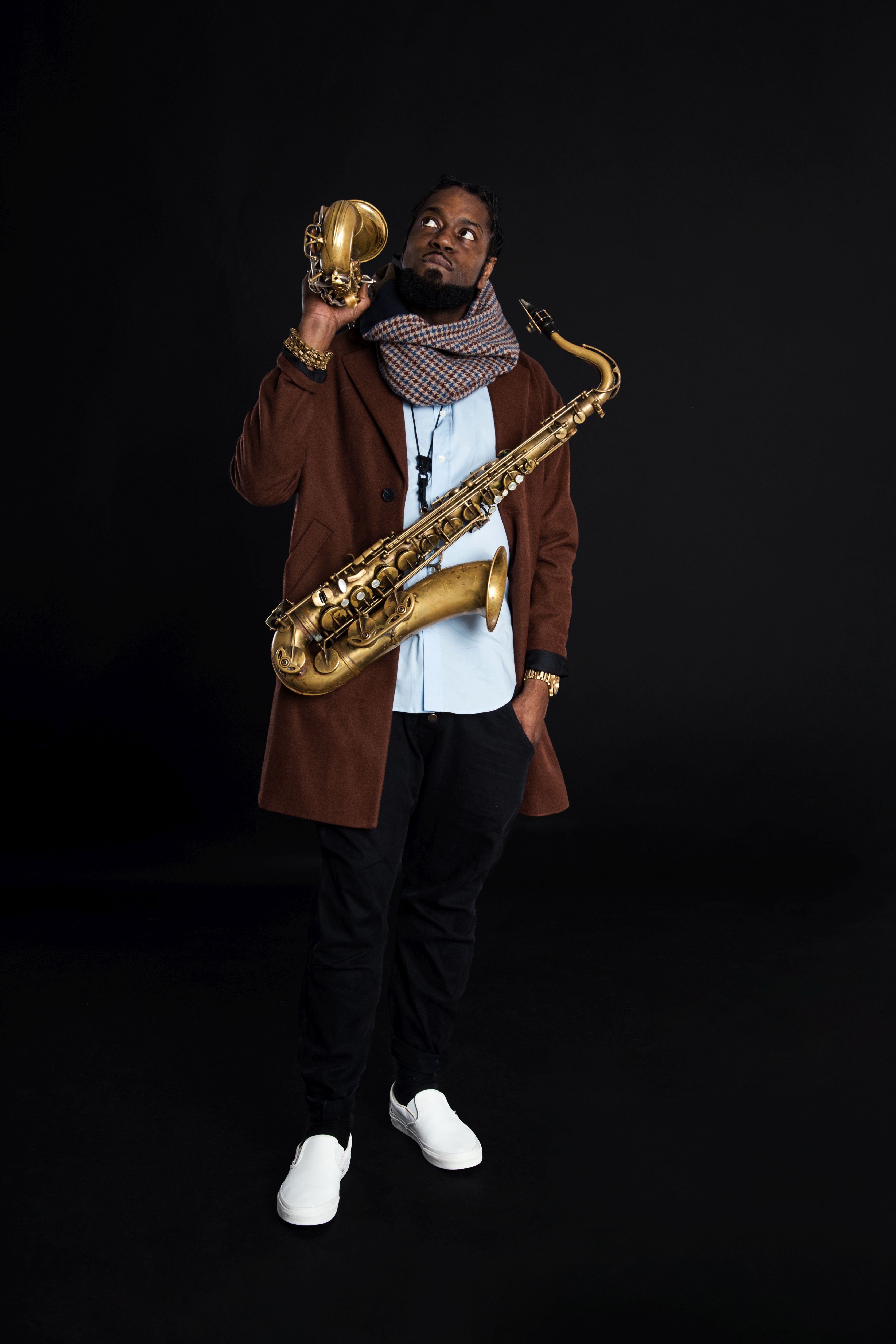
Name: Soweto Kinch
Nationality: British
Occupation: Saxophonist, composer, poet, MC, producer
Current event: Soweto Kinch will perform Soundtrack to the Apocalypse - the finale of his acclaimed trilogy of politically charged, genre-defying works - with the London Symphony Orchestra at the Barbican on Friday 14th November 2025. For tickets, go here.
Shoutouts: Shout out Alfa Mist, Chance the Rapper, Earl Sweatshirt, Little Simz, Truemendous, Lady Leshurr and so many others continually pushing the envelope and expanding what we know as Hip Hop.
[Read our Alfa Mist interview]
If you enjoyed this Soweto Kinch interview and would like to stay up to date with his music and live dates, visit his official homepage. He is also on Instagram, and Facebook.
What were some of the musical experiences which planted a seed for your interest in hip hop?
Growing up in London and Birmingham, hip hop and wider sound system culture were ubiquitous throughout my childhood: from breakdancing on Aklam Road to being part of the group Pentalk in my teens.
What inspired me was the range of styles and personalities; the fact I could draw strands to other traditions from across the Diaspora; and the insistence placed on finding your own approach - we all hate biters!
I’ve always tried to channel the environments I lived in through my music - like "Ridez" from A Day in the life of B19: Tales of the Towerblock.
What does the term hip hop mean and stand for today, would you say?
It’s a prescient question.
Growing up with icons like Public Enemy and KRS One, hip hop stood in stark opposition racism, police violence and offered a path to ‘knowledge of self.’ Several decades of commercialisation have left it struggling for an identity. Artists are often kept in a creative chokehold by major labels and the threat of demonetisation.
If Hip Hop’s going to mean anything more than a button preset setting, somewhere between ‘EDM’ and ‘reggaeton,’ it has to recover its power to articulate the unspoken thoughts of the masses.
Hip hop has always been about a lot more than just music. For you personally, is hip hop a way of life – and if so, in which way?
Hip Hop is absolutely a ‘way of life’ - not just because of the devotion required to become a respected b-boy, graffitti artist or MC but also in terms of the original perspectives and outlooks it engenders.
It’s encouraged me to have greater conviction - ignoring the early advice of jazz pundits to just concentrate on the saxophone.
It’s also, given my background with free-styling, shown me that art and new stories can be generated from the most unlikely places and people.
What, would you say, are the key ideas behind your approach to creativity?
It’s hard to condense my creative approach to a few key ideas, as I think they’ve continually evolved.
But one inspiration has been untold Black British history, and drawing out the similarities between our contemporary and older artistic expression.
For example, on the song “Riot Music” from The Black Peril, what begins as purely ragtime explores the subject matter of the 1919 Race Riots and also brings early jazz, trap and Hip Hop together.
Maybe if there’s anything that connects my projects, it's the desire to push my pen as a lyricist, but also to develop the same nuance, iconoclasm and layered meaning in my Hip Hop, that I’ve discovered in jazz.
Where do most of your inspirations to create come from – rather from internal impulses or external ones? Which current social / political / ecological or other developments make you feel like you need to respond as an artist?
This past two years has been remarkable for Hip Hop’s lack of response to a flagrant genocide - backed by our governments.
Just in the UK we’ve witnessed celebrities fired for expressing an opinion, and grannies carted off into police vans for holding placards. We’ve all seen hysterical over-reactions to Bobby Vylan and Kneecap, and I’ve personally witnessed friends being silenced by the threat of no radio-play and losing livelihoods.
Congo, Sudan, Palestine and Ukraine: we’ve all born witness to a hierarchy of human life in which the darker you are, the more invisible your suffering. It’s personally time to say out loud what a lot of people are thinking.
It’s almost impossible to separate my internal or external creative impulses - as so much of what’s congealed inside, bubbles up from observing the world outside.
On a song like “March of the Unicorns” from my last collaboration with LSO - I wrote it whilst we were all still in lockdown.
Many of us were deluged by videos of racist police brutality, discovering the connection to centuries old imperialism, and literally looking anew at the weird iconography on everything from our coinage to state buildings.
Hip hop has always had an interesting relationship between honouring its roots and pushing the music forward. What does the balance between these two poles look like in your music?
As a jazz musician I’m often forced to consider the even older roots of both traditions. I don’t see them as opposing poles but rather a quality present in most music from the African Diaspora: a requirement to embody the past, present and future.
It all sounds pretty cryptic until you’ve seen that incredible dance sequence in the movie Sinners.
In dissecting elements of the blues you can hear its constituent parts reconfigured in a J Dilla beat; and its similar with Wolof dance moves reappearing in ‘Krump.’
Much like the griot traditions of West Africa, you have to learn the stories of your ancestors before qualifying as a master ‘Djeli’, but in the process somehow sound even more like yourself and project a new sound into the future.
What role do electronic tools and instruments, including AI, play for your creative process?
A great deal in this particular moment.
I’ve been deep diving into my Aerophone - an electronic wind instrument, and embracing the technology’s almost limitless potential to recreate or reconfigure sound. It’s by no means replacing my acoustic instruments, but actually giving me a new perspective.
AI can only generate from content which is already in existence - which also presents a tempting artistic challenge. Can we hear or imagine what the robots can’t?
Tell me a bit about the sounds & creative directions, artists & communities, as well as the colleagues & creative hotspots of your current hometown, please. How do they influence your music?
Birmingham, my home city, is a huge inspiration having grown up with so much creativity around me. Handsworth carnival, for instance, was an annual spectacle which fired my imagination.
As well as huge inspirational figures like Benjamin Zephaniah, Steel Pulse, I grew up with a plethora of gifted hip hop crews, Pentalk, MSI Asylum and Elements, Moorish Delta and others - almost all of my freestyling and battle skills, were honed in those cyphers in the late 1990s.
It’s funny that my area was recently in the news as a ‘failure of integration’ - but it’s always been so culturally vibrant that racists have never felt comfortable with our existence.
Whether today or when police brutality stoked riots in 1981 and 1985. It’s always produced charismatic, proudly Black and Asian role models - all very British without compromising their identity. That fact alone riles all the right people.
How do you see the role of sampling in hip hop today?
There’s so much tech that allows you to generate or rip sounds from an almost infinite archive.
I expect it will be less about ‘crate digging’ for rare breaks and more about scraping cyberspace for the most unusual or arresting sounds.
There has always been a close connection between hip hop and jazz. What role does improvisation play in your current creative process?
Improvising is key to my music, both in how it originates and it’s performed. I freestyle a lot in my shows - one way to emphasise the fact that no two shows are the same, and the live experience can never be replicated.
I revel in the fact that music can be constantly remoulded and made novel through improvising.
It can sometimes seem as though, in hip hop, production is the main force of progress. Do you feel like there is still space for genuinely new ideas for lyrics and vocals as well? If so, what could these look like?
There’s definitely space for new progress for lyricists - both finding original musicality in how their bars are delivered and mining new subjects to write about.
I think a creative impasse is an opportunity for rappers - when everyone seems to be using the same patterns and subjects, we could turn in a different direction.
I think once people break the algorithm and fear of being demonetised, I’m hopeful new and original rappers will flourish.
From Star Wars via The Hitchhiker's Guide to the Galaxy to the Fifth Element, there have always been amusing sci fi ideas about how music could look like at some point. For a not too distant future, where do you personally see it going?
A Smack/URL battle between two AI bots, “My processing speed so big, it bankrupted Sam Altman!”