Published
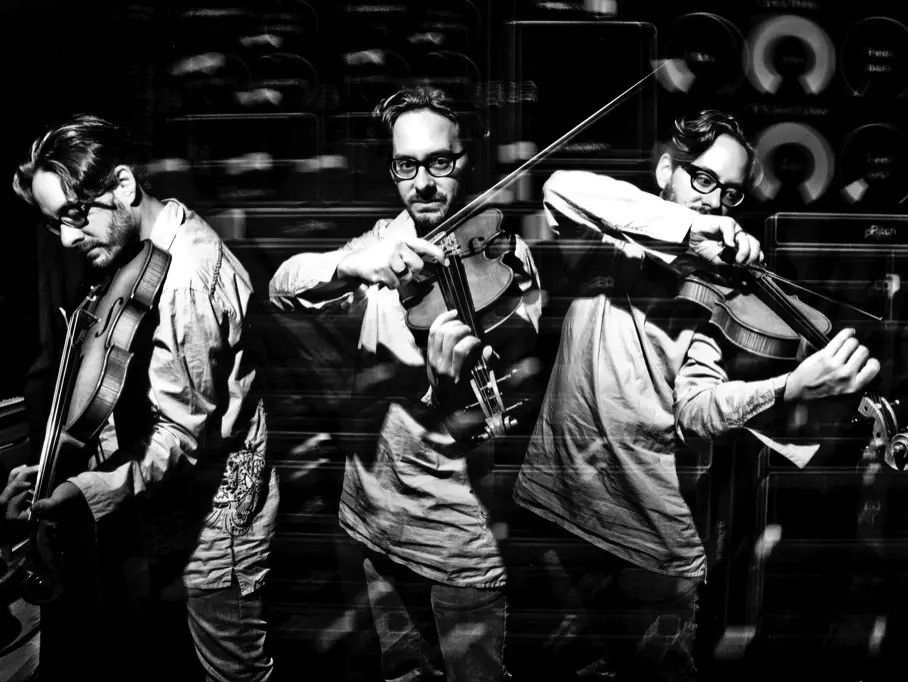
Name: Stefan Smulovitz
Nationality: Canadian
Occupation: Composer, violist, laptop artist, music software developer
Current release: Stefan Smulovitz's new album new album Bow & Brush: 12 scores of Nadina Tandy is out via Redshift.
If you enjoyed this Stefan Smulovitz interview and would like to know more about his music, visit his official homepage.
We also recommend checking out his software Kenaxis, which is said to “transform the laptop into a powerful and highly adaptable musical instrument.”
What were some of the musical experiences which planted a seed for your interest in composition?
I saw a concert by R Murray Schafer and picked up one of his books. Not only did I love the music but his books planted the seed that I too could be a composer – specifically through the use of graphic scores and notations to organize sound.
Once I realized that I did not need to be a genius at music theory to be a composer – I started getting very interested in different ways of organizing sound.
The borders between producers, sound artists, and even songwriters are becoming increasingly blurry. What does being a composer mean today, would you say?
For me being a composer is organizing sound. Most of my sonic output is via instant composition – improvisation.
But for me just improvising without knowing what you want to say or any organization often meanders too much and is not satisfying. This is why I have created composition systems specifically for improvisation such as the Mad Scientist Machine that allow you to keep the energy of improv but the development and simultaneity of composition.
Composition was about a lot more than just music for many decades. For you personally, is music still a way of life or a way of seeing life – and if so, in which way?
Cage’s 4:33 has become a joke and or a cliché for many – but when I teach my sound course – I find this piece to be extraordinary at making listeners that have never experienced it to reconsider composition as just the organization of sound.
Once this enters and you explore Pauline Oliveros and Deep Listening – then all the world becomes composition. Why do a certain order of sounds make you feel one way? What timbres have what effects on you?
This exploration – particularly of timbre is what excites me about composition and then you start relating it to light and shadow – or shades of green on a walk in the woods. How do all those things interact and what are their sonic equivalents?
[Read our Pauline Oliveros interview]
Many people perceive classical music and contemporary composition as having high barriers of entrance, both for listeners and musicians. What have your own experiences been in this regard?
My group Eye of Newt have performed over a 100 live soundtracks to films. When doing a film soundtrack the film creates a bridge that provides context and meaning for the listener. If I play the same music without the film- then it is perceived as much more experimental and the question of what does it mean – I don’t understand it – all these doubts arise.
That for me is the main barrier to contemporary music – a feeling that the listener feels dumb or ignorant because they don’t understand it all. I don’t think music is meant always to be understood – in fact most often it is meant to be felt and absorbed and it is this desire to understand it that causes a lack of enjoyment of it.
So my solution was to do these live film sountracks that created a bridge to the creative music.
The Oxford Dictionary defines music as “vocal or instrumental sounds (or both) combined in such a way as to produce beauty of form, harmony, and expression of emotion.” As of 2024, what kind of sounds and which kinds of results are particularly stimulating for you?
I love the huge world of sonic imagination that computers and electronics open up – that being said – that sound world often lacks the magic breath of acoustic instruments.
For me it’s the fertile combination of the two that excites me.
What, would you say, are the key ideas behind your approach to composition?
Freedom of expression and exploration of timbre and the colour and ideas of the living human behind the instruments making the sounds.
This comes from a deep rooting in the tradition of instant composition and the many jazz composers who have pushed ways to organize sounds that allow greater personal expression than most forms of classical composition.
Composing has always had an interesting relationship between honouring its roots and exploring the unknown. What does the balance between these two poles look like in your music?
Computers and electronics are the great unknown for composition. For notation it is only utilitarian – but for the creation of new timbres and sounds – this is where the excitement is.
During my lifetime the evolution of these tools has been staggering.
What role do electronic tools and instruments play for your creative process?
I would say my single greatest “composition” is the creation of my software tool Kenaxis.
Your tools define what you make. When you start programming and making your own tools then you create new and exciting ways that work for you. Technology is a tool. Use a prepackaged tool and it will do what those that created it think you want to do.
For instance – my software lets you change the pitch of a sound. Most audio manipulation software allows you to do this but decides for you that raising it by more than say 2-3 octaves sounds bad and that is the limit it puts on you. My software can raise the pitch by 5 or 50 or 500 or 5000 octaves – as long as it does not crash the software.
I wanted a tool that would not impose aesthetic choices on the user. Of course you sound will just be a buzzing noise when raised that high – but maybe that is what you want ... Creating you own tools then changes your relationship with technology and helps you create truly new tools for sonic exploration.
What are currently direction in contemporary composition or adjacent communities which you personally find interesting?
The work Pauline Oliveros did with Deep Listening is huge for me.
I do like one aspect of AI – it is being used to analyse and decode various animal sounds such as whale sounds so that we will hopefully eventually be able to understand and communicate with other species.
Imaging the thoughts of other species and songs and meanings – this excites me.
[Read our Selu Herraiz interview, part of a series about Animal Sounds and Interspecies Communication]
[Read David Velez: An Introduction to Plant Music and Plant Communication]
Working with long forms, complex concepts or new vocabulary is potentially more challenging today because they require us to remember things that happened perhaps minutes ago – while most of us are finding it hard to focus even on what's happening right now. Both as a composer and as a listener yourself, how do you deal with this?
For me to work with something I need to find a way to embody it. That does not mean necessarily that I am dancing my concepts – but that I feel the idea in my physical form – how it resonates inside of my body. Just mind is not enough – it just bounces around too much and gets lost.
Those ideas and concepts that I can swallow and ingest – those are the ones I can work with. It’s a subtle feeling of moving down from the head and into the chest or lower.
I think this is why I so often play an acoustic instrument to play with the ideas or be in conversation with the ideas so that I can feel them.
For many artists, life-changing musical experiences take place live. How do you see that yourself?
Absolutely. Sound is a physical force – it’s the movement of air. Listening is a mental activity and the brain is so influenced by its environment and those around it. It's aware of everything and that influences what you absorb sonically.
While I have had some amazing experiences listening at night to music by myself – the truly magical experiences are a sharing of the energy of the performers transmuted through music to the listener. There is nothing like live music – particularly, of course, acoustic music.
How, would you say are live performances of your music and your recording projects connected at the moment? How do they mutually influence and feed off each other?
My recordings are snapshots of what I do live. Although they do let me layer and shape things in ways that I cannot do live.
For me the most important part of recordings is listening back to them. It’s a mirror that illuminates what you are currently interested in – what you are good at – what you need to develop.
Bill Viola was asked why he makes art in a documentary I watched – his answer was “To inspire others”. So I guess recordings are there to hopefully inspire those that cannot hear my music live and to inspire me to keep creating.
To some, the advent of AI and 'intelligent' composing tools offers potential for machines to contribute to the creative process. What are your hopes, fears, expectations and possible concrete plans in this regard?
As mentioned earlier – I am interested in the use of AI to communicate with animals.
I do use one “AI” style plugin that has been trained to model the sound of using tape machines to record to. It's great and sounds amazing. For me this is where AI can be used well – to augment our choices – but where it comes out lacking is where it makes the choices.
I messed around with generative image AI systems when they were first released to the public and I enjoyed the weird surreal images that came out and the ease with which I could make images – something I do not have the skills to do. But it was also empty. The true transformational aspect of art is the idea filtered through the body – through the hand and into creation. If it goes directly from idea to finish and skips the body and hands – then the human aspect is missing – it's hollow.
Sure it will sound and look better than most humans – but is the point a capitalist production of as many goods as possible – or is it an exploration of the human condition? For me I always make sure the hand is primary in the creation of my work.
Are there approaches, artists, festivals, labels, spaces or anyone/-thing else out there who you feel deserve a shout out for taking composition into the future?
Vancouver New Music has been absolutely key in supporting and inspiring my work.