Published
Name: Steiger
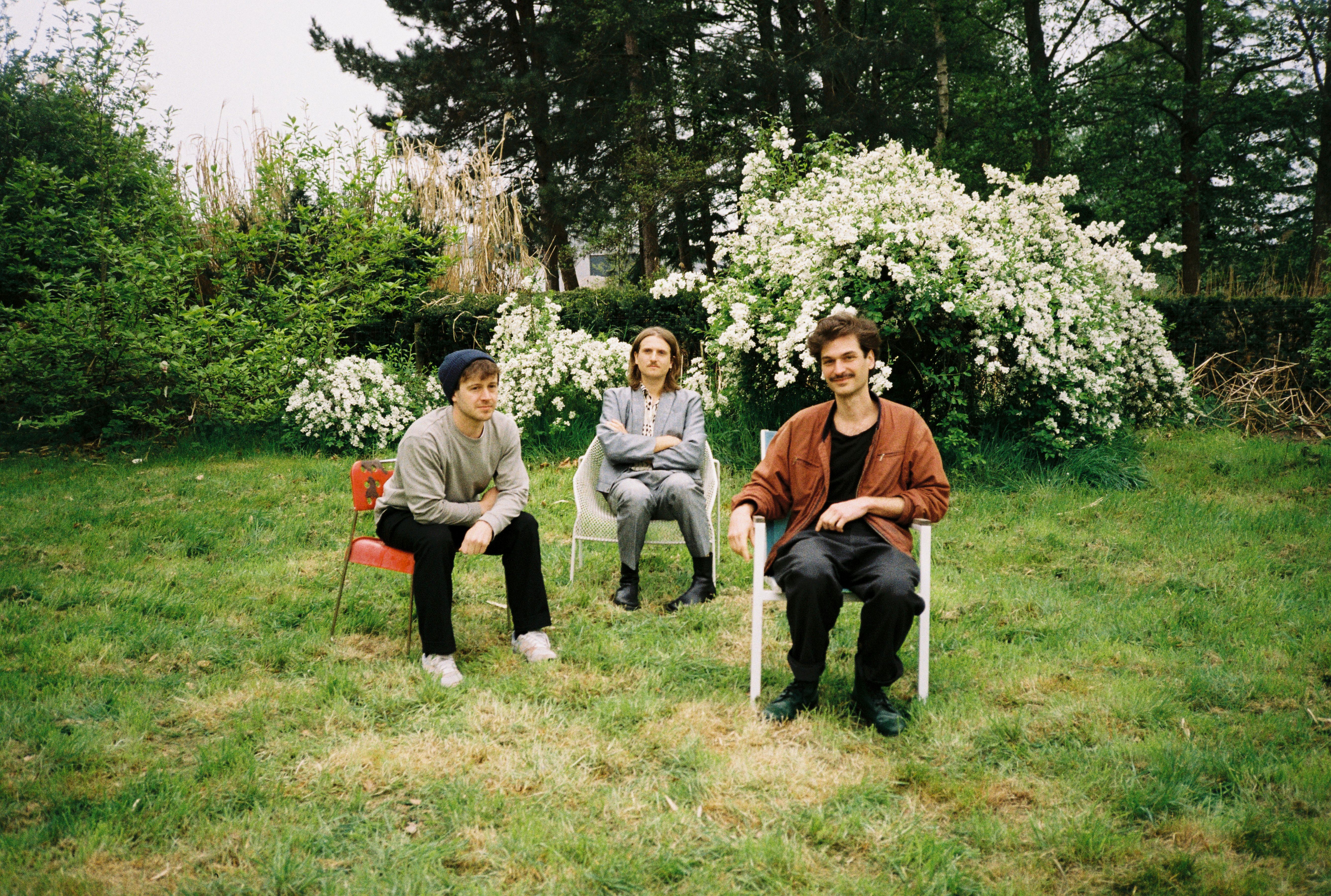
Members: Kobe Boon (double bass), Simon Raman (drums, percussion), Gilles Vandecaveye-Pinoy (keys)
Interviewee: Gilles Vandecaveye-Pinoy
Nationality: Belgian
Current Release: Steiger's new album Mowglowski's First Take is out October 17th 2025.
Recommendation for Brussels, Belgium: Close to my home there’s a beautiful parc called Parc Duden. On the edge of the parc there’s the football stadium of Union Saint Gilloise, the oldest football club of Belgium. The east side of the stadium is surrounded by trees and literally connected to the park. It is still in the state it was when it got renovated somewhere in the middle of the 20th century. The place breaths familiarity and real Brussels/ Belgium vibes where everyone is welcome. It’s also one of the few teams that literally have banners with Antifa on it, never heard of any racist incidents or aggression from the supporters (I’m one of them now), quite cool if you ask me.
Topic that I am passionate about but rarely get to talk about: Since a couple of years I really got fascinated, even addicted, to the world of fungi. Now every autumn is an adventure, searching for new species of mushrooms I didn’t find yet. Being in the forest and having this hyper focus on something that’s sometimes very difficult to find is just wonderful. I’m not sure how it’s inspiring me, but I guess that just doesn’t matter, it brings me a lot of joy and peace of mind.
We used to have a song called ‘Autumn is a shitty season’ with Steiger. Like music, people have the tendency to change, that’s for sure.
If you enjoyed this Steiger interview and would like to find out more about the band and their music, visit their official homepage. They are also on Instagram, Facebook, and bandcamp.
When did you first consciously start getting interested in musical improvisation? What was your first improvisation on stage or in the studio and what was the experience like?
At a very young age I sat down at the piano at our house and started improvising, even before I went to take my first music classes. Later on, the 3 of us met at a music camp and it clicked immediately. We then studied at the music conservatory in Ghent and the band was formed even before we realised it, we just loved playing together.
We started finding our way, also through improvising a lot together. When improvising you slowly manage to find your own voice. So it’s important to do it a lot, because you tap into your unconscious musical knowledge that you gathered for many years, on a very intuitive level.
Me and Kobe knew each other long before and we used to play covers on the streets of Ghent during Gentse Feesten (a 10 day festival) when we were 15/16 years old.
I remember that, while busking, I played a lot of too long and too extensive blues solos on my, way too heavy, keyboard.
Tell me about your instrument and/or tools, please. What made you seek it out, what makes it “your” instrument, and what are some of the most important aspects of playing it?
I was educated on the piano, first classical music, later I got into jazz, rock and experimental music. Every time I sit down before a piano I feel wholesome.
Because I have such a long relationship with the instrument I learned how to get the sound I wanted from it. But every concert you play on a different instrument, so every time, mostly during soundchecks, I try to get to know it, feel the weight and touch of the keys, how to get the sound I want from it. Sometimes it’s a struggle, but usually I manage to make music through it, not fight with it.
When I was 17 I got my first synthesizer, a Novation Bass station II. I remember I didn’t understand anything, but after a while I started making my own sounds and the love for synthesizers and sound design was born.
With Steiger we tend to merge these 2 worlds. I love to create sounds that are on the spectrum of the acoustic and electronic world. The contrast between these sounds merging with the double bass and drums and percussion of the rest of the band can be magical.
I guess after some time it became our signature sound, these electro-acoustic sounds. With our new album, we succeeded in making everything sound alive, without overdoing on too many layerings and overdubs. We still sound like a trio.
Take the song “Mowgloski” on our new album. It’s the perfect example of these merging world of sounds, where you don’t know when listening who is playing what.
The melody and harmony could be played by the keys as well as percussion the bass could be both keys as double bass, in the end it doesn’t matter, it’s the music that tells the story.
Derek Bailey defined improvising as the search for material which is endlessly transformable. What kind of materials have turned to be particularly transformable and stimulating for you?
When you’re improvising in front of an audience, every little detail matters. The sound of the room, the audience being involved or not, the energy and vibe of the place, the food you ate … Therefore it is never possible to play the same kind of melodies or rhythms or vibe you created last time, even if it’s the exact same set-up in the exact same space the next day.
The material you work with, even when it’s the same instrument obviously evolves constantly. For me it’s not really about the material itself, rather about the materialisation of sound in a space. Sometimes, the less you know a sound you’re going to use, the more it can be materialised into the now.
I recently improvised on a Casiotone keyboard, a very simple, sample based keyboard. I selected some sounds an hour before the session, and it turned out great. Without knowing if the sounds would really work, it can surprise the other players and yourself into doing stuff you wouldn’t believe you could ever do.
When you're improvising, does it actually feel like you're inventing something on the spot – or are you inventively re-arranging patterns from preparations, practise or previous performances? What balance is there between forgetting and remembering in your work?
When we are recording with Steiger, a lot of the improvised parts of our music showed themselves during the session. So in that way, during recording sessions, I have the feeling it’s some kind of composed improvisation that’s happening.
Since you’re usually doing multiple takes of the same song, I notice that I tend to find complete freedom in improvising in the studio very difficult. Like we did with “Gauchoman.”
We wanted to counter the steadiness, letting go of the kraut vibe and dive into a whole new world to then get back to the initial melody.
In a way you’re coming up with new parts there and then, to then use those parts as a basis to vary on. The thing is, when you play this music live and you get to the more improvised parts, letting go of the record version is a difficult task, because I tend to fall back on the vibe of the studio improv.
But if it works to let go of this version that’s in your head, finding new freedom in front of an audience with this music is so rewarding. And then the music starts evolving again, leading its own life.
Artists from all corner of the musical spectrum, not just “free jazz” have emphasised the importance of freedom in their creativity. What defines freedom for your improvisations?
Being at ease and feeling confident are 2 very important conditions to feel the freedom to be creative and being in the here and now during improvisations. This is the most difficult state of mind to get into when you’re in a recording session.
I remember we did an improvised piano part for the B part of “It’s my Stone.” I just couldn’t get it right, I had to find a balance between playing a kind of solo and just vibing. It was the end of the day, everyone was tired and we decided to call it a day. I couldn’t sleep at night because I felt like I was failing to get this part right.
The next morning I decided to get in early with our producer/ engineer Frederik Segers, which was much more intimate and chill then having everyone around listening and watching you struggle. After some takes we got it right. Afterwards I felt vulnerable but relieved.
It doesn’t always go as planned and smooth, sometimes it’s hard work to get it right. Sometimes the more you try to get into the moment the less it works. Letting go of these frustrations is very difficult and demands a lot of concentration and energy.
Taking your recent projects, releases, and performances as examples, what, would you say, are the key ideas behind your approach to improvisation?
For us with Steiger it’s very important to use improvisation in an organic way.
At school we got tired of having to listen to a theme that’s being played and then there’s a solo on the changes / chords of this song. It became boring to use this method to create music. So we started to experiment with different forms. Taking free improvisation as a basis, it opened up a lot of possibilities and new ways to use improv in our compositions.
If you listen to “The Latin” album on our new record, you’ll notice it jumps around a whole spectrum of styles and sounds but still it sounds like one song, one composition. Here we used free improvisation as a glue to connect parts that initially would never go together. The main insert was playfulness/ joyfulness.
It was so much fun, we even ended up using The Korean drummer (YouTube phenomenon) as an inspiration for some punk drum overdubs of Simon.
In your best improvisations, do you feel a strong sense of personal presence or do you (or your ego) “disappear”?
The best improvisations are the ones you don’t remember afterwards. I did a one hour improvisation with other musicians and it felt like I was dreaming for 8 hours - or sometimes 2 hours feel like 5 minutes.
The ego is definitely present but is being challenged by an unconscious entity that’s inside every one of us, like a spirit taking control of our ego, our hands, even our body. The moments you start to try to be conscious are usually the moments you drop out. Losing control is usually the best thing to do.
When this happens, afterwards, I usually feel alive like never before. Sometimes it feels like you traveled space and time and then when you come back you feel energised and tired at the same time. Fulfilment is maybe the best word to describe this feeling.
In a live situation, decisions between creatives often work without words. From your experience and current projects, what does this process feel like and how does it work?
Recently we played a show with Steiger at Gent Jazz Festival. It was such a joy to, after some time, being able to play together in front of an audience that was very open and receptive. We were having so much fun, challenging each other through our music.
Even though we hadn't play a gig for more than a year, there was some kind of magical connection, an invisible thread between the 3 of us, that made even mistakes sound right.
Stewart Copeland said: “Listening is where the cool stuff comes from. And that listening thing, magically, turns all of your chops into gold.” What do you listen for?
Listening is very difficult. We tend to, when playing, mostly focus on our own playing.
The art of listening is to be able to merge between oneself and the others, like a conductor trying to hear everything all at once, so the music as a whole and all the different parts separately. This is an almost impossible task, but it’s worth the effort.
There can be surprising moments during improvisations – from one of the performers not playing a single note to another shaking up a quiet section with an outburst of noise. Can you tell me about such situations from your own performances and how they impacted the performance?
When we’re playing with the band I sometimes tend to do some weird stuff, especially during improv moments. I love to explore the unknown or just challenge the others. Usually they respond positively to it, but sometimes it’s just weird, and that’s also fine.
It happened sometimes that I forgot a part of a song and then someone starts improvising and one person stubbornly tries to continue the tune as is. The nice thing about this is, our music allows for such weird moments to exist, we usually get out of the limbo.
In a way, we improvise all the time. In which way is your creative work feeding back and possibly supporting other areas of your life?
I love traveling without preparing anything. Then every day is an adventure, you make decisions on the spot and you get into unknown and unplanned situations that are beautiful.
I went to Indonesia with my girlfriend last winter, we were driving on a scooter when it was dark, going back to our sleeping place, when I heard an outburst of music carried through the rainforest surrounding the villages. I felt I had to go there. By following the music by ear we managed to end up at a small festival/ carnival, we were the only foreigners there.
It turned out it was a contemporary gamelan orchestra (acoustic and electrical instruments) playing there with dancers that mimicked horses trying to get rid of evil spirits. Quite the experience.