Published
Name: Suntou Susso
Occupation: Kora player, singer, percussionist, producer, composer, teacher
Nationality: Gambian
Current release: Suntou Susso's new album Jaliya Silokang (The Path of a Griot) is out now.
Recommendations for Gambia: The beach and culture is unmatched and I would highly recommend them. Gambia is known as the smiling coast of Africa. There is a buzz in the air, people are out, playing instruments, vibing and being friendly. There are beach bars that stretch along some of the beaches and sitting with a cold drink watching the sunset makes me so happy.
[Read our feature on the kora]
If you enjoyed this Suntou Susso interview and would like to stay up to date with his music, visit his official homepage. He is also on Instagram, bandcamp, and Facebook.
Where does the impulse to create something come from for you? What role do often-quoted sources of inspiration like dreams, other forms of art, personal relationships, politics etc play?
Walking alone. Whether I'm walking in green spaces or walking through a city. That's often where I connect with creativity. Melodies come to me. The world around me inspires me.
I am a Griot and we are storytellers and communicators. We are teachers. Through song. If something is wrong, we address it. If something is right or beautiful, we celebrate it, we dedicate songs to great people for example.
If something is important, we make sure the message is shared.
For you to get started, do there need to be concrete ideas – or what some have called a 'visualisation' of the finished work? What does the balance between planning and chance look like for you?
For me, it'll begin as something free flowing until I’m far into the creation process of that song. Then, when it has taken shape and I like where it's going, I'm more working to improve it within the framework of what it is.
But also, the listener is an active creator. So really, composition and interpretation of music never ends. The arranger / composer creates, but the listener interprets it their way, they add their own experience to the song.
So in this way, the creating process never ends.
Do you have certain rituals to get you into the right mindset for creating? What role do certain foods or stimulants like coffee, lighting, scents, exercise or reading poetry play?
Nothing too regimented. But there are definitely conditions and environments I prefer or will seek out.
Rainy days are good for writing, sunny days are good for writing too. Being by water, whether a river or the sea.
I like to be undisturbed. I don't mind a buzz / background noise around me, but I need to be uninterrupted.
For Jaliya Silokang, what did you start with? If there were conceptual considerations, what were they?
For this latest release, I started with a concept. The core theme of this album is explored and introduced in the opening track. It is called “Jaliya” which translates to ‘being a griot’.
It talks about my life as a griot and what it means to be born into that tradition, how that has shaped my life and my purpose on this planet.
With this album I am exploring the connection to my ancestors, to the role of griot and considering the role of a griot in today’s world. These themes deepen throughout the album.
“Jangfa,” for example, talks about being a reliable and trustworthy person.
Where I explore more contemporary issues such as migration in Barro, or the climate and nature crises in Yirolu Bala, that's in response to the world today. They are important issues and I believe these issues too fall to the Griot to speak to people.
More broadly, it is important to me to preserve my culture so I will always reference this inspiration in my songs and performances.
Tell me a bit about the way the new material developed and gradually took its final form, please.
First of all I get my inspiration and I'll sing it into my voice notes app on my phone - I have hundreds of clips. Then when I'm ready to develop it, I'll tune my kora to the key I've had in my head. Then I make a demo to play over and develop. Sometimes I'll ask a percussionist to play with me so I get a sense of the rhythm.
Once I have the core of the song - chords, the kora melody and rhythmic percussion - I make parts for each instrument that will be on the track. I'll teach that to the band, we'll rehearse and then jump in the studio! I like to record live, I like the energy it creates. Especially the bass, drums, myself, percussion and rhythm guitar. The rest can sometimes be over-dubs or playing along with the band. I record vocals after.
At each phase, I tend to focus on something intensively - hours or days. Then I'll give it a little break. When I come back to it, there's often some fresh inspiration that I bring to it.
What makes lyrics good in your opinion? What are your own ambitions and challenges in this regard?
For me, it's lyrics that have meaning and are clear. Griot music is full of messages.
Challenges come from trying to make something work. It can take time sometimes, but when it hits, I know I’ve landed on the right thing.
I sing in my language, Mandinka. I know a lot of my audiences don’t know what I’m saying so I have also included the translations in the booklet of my new album so listeners know the meaning of the songs. During live shows we'll often sing some together and I'll tell them what it means, so they're learning just a bit of Mandinka.
What are areas/themes/topics that you keep returning to in your lyrics?
This is quite easy for me to answer. Griots are historians, storytellers, peace keepers, advisors. This is our inspiration. Our traditional songs are full of dedications to good people and advice and guidance on being a good, honest person.
Whilst I follow this tradition - having songs on my new album about respect, and trust, and kind hearted-ness - I also explore themes that wouldn’t have been a concern to my ancestors such as climate change and migration.
There are many descriptions of the creative state. How would you describe it for you personally? Is there an element of spirituality to what you do?
Some songs transport me deep into the song, I am fully connected with it. It’s the same when I perform live. Mind, body and soul all connect to the song. In that way, yes, there is an element of spirituality to what I do.
There is also a connection between me and my instrument which is really strong. And a connection to my ancestors, knowing I’m doing what 700 years worth of family have done, it can be a really deep experience.
Once a piece is finished, how important is it for you to let it lie and evaluate it later on? How much improvement and refinement do you personally allow until you're satisfied with a piece?
In terms of the writing, I know when it’s finished. And if I’m composing for multiple instruments and voices, I can hear the layers of instruments and harmonies in my head.
I may make adjustments during the recording. But really, I would say it is in the mixing and post-production that I can go and go and go. I am seeking perfect clarity, space, and cleanness of the layers. After a day of editing, I'll go away and listen carefully to what has been done and come back the next day with lots of notes.
I work with a very patient and wonderful mixing engineer - shout out Arthur at Shaken Oak Studios.
How do you think the meaning, or effect of an individual piece is enhanced, clarified or possibly contrasted by the EPs, or albums it is part of? Does each piece, for example, need to be consistent with the larger whole?
I think of the whole as I'm creating. I like a cohesive sound. And this, my second album, has a narrative that runs throughout It …the role of a Griot, the path of my ancestors.
Each song has a role to play in that story. I am using the album to tell a story.
Music and the accompanying artwork are often closely related. Can you talk about this a little bit for your current project and the relationship that images and sounds have for you in general?
Yes, the artwork for this album is definitely designed to echo and compliment the messages of the music.
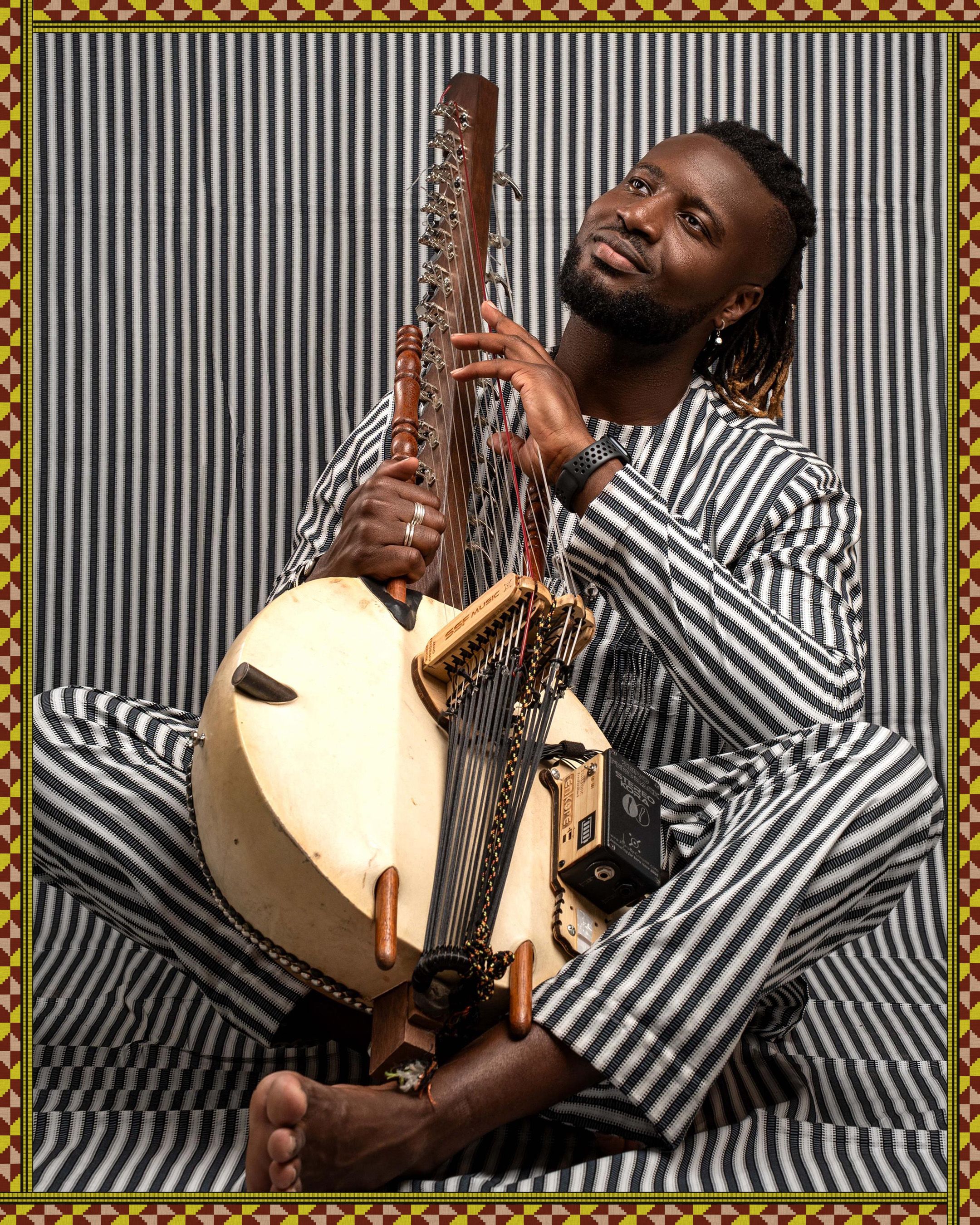
The traditional African print that I wear is a nod to tradition, roots and an African aesthetic. The composition of the photo whereby the same fabric that I wear forms the backdrop is also a nod to the afro-futuristic aesthetic. So in that way I am connecting the past and the present, heritage and hope for the future. It was also important for me that my kora features in the image.
With regards to my relationship sound and image have, when I play traditional music, I can remember back to the first day I began learning that piece. I am a visual learner so I used to watch my Dad play, and then play exactly what he just played, just by looking.
After finishing a piece or album and releasing something into the world, there can be a sense of emptiness. Can you relate to this – and how do you return to the state of creativity after experiencing it?
To me it feels great. It needs to be heard. I love hearing people’s experiences of how the music has affected them.
I can relate to the emptiness a little but it is overpowered by my excitement of it being out in the world. For me, I often miss the intense creativity of producing an album, it is so involved and immersive. I like to be involved in all the various aspects of creating and releasing music. I often don’t know what to do with myself after the hyper-focus needed.
This one has felt I've completed like a pHD! I created, composed and arranged it myself. Doing so with such a closely related set of themes has been super valuable and hard work.
I am ready to rest a bit now. But to be honest, I already have new songs swirling around my head!
I would love to know a little about the feedback you've received from listeners or critics about what they thought some of your songs are about or the impact it had on them – have there been “misunderstandings” or did you perhaps even gain new “insights?”
The album doesn't actually come out until 7th November. We're getting good reviews, people get what I was trying to do with the album. People I'm close to have heard it, and love it. Otherwise so far people have just heard the debut single and snippets of the rest until it's released.
The single has had an amazing response. People love the sound and resonate with / appreciate the message. This is the one about protecting the environment.
It’s interesting recognising the difference between people who know Afro-Manding music and people who might be hearing it for the first time, or who are less familiar with it. As a sound it is poly-rhythmic, complex, layered, there are sometimes 6/8 rhythms. People back home are going crazy for what they've heard. And when we recorded some of the tracks in Senegal, the people in the studio couldn’t believe the sound coming from these guys from Gambia!
It also made me realise that I can be responsible for spreading awareness of Afro-Manding to music fans in the UK. It is a beautiful and rich sound.
Creativity can reach many different corners of our lives. Do you personally feel as though writing a piece of music is inherently different from something like making a great cup of coffee? What do you express through music that you couldn't or wouldn't in more 'mundane' tasks?
Yes, very different! Composing is exciting. Making music can transport me. Doing the dishes is not exciting.
I like the level of intelligence and emotion that goes into making a piece of music, the immersion and sophistication of creation.