Published
Part 1
Name: TaboTago
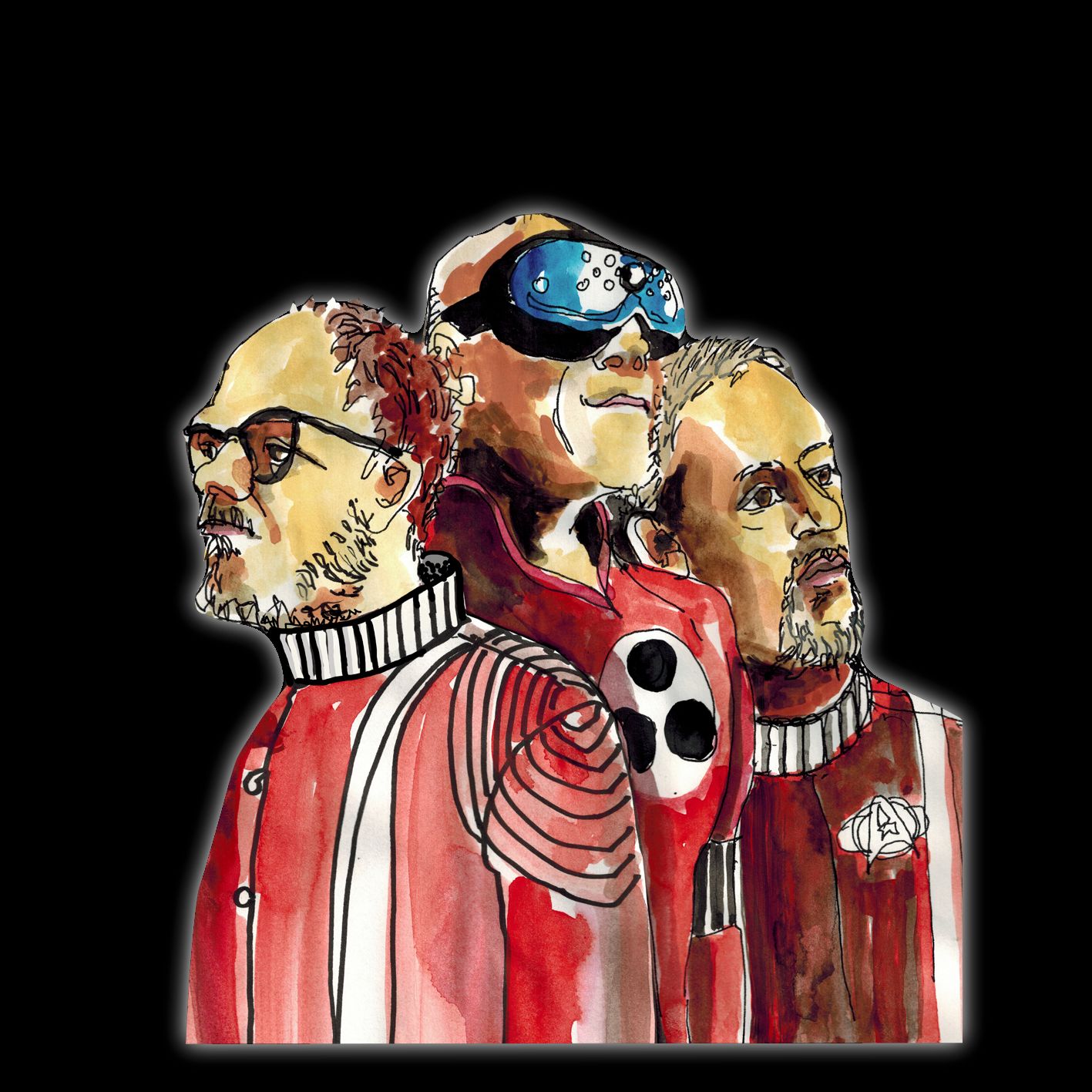
Members: Andreas von Garnier (synthesizer, keyboards, sequencer), Bernhard Wöstheinrich (synthesizer, keyboards, sequencer), Leander Reininghaus (bass, electronics)
Nationality: German
Current release: TaboTago's new album Sessions 017 - 20250308 Live in Schwerin is out now via Iapetus.
Kraut-related Shout outs:
Leander: The longest-running festivals, such as the Herzberg Festival, as well as the whole movement of “Umsonst und Draußen” festivals, contributed greatly to the spread of Krautrock. Some of them still exist today, while others have unfortunately disappeared.
When it comes to labels, I think it's important to mention the early German independent labels such as 'Schneeball', which featured some of the Krautrock bands such as Guru Guru, Embryo and, to some extent, Kraan. A little later, the '2001 Versand' also played a role with its 'Mood' label.
At the moment, apart from our own label 'Iapetus', I can't think of any company names that actively promote Kraut, although I'm sure there are some.
Krautrock recommendations:
Bernhard: I always find the genre definition of Kraut very blurry, but here we go, assuming that I am not even close what many would consider as Kraut, I'm suggesting two releases that, to me, have a certain Kraut vibe but still represent two sides that couldn't be more different: Peter Michael Hamel – Nada and Schroeder Roadshow - Anarchie in Germoney (sic!)
Recommendation for Berlin, Germany:
Bernhard: Café Morgenstern. Since it's one of my favorite places to hang out and drink coffee, it has already become a kind of main meeting place for some of my friends and colleagues from the music scene, whom I would describe as part of the “New Berlin School” scene, at least that's how I would put it. There's even already an album with “Cafe Morgenstern” in the title. And then there's Cafe Kotti, which also has a certain charm for me. It's not directly related to Kraut, but I still feel a certain vibe there.
If you enjoyed this TaboTago interview and would like to stay up to date with the band and their music, visit them on bandcamp, and Facebook.
How would you describe your personal relationship with Krautrock? When and how did it start?
Andreas: I don't really care whether it's Krautrock or not. I first consciously perceived German music as German rock music around 1974.
Leander: My interest in Krautrock began in 1974 when Kraftwerk's song 'Autobahn' was played on the radio.
Bernhard: As a matter of fact, when I first learned about the term 'Krautrock', I was still a boy and mostly listened to the music my older siblings listened to. This music seemed to me like an odd variation of the so-called progressive rock albums that were famous at the time.
It took me a while to understand that what I first thought was that they didn't really get it quite right was actually a special feature of that music.
Tell me about one or two of your favourite Krautrock records please.
Andreas: For me, Tangerine Dream's “Ricochet Part 2” was the ultimate introduction to both Krautrock and electronic music. Beautiful melodies are very important to me in music.
In addition to the Tangerine Dream albums, I always found Edgar Froese's 'Epsilon in Malaysian Pale' and Klaus Schulze's 'Mirage' particularly beautiful.
I also liked Kraftwerk's albums up until the 1990s.
But in addition to electronic music from Germany and abroad, I also listened to the music of other bands as I got to know them, including: Can, Kraan, Guru Guru, Embryo, Roman Bunka, Michael Rother, Ashra, Popol Vuh, Neu!, Harmonia, Cluster (+Eno), Roedelius solo albums, Triumvirat, Czukay solo albums and others.
[Read our Michael Rother interview]
[Read our Ashra's Manuel Göttsching interview]
[Read our Roedelius interview]
Krautrock always seemed like a phenomenon connected to a very specific era in German history. What about this music and its time do you connect with?
Andreas: When I started listening to Krautrock, there were still two German states. In that respect, Krautrock has a taste of freedom and independence in musical composition for me.
Leander: I associate Krautrock with my teenage years and, at the same time, with my introduction to electronic music. Of course, it wasn't the only music I listened to, but it was a significant part of it.
Bernhard: For some strange reason, Kraut seems to me to point back to something very old, even ancient. I can only guess why that is. Of course, I am familiar with the historical context of 'Kraut', yet it still gives me this very primordial impression.
Many of the original Kraut musicians loved blues, rock, and psychedelia; they were intrigued by electronics and improvisation; they rebelled against virtuosity, classical education and the superficiality of Schlager on German radio. How much of that do you recognise in your own creative preferences and interests?
Andreas: I recognise a lot of this in my own preferences and interests, as I mostly improvise music myself - naturally also together with other musicians.
Leander: I shared the musicians' aversion to German 'Schlager' music. Improvisation and repetitive elements have become an essential part of my musical expression.
Bernhard: For me, a very important aspect of Krautrock is that it gave some people the opportunity to become musicians even though they didn't come from a part of society that readily allowed this, namely descendants of working-class families. This certainly doesn't apply to all Krautrock acts, but it does apply to some.
Being detached from a certain musical tradition or lore meant they were free to develop their own sound and style of performance. And that I can really identify with very well.
Both in the music and the way it was made, Krautrock was about imagining different worlds. What is the experience of listening to this music like for you and what kinds of worlds is it taking you to? What is your preferred way of listening to it?
Andreas: When I listen to music, I don't imagine other worlds, but rather experience an emotional journey. I usually listen to music alone through speakers and nice and loud.
Leander: I've always liked it when music triggers a kind of mental cinema (Kopfkino). I mostly listened to music alone with headphones or through speakers.
Drugs played no role in this. The music was enough.
A lot of the Kraut spirit came to life through musicians living in communities, playing and recording together every single day. Have you ever tried working and creating in such a constellation? Is it possible to emulate this process from a home studio?
Andreas: I don't think you can replicate the process of making music together in a home studio. I myself have never lived in a commune and created music that way. We always got together to improvise during sessions.
Leander: I didn't live in a musicians' commune, but with my world music band Moka Efti, we had creative meetings that usually lasted several days or sometimes weeks to work out a new programme and then either go into the studio or on tour, or both.
I still find this way of working and creating very enjoyable and effective.
I don't think you can replicate this process alone in a home studio. However, it might be different if you invited fellow musicians into your home studio.
Bernhard: I would like to disagree in some degrees with what Andreas and Leander said. Whether or not we live together, I feel that we actually form a community.
If it weren't for the interconnection, the way we play together would just be pragmatic. I can’t see how the kind of music we make could result from such a way of collaborating.
What, to you, are the main elements that make something “Kraut?” What are the practises of the musicians from the 70s that inspire your own practise today?
Andreas: Krautrock was a derogatory term used by English-speaking people to describe German rock music. In that sense, there is nothing specifically Krautrock-esque for me. I am inspired by the fact that people improvised uninhibitedly back then.
Leander: Important elements of Krautrock for me are improvisation and experimentation, both with sounds and with compositional techniques, as well as a certain rhythm, such as the “motor beat” and Jaki Liebezeit's style of drumming.
Improvisation and experimentation with sounds, both with my instruments and with effects devices, have also become an important part of my own music.
Bernhard: Wolfgang Seidel, the former drummer of the German band Ton Steine Scherben, once proposed the thesis that the phenomenon of Krautrock stems from the fact that a great many German artists and musicians were forced to flee, were murdered or were expelled during the Third Reich, resulting in a significant loss of tradition and national style in German music.
During the post-war years, this left a void for a new generation of artists to fill with their own style. This led to what is now called Krautrock. I'm not sure if this is true, but it sounds plausible to me.
This impartiality towards tradition is one of the main elements of Krautrock for me. This is also the main aspect that I want to maintain as my main source of inspiration, rather than simply trying to imitate particular musical styles or clichés.