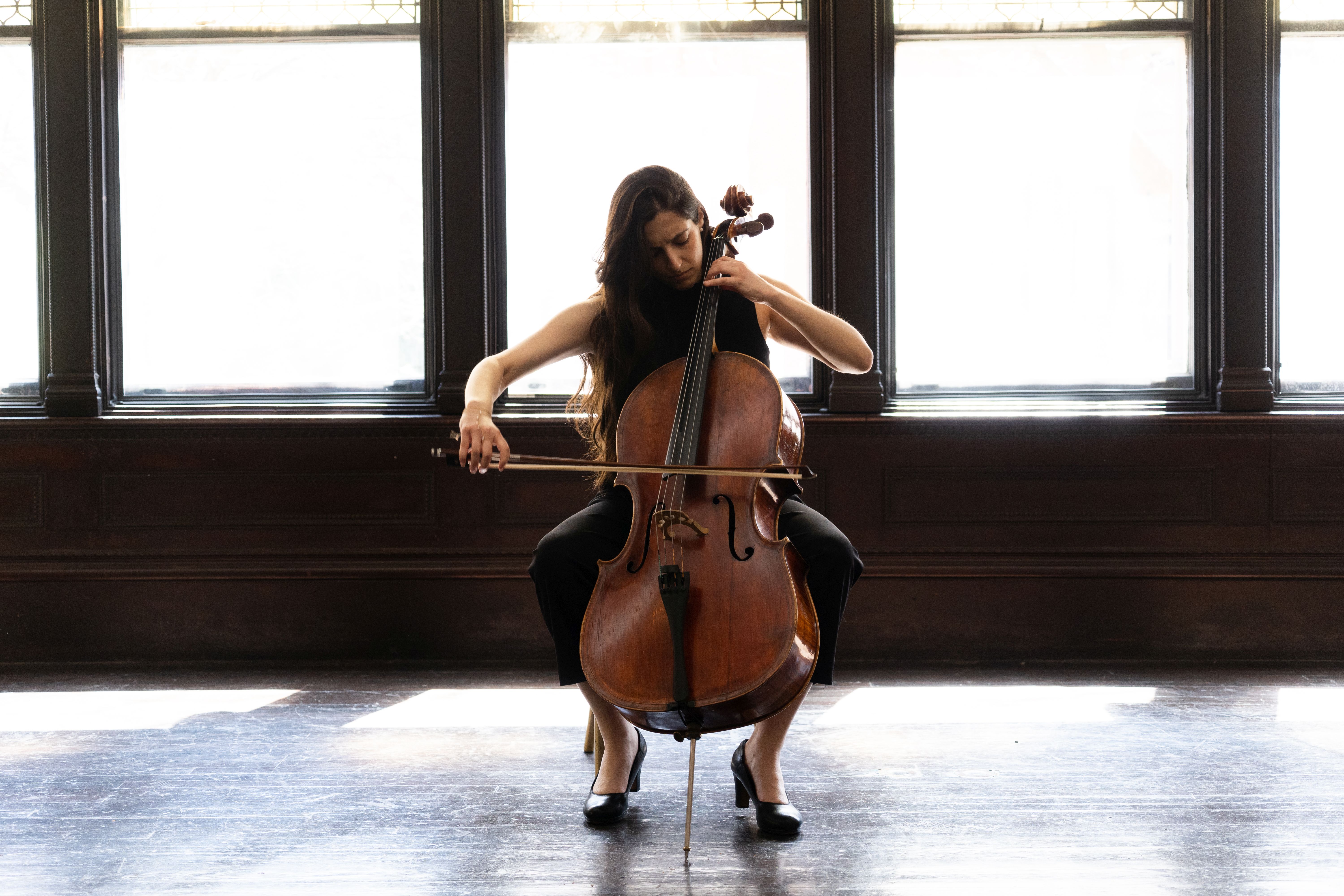
Published
Name: Tamar Sagiv
Nationality: Israeli
Occupation: Composer, cellist
Current release: Tamar Sagiv's new album Shades Of Mourning is out now via Sono Luminus.
Recommendations for New York City, USA: I have so many beautiful corners that I love in NYC, and there are always so many things to see and taste. I mostly love the rhythm of the city and how lively it is, but lately one of my favorite things to do is watch the sunset from the bridge in Tudor City - if you get a Manhattanhenge, it's a bonus!
If you enjoyed this Tamar Sagiv interview and would like to stay up to date with her music, visit her official homepage. She is also on Instagram, Facebook, Soundcloud, and bandcamp.
When it comes to experiencing strong emotions as a listener, which albums, performances, and artists come to mind?
I draw inspiration from artists across all genres.
Truls Mørk's recording of the Grieg Cello Sonata moves me deeply, there's always something extraordinarily emotional and touching about his approach, specifically his vibrato and the way he uses it. On the other end of the spectrum, I love Steven Isserlis, who uses much less vibrato than Mørk but creates incredible expression purely through his bow.
In pop music, Lana Del Rey is one of my favorite performers. I'm captivated by how she uses her voice, with such a distinctive and artistic approach. Her version of "The Other Woman" always brings me to tears.
I love the tenderness of Miles Davis - he had this incredible ability to use silence in a way which makes the music so powerful, I love the way he uses mutes, his sound is so intimate delicate.
There can be many different kinds of emotions in art – soft, harsh, healing, aggressive, uplifting and many more. Which do you tend to feel drawn to most?
It really depends on what I'm writing and where I am emotionally in my life.
For the past few years, I've been grieving a lot, as many people around the world still are, and I found myself writing primarily around that experience.
Grief encompasses such a vast range of feelings, so I would say I was drawn to emotions that were more soft and minor.
In as far as it plays a role for the music you like listening to or making, what role do words and the voice of a vocalist play for the transmission of emotions?
I find instrumental music to be the most challenging because we cannot use words. As an artist, you have to find a way to transfer your emotions and communicate what the music is about without explicitly saying what it's about.
In a way, I find this limitation freeing at the same time, it allows the listener to decide what the music means to them personally.
When it comes to composing/songwriting, are you finding that spontaneity and just a few takes tend to capture emotions best? Or does honing a piece bring you closer to that goal?
I've found that for me spontaneity brings something really special emotionally.
When I recorded "Roots," I only played 2-3 complete takes because I wanted it to sound raw. "Shades of Mourning" and "Prelude" are much more gentle and tender - and technically challenging because of how exposed they are.
I remember with "Shades of Mourning," I actually had to come back on a different day to record it again because I wasn't happy with the first session. So I would say it really depends on the piece and what it requires from you as a performer.
How much of the emotions of your own music would you say are already part of the composition, versus the result of the recording process?
Since my compositions are mostly improvisational-based, I do write about my own life and experiences, so I think my music is primarily emotionally driven. The emotions are deeply embedded in the composition from the very beginning - they're the foundation that everything else is built upon.
But I do think the recording process has a big effect on where the piece ultimately goes and the end result. There's something about being in that moment, whether it's the studio or live performance, that can intensify or reshape those emotions in ways I couldn't predict when I first conceived the piece.
How do you capture the emotions you want to get across in the studio?
I played around with intonation and tuning, which gave the music an extra color. I experimented with mutes and different techniques like sul tasto and sul ponticello and in general I experimented with what I could create only with my bow.
It felt much more difficult to pull out all the emotions in the studio because everything has to sound so clear and perfect. Many times, making the emotions happen meant I had to give up some of the perfection and make the performance a bit "dirty."
As I come from the rigid classical music tradition it bothered me at first, but I learned to love the imperfections and I think that as an artist I have a different view today and I find it to be much more appealing and interesting to listen to.
What role do factors like volume, effects like distortion, amplification, and production in general play in terms of creating the emotions, energies or impressions you want?
With this album, I wanted the music to feel personal and intimate, and I wanted to achieve that using the raw sound of my instrument.
I love effects and I think that today we tend to add effects because it's cool. Also nowadays, they are available and sound new and indeed they are impressive and they do add a lot.
But the classical cellist that I am, I felt it would be more special to find a way to capture the emotions without using anything external - I wanted to create the sound I wanted purely with the ability of the instrument(s) which I think are endless.
In "In My Blue" I loved playing with the sound of the wood of the cello, I knocked on different parts of the instrument (until I found the pitch and color that I wanted) and sometimes 'rubbed' the wood, I fell in love with what it added to the music.
In terms of emotions, what changes when you're performing live on stage, with an audience present, compared to the recording stage?
I always feel that recordings have to be very clean because they lack the visual element.
In a way, I felt freer performing some of the pieces and getting lost in the music, while in the studio I had to be in control of every note.
How does the presence of the audience and your interaction with it change the emotional impact of the music, and how would you describe the creative interaction with listeners during a gig?
This is one of my favorite questions!
I improvise a lot, and I find that the audience makes such a big impact on how the improvisation develops. I feel that as people, we transfer a lot of information to each other without even knowing it. It's happened to me several times that I was on stage improvising and something unexpected came out, then an audience member told me afterwards that I improvised exactly what they felt that day. It was really an incredible experience!
Since this release contains a lot of improvisational elements, when I performed these pieces live on stage, I did feel I was performing them differently every time.
What kind of feedback have you received from listeners or concert audiences in terms of the experience that your music and/or performances have had on them?
Since I tend not to share much about how my pieces came to be, it creates fertile ground for people to create their own stories and ideas about the music. It's fascinating, and I kind of like it. Until recently, I really enjoyed the mystery of it.
I had one interaction 2-3 years ago in Amsterdam. I was in the midst of writing "Roots" and had to perform it when it still didn't have an ending - I was improvising something. After the concert, a man came to me and told me his version of the story behind the music. I feel conflicted about sharing it here, as I feel each story is personal for the listener, without sharing it in great detail.
In his mind, I wrote it about a mother and daughter who go into war and fight over their land. It was very emotional and I was struck by how detailed it was. It wasn't what I wrote the piece about, and when he asked me, I decided not to tell him that. I felt it was a beautiful story that he should keep, even though it wasn't mine.
Recently, I also had an audience member who comes to almost all of my concerts write me afterwards that he felt I was worried about something and hoped everything was okay back home. Performing for people is my favorite thing in life and I have gone on stage and played concerts while experiencing things in my personal life that were difficult to handle, I still always put a smile on and perform and usually no one can tell.
But that day I indeed was worried, and it's funny that they could tell.
Would you say that you prefer to stay in control to be able to shape the emotions, or do you surrender to them and allow the music to take over? Who, ultimately, has control during a live performance?
That's a question I think many musicians, including myself, are constantly thinking about.
When I was a teenager, one of my teachers, Hillel Zori, a legendary cellist, was mostly concerned about how much I would allow myself to get lost in the music on stage. He had a good point that I couldn't understand at the time, but indeed sometimes it worked beautifully and sometimes the loss of control was too much that I lost aspects of the performance that were important.
With the years, I understand that there's a balance one needs to master between how much to let go and how much to remain in control. It's about making yourself free while being in control of the freedom.
The emotions that music is able to generate can be extremely powerful. How do you think artists can make use of this power to bring about change in the world?
I think music is so powerful because of the simple fact that it makes people feel and connect.
Nowadays, I feel we've become desensitized to so many things that happen around us. Just by the simple fact that we hear something that makes us feel, we open our hearts.
I think that on its own makes people live better lives and treat each other better, and that, in my opinion, is the biggest impact one could create in the world.