

Name: Terri Lyne Carrington
Occupation: Drummer, composer, improviser, producer, educator
Nationality: American
Recent event: Terri Lyne Carrington will perform at SMOKE Jazz Club March 5th-9th 2025 with her “We Insist! 2025” ensemble. For tickets, go here. Her most recent album New Standards Vol. 1 is still available.
Global recommendation: Horn Pond in Woburn, MA
If you enjoyed this Terri Lyne Carrington interview and would like to find out more about her music, visit her official homepage. She is also on Instagram, and Facebook.
It seems as though most aspiring artists are drawn to the drums and percussion for one of two reasons: Creating sound/noise and creating rhythm. What captivated you?
I started so young, that I don’t really remember what captivated me. It was mostly because the drums were there. My dad used to play his father‘s drums on occasion, so I’m a firm believer that if you provide instruments or other means of artistic expression, children will find their way.
The more interesting question to me is what has kept me captivated, and interested in the drums. I always say that I don’t LOVE the drums. I don’t like talking shop and I don’t like them enough to really practice, but I love music. I love improvising and I love being creative. The drums are a tool to do those things.
Rhythm itself is something that can be extremely captivating. It’s one of the most important parts of jazz. It doesn’t matter what instrument, it’s the rhythm that makes you dance. Makes you feel things. It can design or change the direction of a piece of music.
And the band is only as good as its drummer. I love the feeling of laying the foundation that other people find comfort in. Also rhythm is spiritual. Even if I don’t know consciously all the gods and goddesses I am calling, I know they’re there.
When I listen to music, I see shapes, objects and colours. Others experience emotions. Everything around drums, on the other hand, is based on touch, vibration, and movement. Does this mean that your own perception as a listener is also more connected to touch, vibration, and movement? What happens in your body when you're listening?
I see shapes and colors too! We are not relegated to vibration and movement, just as those things are qualities of melody and harmony too.
My connection to music when listening is free- free to experience whatever I’m able and hopefully whatever my mind and body and spirit need at that time. I mostly hear melody and harmony first before whatever drums are doing but mostly I hear it all as a whole, not fragmented. When great trumpet or guitar players - who have great time - play they are making the dance happen sometimes more than the drummer.
What happens in my body is a sense of peace, a feeling of good health, of soul nurturing … headaches go away, problems and challenges go away and I’m able to be in the moment and let it in and let it heal and ease me.
What was your first drum set like and what are you using today? What, to you personally, are factors in terms of build and design that you appreciate in drums and percussion instruments?
First drum kit was my grandfather's so it was very old - from the late 40s or early 50s. Then I got an endorsement at 11 with Slingerland and got a replica of Buddy Rich’s set, at his request. 20’inch kick. I wasn't confident to really play an 18 kick until I was 18 and began endorsing Yamaha drums. Have been with them and Zildjian ever since.
But I’m not an instrument geek. And more interested in creating something with whatever is there, adapting and adjusting to the sound needed at the moment - depending on the room, the music and the equipment.
I also worked on developing my touch and sound so that I can still sound like me no matter what I’m playing.
Late Rush-drummer Neil Peart said: “The equipment is not an influence. It doesn't affect the way I play. It's an expression of the way I play.” What's your take on that?
It’s neither for me.
The equipment is a tool. Your voice is inner, and we are constant trying to get what we are hearing in our heads out.
Drums and percussive instruments are an integral part of many cultures, and traditions. Which of these do you draw from in your playing – and why?
The drumset has its own tradition, developed in the United States. Jazz has its own sonic tradition rooted in African American culture. So the drumming in jazz has a unique approach to rhythm, which is where I draw from the most in my playing.
Of course through my development I learned about Afro Cuban rhythms and other Afro diasporic rhythmic traditions and approaches. And the more you learn the more you can make the connections between them all.
What were some of the main challenges in your development as a drummer / percussionist? Which practices, exercises, or experiences were most helpful in reaching your goals?
Learning to play Afro Latin music was a big challenge - it took many years of not only learning rhythms but learning the time feel - meaning being able to have the approach to the 8th note in a way that feels right to the idiom. Not necessarily sounding “authentic” but playing in a hybrid Latin Jazz way that I would consider acceptable.
Also, another challenge was being able to play free- out of time and without structure. But once I got better at creating something in the moment - something from nothing - then I felt better and it became my favorite way to play.
I still try to break habits to expand in more free situations. I’m not sure about ways to work on it other than listening to other drummers that sound good in the areas you are weak. And trying to analyze what they are doing differently than yourself.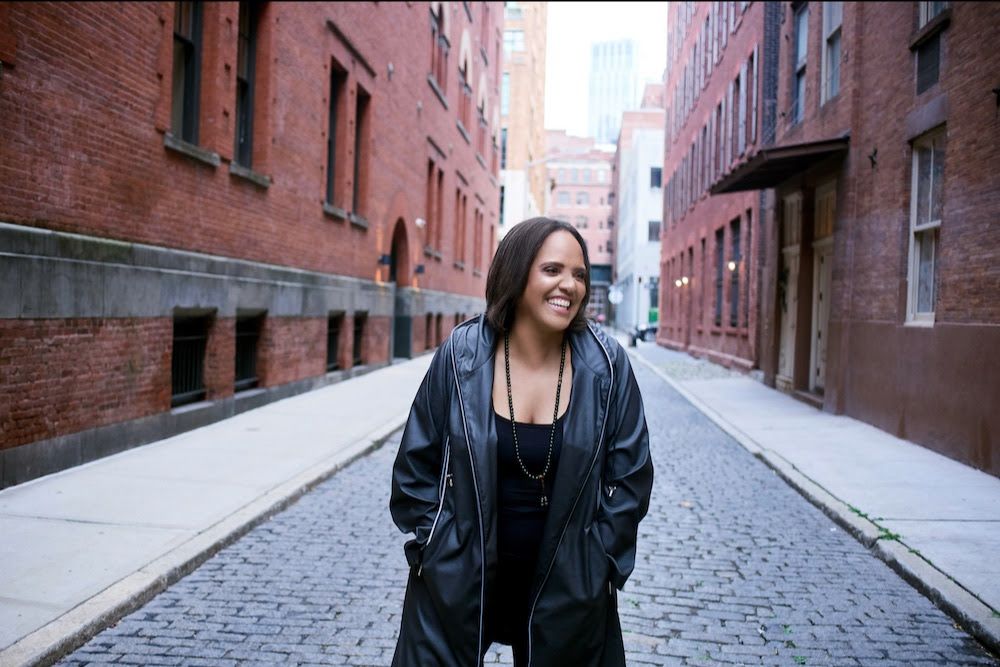
Terri Lyne Carrington Interview by Michael Goldman
How would you describe the physical sensation of playing the drums? [Where do you feel the resonances/pulse/groove, what are emotional sensations, is there a sense of release or tension etc …]
I’ve never really thought about it like that. But I do feel there is a grounding that needs to be there. An approach to time and feel that emerges from the root chakra. A grounding with the earth, also a connection to ritual, then to also emerge free from all of it.
I think about articulation and power from how I flex muscles in my hands and arms. I tighten my grip at the time of impact to create a strong sound. I am also working on not doing that as much to have a more relaxed sound when desired.
What is the relationship between harmony, rhythm and melody? How do non-percussion instruments contribute to the overall rhythmic texture of a piece?
Harmony and melody have an effect on rhythm. Some grooves don’t sound as funky if major triads accompany them, opposed to minor 7 chords or dominant chords. It’s contextual. Same with melodies - some combinations of intervals create a shape that can make something feel more in the pocket opposed to helping it to groove less.
It also depends on the interlocking of the melodies with the groove. For instance, bass and drums playing the same accents - with bass locked completely together with kick drum - can sound immature and less funky than a call and response rhythm approach, or an approach that finds ways to ebb and flow with bass and drums to fit more like a puzzle than a “locked” groove.
Melodies have to leave space for the rhythm to pop through, to compliment it - when there are two many notes in melody or in improvising, it does not leave enough pace for the rhythm to punctuate answers.
Do you feel that honing your compositional / songwriting skills has an effect on your drumming skills?
Yes because the better a composer I am, the better I will play other people's music.
And the more I will be interested in what serves the composing opposed to what serves my ego. It becomes more about the piece than about the drummer.
I've long been intrigued by bands or ensembles where the drummer is the leader and/or main composer. In as far as it is possible to generalise, what do you think changes in terms of the music or performance in these situations?
I feel drummers are natural leaders and lead bands they play in even when it is not official.
Also this is why we make good producers. We have the ability to understand and design the shape of a piece - catching the right arcs, allowing for enough space or driving energetically when needed. Drums really help to define the style of a piece and where it is going, so that at the end there is a feeling of satisfaction - that you went on a journey.
I am not saying this is not possible without drums, but possibly harder ...
How are you making use of the timbral and textural potentials/possibilities of your drums and percussion instruments when making music?
I need to do more of that, I love to hear other drummers do that.
I love trying to find textures with whatever I have to work with - whether just the drums and cymbals, or maybe grabbing some things around me. I use bells and hooves sometimes, but mostly just the drum kit.
Graduating soon to have more colors as part of the kit!
How has technology, such as drum machines and sequencers, impacted the way rhythm is created and perceived? Has it been a concrete influence on your own approach?
We are a product of our times, so yes it has impacted my playing and approach to some degree. My time is better due to hearing good time all the time and knowing it is an industry standard to be able to play with a click.
And now sometimes we emulate drum machines when we play - we deaden our snare and toms and do things to make drums sound less acoustic. Or we figure out how to play with drum machines to have a hybrid sound of acoustic and electronic.
But electronics are here to stay. So we may as well figure out how to work with them and how to sue them for our won taste and creative output.
Physical strain is a particularly serious issue for many drummers. How does it manifest itself, how do you deal with it and in how far does it affect your creativity?
I think I have had tendonitis possibly more from computer work than from playing drums.
I have discovered that I need to warm up before playing to not hurt afterward. I have to move my wrists and hands in increments so after a 3-5 night run, I am nearly a totally different drummer. I always say drumming is not sports.
But there is a physical aspect that has to be respected. Physical dexterity is imperative so either one has to practice or play enough to keep themselves loose. But you also have to start with good habits, Good form, good hands, good posture, etc. to not be in pain later.
Many recording engineers have remarked that the drums can be particularly hard to capture. What makes drums sound great on record and in a live setting?
I like isolation to be able to manipulate the drum sound later. So I cannot stand leakage. I like to hear the drums form drummer's perspective opposed to audience perspective.
And it depends on the music - if it is more old school jazz then sometimes it is better to just mic over heads kick and snare. with mics further away to not capture the sound so directly.
But if it is groove music, you want the kick and snare in your face, and that is what is driving the whole thing, so we have to recognize context always.
Drums and percussion are remarkably often used for physical therapy / healing. What, from your point of view, makes them particularly suitable tools for this?
Sound is energy, so the source of the sound - the person, not the instrument - is a source for healing, or not healing. rhythms are vibrations. Healing happens at a vibrational level.
Repeated rhythm is tribal, so it also helps to know something historical and cultural about the rhythms you play. Otherwise you are just playing notes, or beats.

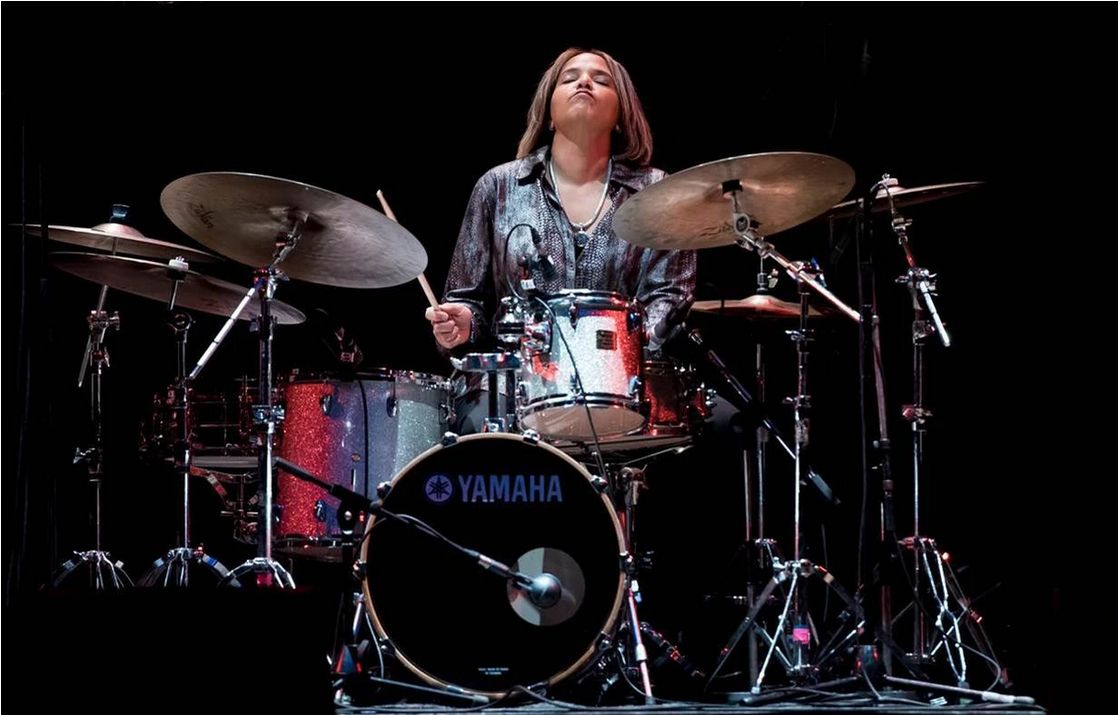 Terri Lyne Carrington Interview by John Watson
“Even if I don’t know consciously all the gods and goddesses I am calling, I know they’re there.”
Video
