Published
Name: Thomas Burkhardt
Nationality: German
Occupation: Sound artist, producer, composer
Current release: Thomas Burkhardt's Halbautomatik II EP is out via LIN/LOG.
Topics I rarely get to talk about: Haha, very nice question. I like having secrets.
Global Recommendation: I live in Aschaffenburg and this town lacks interesting people, I am sorry to say. But I do like interesting people. If anyone reads this: contact me 😊
If you enjoyed this Thomas Burkhardt interview and would like to know more about his music, visit his official homepage. He is also on Soundcloud.
Are there examples of minimalism in music – and outside of music - that impressed you early on?
Minimalism in music is a phenomenon of our current times. There is a need for reduction, be it less instruments, less recording tracks, less effects and so on.
It shows that there are sometimes too many possibilities to handle and I also tend to prefer clarity over plenty. This includes all kinds of art.
Were you ever interested in minimalism as a style – from the Philip-Glass-variety to solo instrumental work to minimal techno? If so, tell me a bit about your interest in this.
To me minimalism is a principle that separates the ones that have something to say from the ones that perform. If there is a reason for sound, it is the best thing that can happen to music.
I love the work of Philip Glass and Pan(a)sonic, which both have/had many reasons to create sound.
[Read our Mika Vainio of Pan Sonic interview]
Do you tend to find that, as many claim, “less is more?” Are the notes you don't play really as important as the ones you do play?
Haha, no. Not exactly. That is very theoretical and must be considered on a case-by-case basis.
Do you feel as that making music is a process of adding elements until it is done – or one where you chisel away pieces from something that is already there?
“Chiseling” is a good word in this context.
A known product designer once said that he tries to eliminate parts of his designs bit by bit, until the point has reached where the meaning is starting to alter. That is exactly how I work with music.
Many artists are becoming more minimalist in their music as the years go on, focusing on the “essence.” How is that for yourself and how would you describe your development in this regard?
You are right. Young people often refer to this process as “getting old”. But they become wiser as well.
Wisdom is knowing much and doing less.
What were some of the starting points for your Halbautomatik II EP?
The “Halbautomatik” series is all about working with limited options. I asked myself if I could do something like techno without having a sequencer or drum voices or voices at all. That was the starting point.
I found myself setting up a process where logic blocks shift events periodically. And that is was Techno music is all about – but this time without dedicated tools.
How did a minimalist mindset possibly inform the creative process?
I once heard a saying I cannot say where it comes from. There are two types of artists: the ones creating by abundance and the ones creating by necessity.
Thanks to sampling and digital synthesis, there are endless possibilities for sculpting the sounds and overall sound design of a piece or album. What are your considerations in this regard?
There are two types of sampling: recording an event to repeat it or recording an event to dismantle it. And for digital synthesis: it can be used to reproduce something or to rework something in a way you could not in the analog domain.
In both cases I tend to use option B.
Would you say that you approach your creative tools with a minimalist mindset? Or do you need a wide choice of instruments and tools to make music?
In all my works I impose severe restrictions on myself like which tools to work with, duration of tracks, times of re-recordings, and so on. This helps me stay focused.
What were some of the most important pieces of gear or instruments for this release?
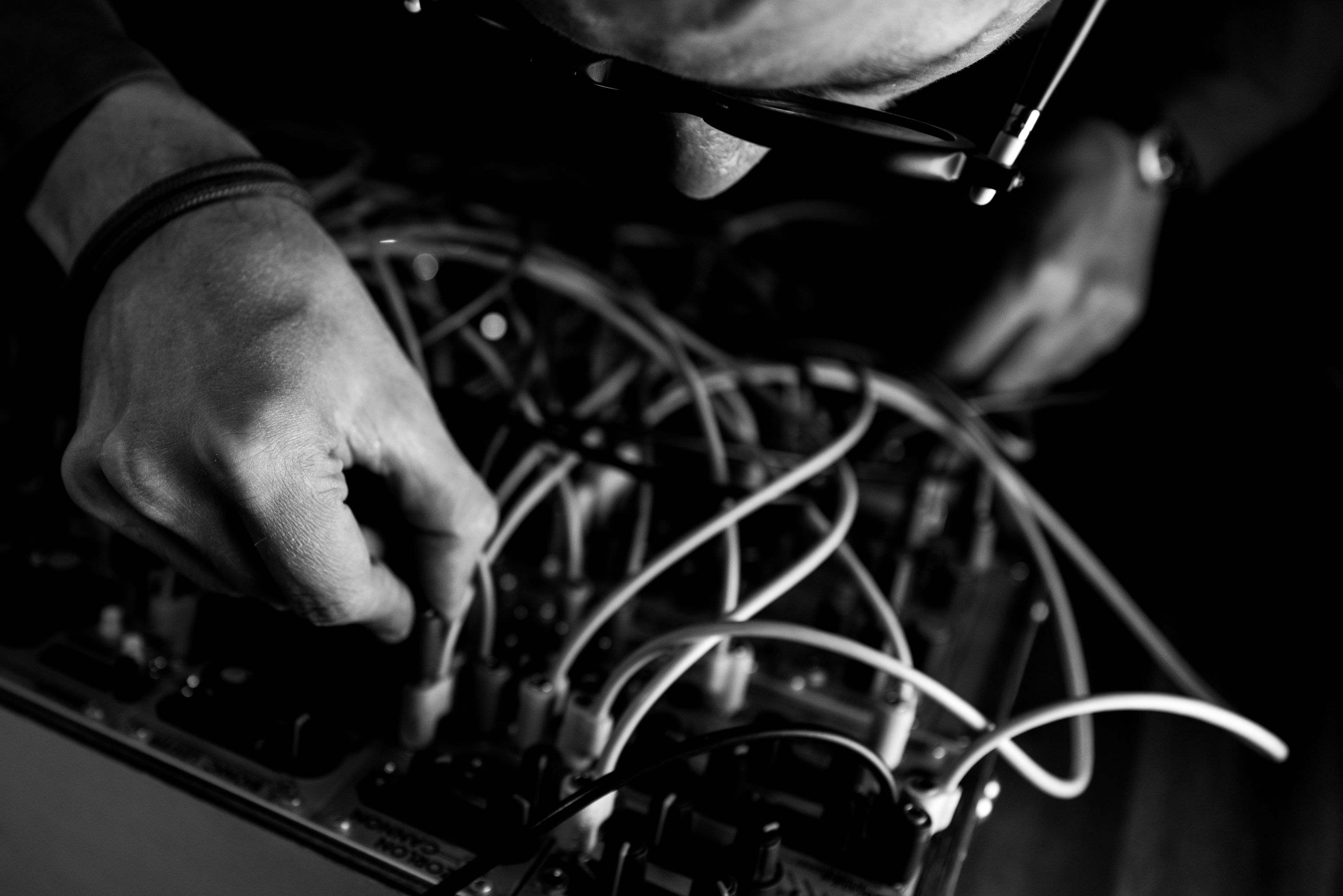
For “Halbautomatik” I use only one case of selected modules (mainly from Industrial Music Electronics). There is no further processing but a little finishing and mastering. 95% is done in one box, in one recording session with one only take for each track.
Some might call it insane to do something like that. I think it is time to finally do it.
French producer Guillaume Duchastel told me: “Minimalism is about more than owning fewer things. It’s about focusing on what truly matters.“ What are some of your strategies for separating what matters from that which doesn't?
He is absolutely right. To me every project has these stages:
1. I have a flash of inspiration.
2. Carrying the idea with me for a long time, sometimes even years. Thinking about all possible scenarios to make it happen.
3. Coming to a conclusion by getting rid of all unnecessary elements.
4. Doing it, no matter what others say.
With so much incredible music instantly available, are you finding that you want to take it all in – or that you need to be more selective? How do you pick the music you really want to invest in?
That is a very good question. I am sure I have missed great music done by great artists. But you cannot listen to all of them. That is even impossible mathematically.
Sometimes I try to find new music but this often leads to nowhere. Music that got my interest I most often found randomly.
Would you say that minimalism extends into other parts of your life as well?
Of course. I don’t trust many people. That is a good start 😊