Published
Name: Thomas Julienne
Nationality: French
Occupation: Double bass player, composer, arranger, improviser
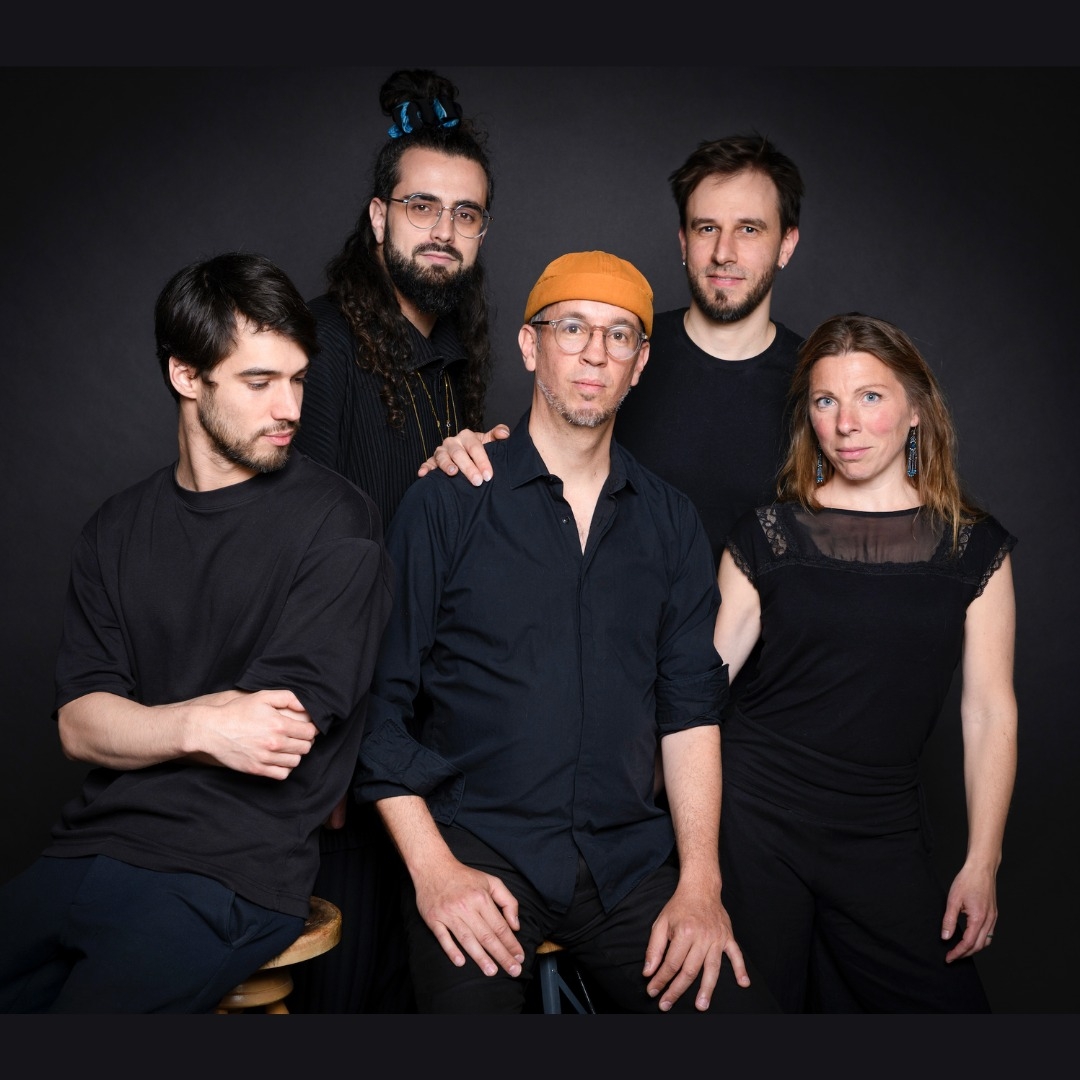
Current Release: Thomas Julienne's new album with Theorem of Joy, Feux, is out now and features the line-up of Tom Peyron, Robin Antunes, Antony Winzenrieth, and Raphaelle Brochet.
Recommendation for Paris, France: Montreuil, just outside Paris. In October, all the artists' workshops open their doors—it’s a beautiful time to explore.
If you enjoyed this Thomas Julienne interview and would like to know more about his music, visit him on Instagram, and Soundcloud. For information on Theorem of Joy, we recommend their official homepage, Instagram account, Facebook page, and tiktok profile.
What were some of the musical experiences which planted a seed for your interest in jazz?
I started out as a guitarist, deeply immersed in alternative rock—Radiohead, Hendrix, Smashing Pumpkins, the whole grunge scene. I was already very focused on music, but jazz wasn’t part of the picture yet.
Over time, my curiosity led me to explore other styles—French hip-hop jazz, especially Erik Truffaz, and the UK Ninja Tune scene with artists like Cinematic Orchestra, The Herbaliser, and Amon Tobin.
From there, I dove into Miles Davis and the entire history of jazz, while also exploring classical music and rich Eastern traditions, from Indian to Arabic and Mediterranean music.
[Read our Erik Truffaz interview]
What does the term jazz mean today, would you say?
Openness.
I think jazz today is defined by its openness—it absorbs and embraces musical traditions from all over the world. That openness is its greatest strength.
As of today, what kind of materials, ideas, and technologies are particularly stimulating for you?
As a composer, the materials I use depend on the atmosphere I want to create.
For the new album Feux, I used very soft virtual instruments to create wider, more immersive spaces. They’re mixed far in the background, but they add a deeper orchestral layer that expands the sonic landscape.
Where do most of your inspirations to create come from—internal impulses or external ones? Which current social, political, or ecological developments make you feel like you need to respond as an artist?
Before becoming a professional musician, I studied sociology, so social questions are naturally embedded in my work. Feux is very much a social and psychological reflection. Each song explores the question: How can we live together, and what are the choices we make?
The nine tracks move across past, present, and future—between reality, dystopia, and utopia. Together they form a kind of map, with fire as a central element that takes on different symbolic meanings in each song.
Tell me a bit about the sounds, creative directions, artists, and communities in your hometown. How do they influence your music?
Living in Paris means being in constant contact with musicians from all kinds of backgrounds. That richness goes beyond music—it’s in the food, the neighborhoods, the energy of the city. I love that mix.
I'm also part of a jazz collective and label called Déluge, based between Paris and Bordeaux (and that’s also really cool for wine and food!). It’s inspiring to follow the work of fellow musicians, discover new releases, and collaborate.
I also conduct a big band called Orchid, where several composers contribute.
Conducting music written by friends is a joyful and dynamic experience.
What role do electronic tools and instruments play in your creative process?
I usually start composing with an acoustic instrument—piano, double bass, or guitar. Then I move to Sibelius to notate and clarify the structure. After that, I dig into orchestration, often using tools like Spitfire Audio’s BBC Symphony Orchestra to shape the vibe—almost like film scoring.
Live is different. Most of us use pedals except for Raphaëlle Brochet (vocals) and Tom Peyron (on drums). I prefer staying close to the natural sound of the double bass—it has so many expressive possibilities.
But Anthony Winzenrieth (guitar) and Robin Antunes (violin) go deeper into effects, and that really complements the music. Their creative use of sound processing is one of the reasons I love working with them.
Thanks to technological advances, collaboration has become a lot easier. What have been some of your most fruitful collaborations recently?
Absolutely—technology opens up incredible possibilities. Before our China tour, we collaborated with Shanghainese singer Voision Xi on the track “L’hiver.” She has a powerful artistic voice.
We also recorded with Manmeet Kaur, an amazing rapper from India with a very committed and personal style. I’ve also had a great experience working with DJ Click for RFI International. Next up: a collaboration with drummer Ches Smith in New York—we’re very excited about that.
I also like to collaborate with visual artist like Alexandre Dupeyron, Sophie Bataille and dancers like we did in Laos with Fanglao Dance company.
Jazz has always balanced honouring its roots with exploring the unknown. How does that balance show up in your own music?
Honestly, I don’t think in terms of jazz "roots" versus the new. I explore music wherever it leads me—and also jazz standards, Bach cello suites, or other styles.
My daily practice does include a lot of traditional material: jazz transcriptions and classical repertoire. So perhaps those are my left and right roots.
How much potential for something “new” is there still in jazz? What could this “new” look like?
The "new" often comes from technology and the blending of cultures—but I think what really creates something new is a strong personal voice. As a composer or bandleader who knows where they’re going and brings others in a truly unique shape of music.
There aren’t that many revolutions in music, but if you look at the 20th century, artists like Lili Boulanger, Wayne Shorter, Steve Reich, and Sonic Youth brought truly new directions.
Live concerts often create life-changing musical experiences. Do you feel that way too?
Definitely. There’s something magical about the stage—it feels like a protected space where you can explore deeply and be fully yourself. The relationship with the audience can push you into emotional or creative territories you never imagined.
Yes, concerts are where the magic happens.
How are your live performances and your recording projects connected at the moment? How do they influence each other?
In the studio, I don’t put limits on orchestration—I include whatever sounds or instruments the composition needs. Then comes the challenge: bringing those ideas to life on stage with just five musicians.
Luckily, before recording Feux, we had the chance to tour the music in China. That helped us test the pieces, feel the energy, and fine-tune the material. We were ready for entering the studio.
Now that the album is done, it’s easier to bring those songs to the stage with a clear vision.
How has the role of improvisation changed in jazz, from your perspective?
We’ve moved beyond the typical AABA, sax-piano-bass-drums solo structure. There’s also the European free improvisation approach, but I don’t follow any dogma.
For me, improvisation is part of the composition. I ask: Is a solo really needed here? Which instrument would best serve this moment?
It depends on the context. For example, in Dysnomia Live—a performance with photographer Alexandre Dupeyron—the music is built to interact with projected images. That format offers more space and flexibility for improvisation.
What are the key ideas behind your approach to improvisation?
Improvisation starts with rhythm, harmony, and melody. But beyond that, it’s about what you want to express. And sometimes, you don’t choose—it just comes.
I try to empty myself before starting, to really listen to the sound and feel the pleasure of playing. If I’m in that state, ideas flow naturally, like a conversation.
I’m also very sensitive to the environment. I don’t go to jam sessions if I don’t feel the vibe. I prefer making music with, warm people—it’s about human connection. Competition in music is useless, we have to serve something higher than us.
Are there any artists, festivals, or spaces you’d like to shout out for pushing jazz into the future?
Yes! With a group of musicians, we created our own label, Collectif Déluge, which gives us more creative independence.
Traveling to new festivals and meeting new audiences is also key—I’d love to tour more in Europe and Japan. In 2026, we’ll be in New York with Dysnomia Live thanks to the Albertine Grants. I also hope to return to China with Theorem of Joy.
I think we really need a different streaming system, some platform have really too much power in this industry, sucking artist blood and force ourselves to do marketing far away from way off sharing something from the heart. This has to change, and consumers have to consider it, they did it for bio food or short-distance markets; so why not for music!
Gilles Deuleuze says :
L'œuvre d'art n'est pas un instrument de communication. L'œuvre d'art n'a rien à faire avec la communication. L'œuvre d'art ne contient strictement pas la moindre information. En revanche, il y a une affinité fondamentale entre l'œuvre d'art et l'acte de résistance.
In English :
The work of art is not an instrument of communication. The work of art has nothing to do with communication. The work of art contains absolutely no information whatsoever. On the other hand, there is a fundamental affinity between the work of art and the act of resistance.
The Montreux Festival intends to preserve its archives for future generations. Do you think everything should remain available forever— or is there value in letting beautiful moments live only in memory?
That’s two questions in one, tied to an even bigger one: How much time are people willing to give to music today?
We’re flooded with information, and attention is getting scarce. Maybe sometimes we should just be present—with no phone, no recording. As Deleuze again said: “We need everything… except more information, Informing means spreading the word”
I feel we’re on the wrong path right now. Too much useless information, stealing our ability to think, stop and listen music … Brad Melhdau was saying something like this in an interview to listen to to jazz you have so sit in and listen to it; that’s the idea of being available for music, being available for grace.
And it’s not only about jazz …