Published
Name: Tobias Pfister
Nationality: Swiss
Occupation: Saxophonist, composer, improviser
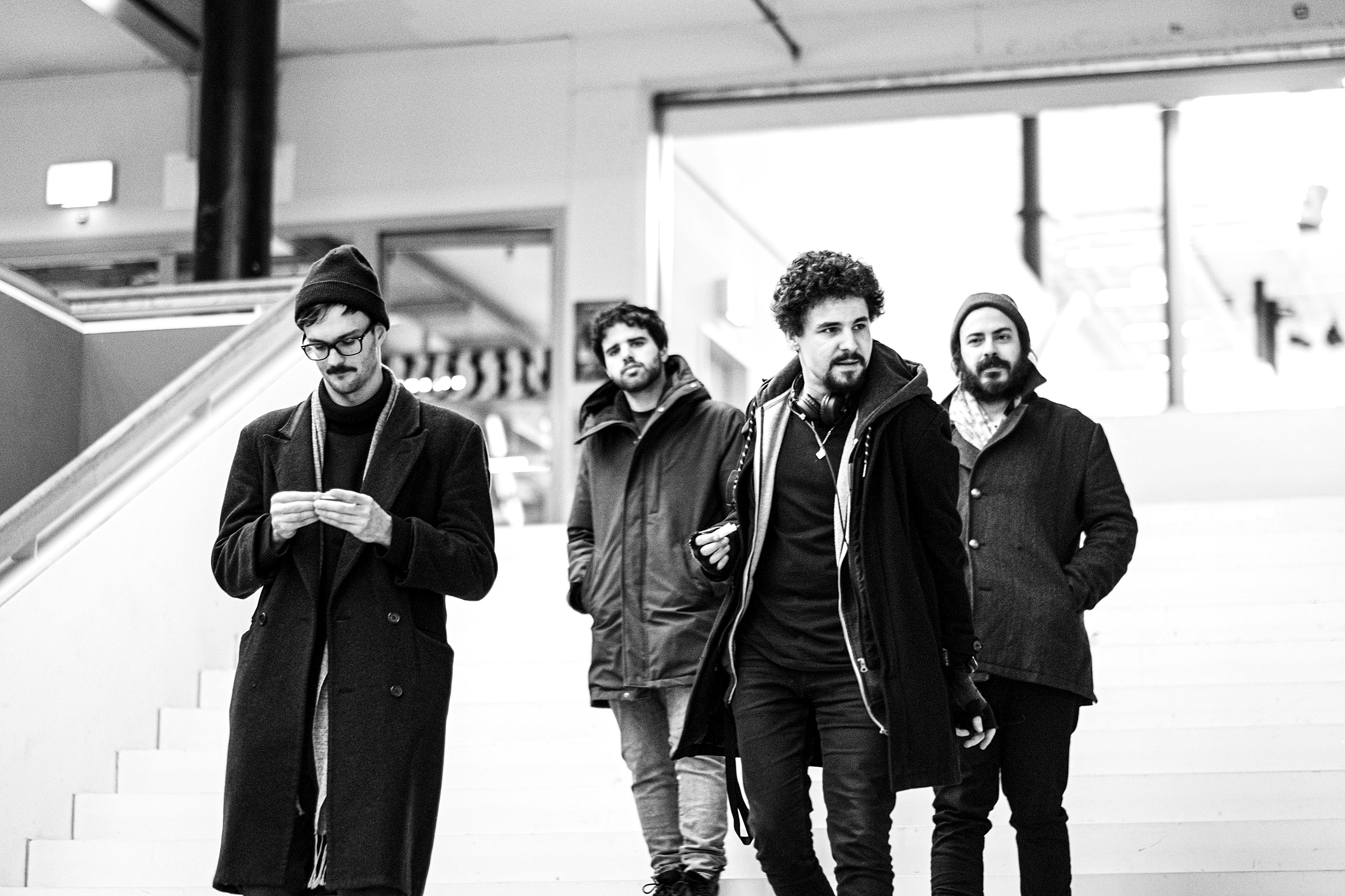
Current Release: Tobias Pfister's band emitime's sophomore album morfosis is out via Unit. It features Santiago Leibson (piano), Santiago Lamisovski (bass), and Samir Böhringer (drums). Tobias also recently released an album with his trio with Noah Punkt and Michael Cina called Playing the Neurodino.
If you enjoyed this Tobias Pfister interview and would like to know more about his music, upcoming live dates and new releases, visit his official homepage. He is also on Instagram.
What were some of the musical experiences which planted a seed for your interest in jazz?
The first time I really came into contact with jazz was when I was about 13 years old. I listened to a lot of punk back then and got into jazz through ska music and, above all, through my music teacher, who was a great inspiration to me as a person.
Then it happened pretty quickly. I found a large selection of jazz CDs in my school's media library and I was obsessed with listening to as many as possible. I listened a lot to Albert Ayler 'Spiritual Unity', John Coltrane 'A Love Supreme', Anthony Braxton and Ornette Coleman in particular.
As a teenager, for me this music meant a personal liberation, also from my environment in the countryside where I grew up. It somehow seemed very urban to me and without then knowing the circumstances and motivations of the musicians, this music had a sort of spiritual character for me.
So I started by listening to live concerts and jam sessions in the city of Zurich and I also started making music with friends.
How do jazz and jazz culture factor into your artistic processes and the music resulting from them?
If I can understand jazz as an approach for collective participation, creation and negotiation in music, and at the same time as a space for individual existences and their expressions and opinions, then that is what I want to do as a music-making artist.
I prefer to work in collective processes, where people can create and develop something together according to their skills and with their history. In processes where individuals can co-exist and dissolve into a unique fusion.
Jazz was about a lot more than just music in the 60s and 70s, from politics to fashion. For you personally, is jazz still a way of life – and if so, in which way?
If jazz can also mean that there is never a finished product, but that the individuals in whatever they do, always keep going, always keep learning, always keep listening, always want to develop further; that they relate what they do to an environment and also actively inspire an environment and strive for change, then I would say that jazz is still a way of life for me personally.
The problem with this definition is perhaps that these characteristics apply to a lot of people who don't make music, or make music that follows other idioms than jazz as an understanding of a musical genre.
I also have to say that the longer I practice music related to jazz, and the more opinions I read, the further away I am from defining jazz for myself. But maybe that's also the point? About moving away from precise and conclusive definitions? Maybe it's about a physicality that knows no definitions translated into language?
Many people perceive jazz as a genre with high barriers of entrance, both for listeners and musicians. What have your own experiences been in this regard?
I can understand why many people think that. Especially if it means trying to reproduce as much of the story as possible and seeing the music from a technical point of view. I think it can be quite overwhelming, because at first glance a lot of things might seem difficult to grasp and perhaps chaos or rawness can also create a distance.
From my perspective, when I came into contact with jazz, I also felt a certain distance. But I somehow was referring this to myself and not to the music. The fact of not feeling familiar with this music made me curious.
The way I remember it, I did not see the music from a technical perspective. Rather, an emotionality, a kind of spirituality or spiritual connection and a power in the rawness and uniqueness spoke to me and encouraged me to spend time making this kind of music.
Derek Bailey defined improvising as the search for material which is endlessly transformable. As of 2024, what kind of materials are particularly stimulating for you?
To be honest, there are a lot of them at the same time, and at the moment they are also very unstructured and the use of materials is very impulsive. At the same time, I am interested in reducing a material to small kernels. A zooming into a material, which abstracts the material and then can be used in different contexts and retains a kind of rawness.
These can be musical parameters, as well as (non-)musical concepts, or personal feelings and experiences that give me materials. I also believe that most materials are almost endlessly transformable.
In 2024, for example, these are individual sounds from field recordings that I work with and that I can recontextualize.
What, would you say, are the key ideas behind your approach to improvisation?
I think it's the things I tried to define above about the term jazz: Collective participation and creation with simultaneous co-existence of different individuals. A non-linearity in which my materials can dissolve as personal statements in a state of chaos.
And I often try to perceive time not as a linear timeline. I try to see time more as a sphere that is not fixed, but very flexible in all directions, and where It’s boundaries are permeable.
How would you describe your relationship with your instrument – is it an extension of your self/body, a partner and companion, a creative catalyst, a challenge to be overcome, something else entirely?
I would say everything of this applies and is very phase-dependent. I would definitely not describe my relationship with my first instrument, the saxophone, as an unconditional love affair. But I am somehow constantly renegotiating the relationship and working on it.
My relations to other instruments that I play are somewhat less charged. The relations are rather new, which I sometimes really appreciate and find exciting. But what happens to me with all instruments is that their characteristics inspire and surprise me again and again.
What are currently direction in jazz or jazz-adjacent communities which you personally find interesting?
For me, directions that allow and seek cross-genre works and collaborations are what I find the most exciting. I think it's great to see that there are many such communities and initiatives. The labels 'Mexican Summer' or 'Stone Pixels' come to mind when I think of names.
The most interesting directions for me are those who expand boundaries in jazz and can deal with topicality in a natural way, and have the quality to reach a diverse audience.
For many artists, life-changing musical experiences take place live. How do you see that yourself?
I definitely agree with that. Whether it's me as a listener on stage, as a listener in the audience, my own listener in my body, or me as a performer on stage: I can gain a lot of experience everywhere where music take place live.
Basically, I see experiences that I can gain in encounters with other people as very important in my work. The experiences with an audience, with artists with whom I perform, or with the people (organizers, curators, helpers, people at the bar, etc.) who make live settings possible.
Sometimes these live experiences even create a fundamental feeling of connection and an openness with which I can go out into my environment.
There are various models to support jazz artists, from financial help to mentorships/masterclasses. Which of these feel like the best way forward to you?
I think that masterclasses and mentorships are a good way to support artists. I see the direct passing on and the transport of experience and knowledge as the most important thing. Whether it's a mentorship organized from an institution, or passing on knowledge in a personal environment and learning from friends or acquaintances.
In general, I find it very important to share your artistic practice and artistic processes with others and to exchange ideas.
To be able to do all this, of course you need to have some money to live. So, helping artists financially, also facilitates an exchange and knowledge transfer.
Are there approaches, artists, festivals, labels, spaces or anyone/-thing else out there who you feel deserve a shout out for taking jazz into the future?
There are so many interesting communities, artists, labels and spaces. One space that comes in my mind, is the scene around Cafe OTO in London, which has inspired and moved me and many people around me for a long time.
Or the label 'Mexican Summer', which the artist L'Rain works with, for example.
The Montreux Festival intends to preserve its archive of recordings for future generations. Do you personally feels it's important that everything should remain available forever - or is there something to be said for letting beautiful moments pass and linger in the memories of those that experienced them?
I think it is important to preserve art and to remember various works and artists. But I also see a difficulty in the fact that so many good things happen, that it’s impossible to preserve everything.
This raises the important question of who decides who or what is given a spotlight. In other words, who people remember and who is forgotten and remains hidden. I hope that the people and institutions that are doing this work, always think about it and that it will be negotiated and questioned again and again, who gets spotlight.
But of course I think that beautiful moments can also pass and that the people who experienced these moments keep them in their memories. Especially in performative arts, a documentary cannot be an exact reflection of a moment.
But whether such moments are retold in sound, images, through oral narratives or through artistic negotiations, I think it's important that we can learn from the past as well as from the present.