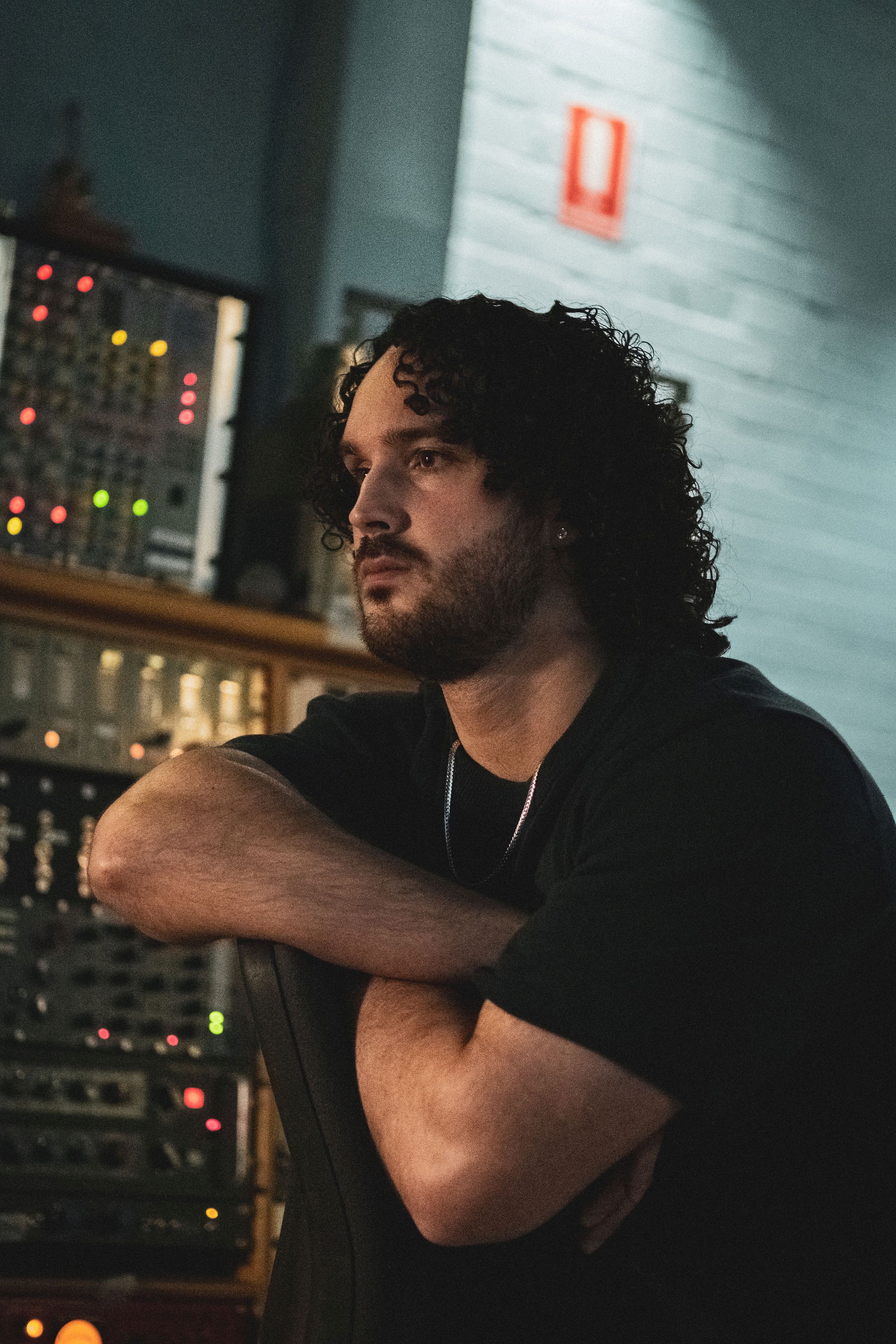
Published
Name: Tom Avgenicos
Nationality: Australian
Occupation: Trumpeter, composer, music-maker
Recent release: Tom Avgenicos's Ghosts Between Streams, featuring Delay 45 and the Ensemble Apex, is out via Earshift.
Global recommendation: I live in Muloobinba (First Nations place name for so-called Newcastle) which is about two hours north of Sydney. It has some of the world’s most beautiful beaches (way better than Sydney’s in my opinion), it’s an amazing place to live and visit.
If you enjoyed this Tom Avgenicos interview and would like to stay up to date with his music, visit his official website. He is also on Instagram.
The borders between producers, sound artists, and even songwriters are becoming increasingly blurry. What does being a composer mean today, would you say?
For me, I’ve never considered the songwriting, performing and production of my work to be separate things. It’s all part of the same process.
As a jazz performer-composer, this means being involved in every aspect of the creative process, from making your own sounds on DAWs, songwriting and arranging, booking musicians, organising rehearsals, performances, recording sessions, all the way to release. The key is getting some help on the way from people you trust whilst maintaining creative control.
I think many independent artists/composers try and do everything themselves which means they can neglect collaborative opportunities with people who are probably a lot better at certain elements of the creative process than the artist themselves. The last few years I have built up a creative team of multidisciplinary artists who I can lean on and trust throughout the creative process. Ultimately, this has the greatest creative outcome whilst also lightening the load a little bit …
For example in Ghosts Between Streams there are many complex moving parts, but I have total trust in the musicians I work with to make the best musical decisions, such as my jazz quartet Delay 45, and the string quartet Ensemble Apex who can function both independently and as part of a larger ensemble.
Many people perceive classical music and contemporary composition as having high barriers of entrance, both for listeners and musicians. What have your own experiences been in this regard?
Recently, myself and a few of my peers have been thinking a lot about this perceived barrier. My view is, with people going out less and the rising cost of living, a transactional dynamic has emerged between audiences and performers: audiences expect a transcendent experience as a measure of “value for money,” while artists expect audiences to pay their hard-earned cash, sit in silence for over an hour and “listen to my shit” ...
As a sort of experiment, at the 2024 Sydney Fringe Festival, we aimed to disrupt this dynamic in a site-specific performance of Ghosts Between Streams, performed in the carpark of Sub Base Platypus, a former torpedo factory overlooking Sydney’s iconic harbour and also just a few kilometres away from Stringybark Creek, the genesis of the work.
We set up a few delay speakers–one up the back, one facing out into the harbour and another out into the precinct, and we had dancers moving through the audience and interacting with the site's industrial objects. The aim was to invite the audience to wander around and engage with the work on their own terms, and for them to be a part of the performance as much as we were.
The performance won two best-in-festival genre awards for Best in Music and Best in Dance, so I guess you could say it was a successful experiment!
Where do most of your inspirations to create come from – rather from internal impulses or external ones? Which current social / political / ecological or other developments make you feel like you need to respond as an artist?
My response to environmental issues has become a huge part of my creative practice. My own local environmental concerns serve as a microcosm for environmental issues globally, which I aim to raise awareness of through my work. Ghosts Between Streams is based on my observations of environmental destruction at Stringybark, caused by overpopulation and overdevelopment.
In this work, the environmental impact is both the subject and the work itself (through field recordings), as well as my response to the changes at Stringybark, observed during my daily walks over two years. This local experience reflects a global issue. Through my work, I hope to generate discussion and awareness of these challenges.
Music has become a lot more global, and incorporating elements from other parts of the world or the musical spectrum is commonplace. Do you still think there are city scenes with a distinct, unique sound? How does your local scene influence your work?
For sure. My experience travelling and interacting with musicians across the world is that each scene is different, and there are even scenes within scenes too!
My local scene heavily influences my work, and I think being isolated from much of the world here in Australia is in some ways an advantage as it allows you to hone into something niche, free from a lot of the external influences.
As a result, a lot of musicians from Sydney have some of the most incredible and individual artistic voices (for e.g. The Necks, Simon Barker, Phil Slater, Laurence Pike).
[Read our The Necks interview]
[Read our creative profile of The Necks]
Of course, the global music scene undeniably influences individual artists, no matter where you live in 2025.
However, my deep love for the musicians in my local scene and the creative environment they have cultivated continues to nourish me–it’s probably the main reason why I haven’t moved overseas.
What role do electronic tools and instruments play for your creative process?
FX pedals, DAWs and field recordings have played an important part in the creation of Ghosts Between Streams.
In past projects, electronics FX have been a bit of an afterthought, but for this project, electronics were central to creating a deep, genre-bending soundscape from the very beginning.
What does your creative space / studio look like and what tools does it contain?
I live in a converted warehouse space, so my kitchen, living room and studio space are all one! It keeps things fun, I feel like I can go and do work whenever without locking myself in a dark room for hours. My desk is a hood of a big old jeep (the lights still work) which is large enough to chuck all my gear onto, which I like.
I’m not super techy, I especially like things being tactile, so I’ve got a basic mic and interface setup I use to record into and I use FX pedals, sampler, and a keyboard. Not too much laptop stuff … I’d eventually like to get a nice piano and start hosting some gigs!
It is my impression that adding a conceptual, non-musical dimension to one's work is almost a prerequisite for commissions and grants. How do you view this tendency and how “conceptual” is your own approach to writing?
Yeah, maybe. Much of the work that gets funded isn’t always the most genuine as I think a lot of artists reverse-engineer their projects …
Having said that, I’ve never been on a panel, so I don’t know … At least in Australia, I do know that most grants are panelled by respected peers in the scene so I think they are still looking for a level of skill and artistic excellence, not just whoever can bullshit the best “story”. They are not easily fooled, so the ideas and creativity still need to be genuine and viable.
I would say that we do need to find ways to connect with our audience, so if framing it through a conceptual lens helps then I think that’s great. Sometimes an extramusical idea is what’s needed to get the creative ball rolling in terms of the actual song-writing process.
For me, I felt passionate about a local issue that was trending globally, and collecting field recordings on my walks got the whole compositional process going … So for me, the project was genuine and I really wanted to do it and I was lucky to get some funding through the Freedman Fellowship to make the whole thing possible …
On the other hand, I recently recorded another new album with my quartet Delay 45 which has no non-musical dimension, just pure music-making. I’m really stoked with how it’s turned out but it will be interesting to see how people respond to it when it gets released (probably sometime next year).
Working with long forms, complex concepts or new vocabulary is potentially more challenging today because they require us to remember things that happened perhaps minutes ago – while most of us are finding it hard to focus even on what's happening right now. Both as a composer and as a listener yourself, how do you deal with this?
Just this week, while teaching a class at the Sydney Conservatorium of Music, a student brought in a wonderful conceptual piece that incorporated several “memory states.” Performers had to recall an improvised cell they had played earlier in the piece, with composed figures triggering the return of a specific memory state. It was a fascinating idea but incredibly challenging in practice—we all struggled to remember what we had played earlier!
As a composer, patience is something I struggle with and constantly try to be mindful of. As a listener, however, I’m surprisingly patient. I love slowly evolving pieces, the gradual emergence of materials and ideas, and immersive listening experiences.
I know many artists who carefully consider how to set up a performance environment that encourages deep listening to long-form works—through elements like low lighting, pillows on the floor, and a relaxed ambience—to help audiences get into the right headspace.
For many artists, life-changing musical experiences take place live. Few works these days, however, are performed beyond their premiere. What, do you feel, does this mean for composers, and the music they write, and how does this reality influence your own work?
Often, a perfect storm of circumstances allows a work to be performed only once—in a particular time, space, and with a particular group of musicians.
I certainly felt this was the case with Ghosts Between Streams at the Sydney Fringe Festival. While it wasn’t the premiere, that iteration was so unique and site-specific that I don’t think it could ever be fully re-created—it would always have to evolve into something new.
Personally, I’m not attached to a fixed version of a work. I see my music as continually evolving, shaped by past performances, the musicians involved, the performance space, and the audience. There is no “perfect” version—only different interpretations.
How, would you say are live performances of your music and your recording projects connected at the moment? How do they mutually influence and feed off each other?
Well, Ghosts Between Streams is a live album, yet listening to the recording and experiencing the performance feel like entirely different things. Many people who attended the concert and later bought the album didn’t even realise it was the same performance!
Whether that’s good or bad, I’m not sure, but the point is they exist as distinct experiences. Albums serve as documents and artefacts, developing a life of their own in a way that live performances cannot, whilst live performance is a dynamic experience, shaped by the space, energy, and audience in real time.
To some, the advent of AI and “intelligent” composing tools offers potential for machines to contribute to the creative process. What are your hopes, fears, expectations and possible concrete plans in this regard?
If you asked me about this last year I would have had a more positive answer, I thought it was great and incredibly helpful. Now, I am deeply worried about AI as it is literally destroying our ability to think critically.
Sure there are positives, especially in terms of workload, but we’ve been fine without it for years. I think it's incredibly dangerous because of its accessibility, lack of regulation and our over-reliance.
The environmental impact of power-hungry AI servers is also ridiculous. If I had it my way I’d blow the whole thing up, we don’t need it.
Are there approaches, artists, festivals, labels, spaces or anyone/-thing else out there who you feel deserve a shout out for taking composition into the future?
So many artists are doing amazing things right now in Australia, let alone the rest of the world.
Shoutout to bassist Helen Svoboda, drummer Chloe Kim, trumpeter/producer Reuben Lewis to name a few. Simon Barker, Scott Tinkler, Phil Slater, Matt McMahon for decades of pioneering virtuosic and artistic excellence.
[Read our Helen Svoboda interview]
[Read our PANGHALINA (featuring Heleven Svoboda) interview]
Globally, I am particularly inspired by what Steve Lehmann, Peter Evans and Kit Downes are doing.
Shoutout to Phoenix Central Park in Sydney for presenting free gigs with no commercial agenda while ensuring artists are paid. Same to Laurence Pike and Clayton Thomas for the Inner West Jazz Fest which is for the community. And to Earshift Music for consistently championing forward-thinking music.