Published
Name: Erwan Keravec
Nationality: Scottish
Occupation: Composer, improviser, performer, bagpipe player
Current release: Erwan Keravec's new album Whitewater is out via Ici d’ailleurs.
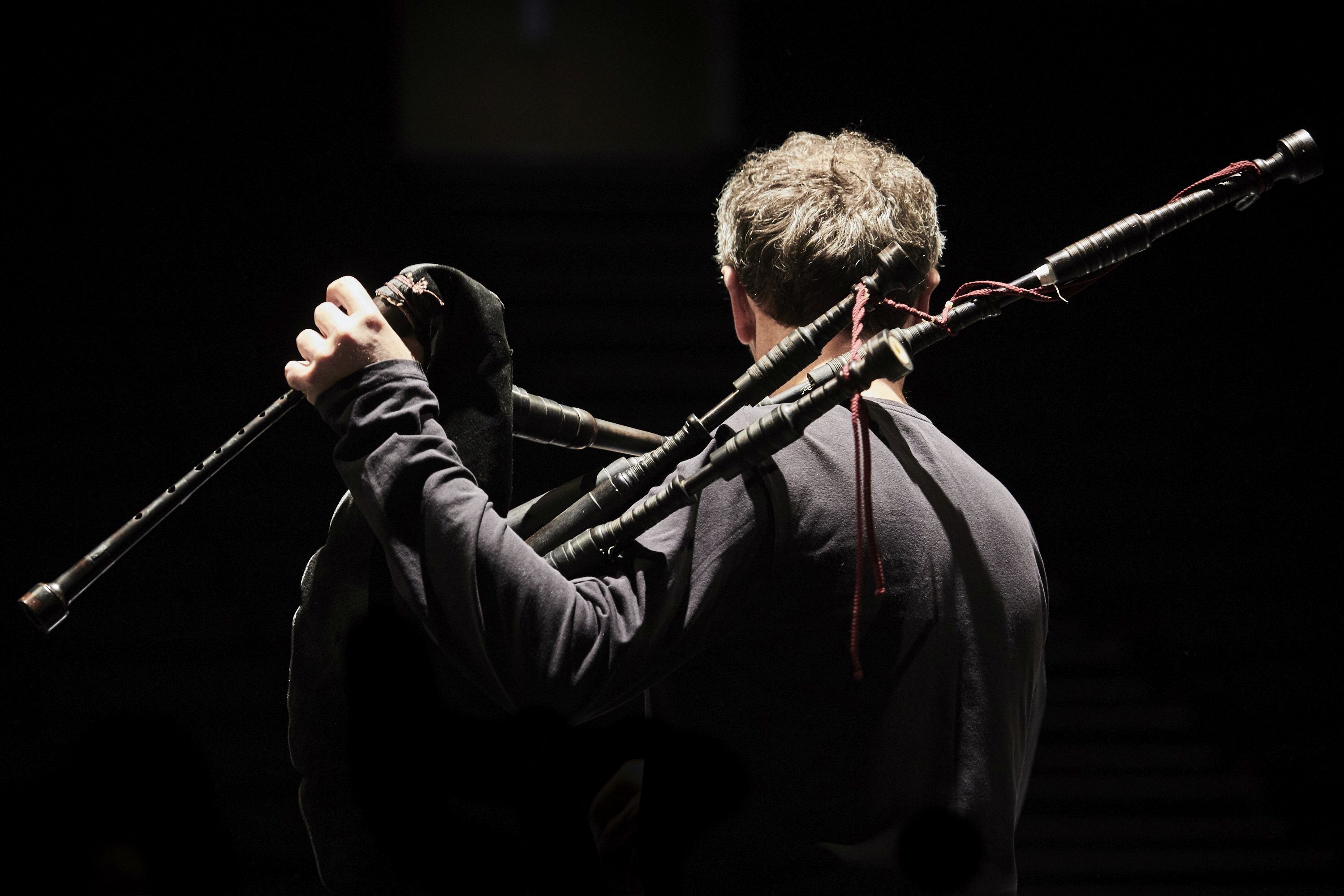
Tool of Creation: The Bagpipes
Type of Tool: Woodwind instrument
Country of origin: Middle East
Became available: 400 BCE
If you enjoyed this Erwan Keravec interview and would like to stay up to date with his music, visit his official homepage. He is also on Facebook.
What was your first encounter with the bagpipes? What was it about them that drew you in?
I didn’t really have a “first” encounter with the instrument. I grew up in a family that was involved in traditional music associations.
The bagpipes have always been there!
Just like any other instrument, the bagpipes have a rich history. What are some of the key points from this history for you personally?
A particular moment was when the Bretons imported the Scottish bagpipes into Brittany. Here, the way it’s played is very different from how it’s played elsewhere in the world.
Breton musicians brought it over so they could perform our traditional repertoire, which is very different from the Scottish one.
What, to you, are some of the most interesting bagpipe recordings and performances by other artists in terms of your personal development?
When we talk about bagpipes, we’re really talking about a family of bag instruments — an air reservoir that allows the musician to produce a continuous sound.
There are a lot of different types of bagpipes across Europe, North Africa, and even as far as Iran. Some have drones, others only chanter (the melodic pipe), or 2 chanters …
So, for me, some of the most interesting recordings might come from Brittany — such as those by Jorj Botuha and Pascal Guingo — or from Iran, with Saied Shanbehzadeh.
Further away from traditional music, there are of course the incredible improvisations of Rufus Harley with Sonny Rollins or John Arvanitas.
What are some of the stand-out features of the bagpipes from your point of view? How would you describe its sonic potential?
The continuity of sound and the drones are key features.
The drones create a sonic envelope within which the chanter evolves. This makes it possible to play with relationships of tension and release between the two.
And, of course, it’s possible to transform the envelope.
Instrument design is an ongoing process. Are you interested in recent developments for the bagpipes in this respect?
A few years ago, I decided to work with an instrument that anyone can buy. My bagpipe is completely “standard.”
What makes it unique is not its setup, but the music I decided to play. This allows me to remain connected to the lineage of traditional pipers.
Tell me about the process of learning to play the instrument and your own explorations with it.
I learned to play the bagpipes through traditional music, mainly Breton, but also Scottish.
When I met jazz musicians, I started getting interested in improvisation. To do that, I had to rethink how I hold and play the bagpipes, moving away from the “lead” role it’s often given. I had to find new ways to play.
When you improvise with someone, you can’t just play loudly all the time — otherwise, there’s no space for the other person. So, I worked on a whole range of extended technics that allow me to approach the instrument in various dynamic situations.
These extended techniques product new sounds I worked as a new vocabulary to create music.
What are some of the specific challenges in terms of playing the bagpipes?
People often say the instrument is limited because it’s diatonic and loud. The challenge is to think of it as infinite …
How would you describe your personal style of playing the bagpipes?
I try to move the instrument into new spaces and different playing situations.
It’s not a rejection of traditional music, but rather a way to expand what’s possible.
If I wanted to start learning to play the bagpipes as well, what would be some of your recommendations?
I’d say: take lessons — don’t start alone. It’s too easy to pick up bad habits.
And then, try to subvert what you’ve learned …
What interests you about the bagpipes in terms of how it contributes to your creative ideals? How do you see the relationship between your instrument and the music you make?
I don’t really ask myself that question.
I started playing the bagpipes very young. It’s my means of expression. So it evolves and changes with me.
For Whitewater, what did you start with? What role did the bagpipes play in it?
For a long time, I searched for new ways of playing, using sounds that are usually hidden.
For Whitewater, I wanted to return to a more stripped-down instrument. Everything happens through fingerwork — using combinations of ornaments and changes in density that transform the instrument’s texture and can make it sound like an organ or a modular synth.
I also wanted to imagine the music as a spiral, starting from a calm state and building into wild acceleration.
When performing live or in the studio, how do the bagpipes interact with other instruments?
It all depends on the partner!
With the voice, there’s something magical that tends to humanize the instrument and animalize the human voice. With a saxophone, it’s a clash of timbres.
With other pipers, like bombard players, it’s a natural combination.
The bagpipes can be an accompanying instrument, but also a lead instrument. Insofar as it’s possible to generalize, what changes in terms of composition or performance in these situations?
The bagpipes are, above all, a lead instrument. Historically, it’s a soloist’s instrument!
But what really needs to change are the textures and the sound envelopes — that’s where you can discover a new way of perceiving the instrument.
What makes the bagpipes sound great on record and in a live setting? How did you approach that for your new release?
For recording, my sound engineer, Manu Le Duigou, used a Decca Tree setup. I wanted an album with no editing — each track recorded in a single take.
This recording method respects the instrument and the natural sound of the studio. There’s no electronic processing at all. Our aim was to be as close as possible of the sound of the bagpipe.
Are there other bagpipe players whose work with the instrument you find inspiring? What do you appreciate about their approach?
There aren’t many examples of new music with the bagpipes.
But I really love the work of Yoshi Wada from the US and David Watson from New Zealand.
They’ve found new and beautiful sounds.