Published
Name: Richard Poher
Nationality: French
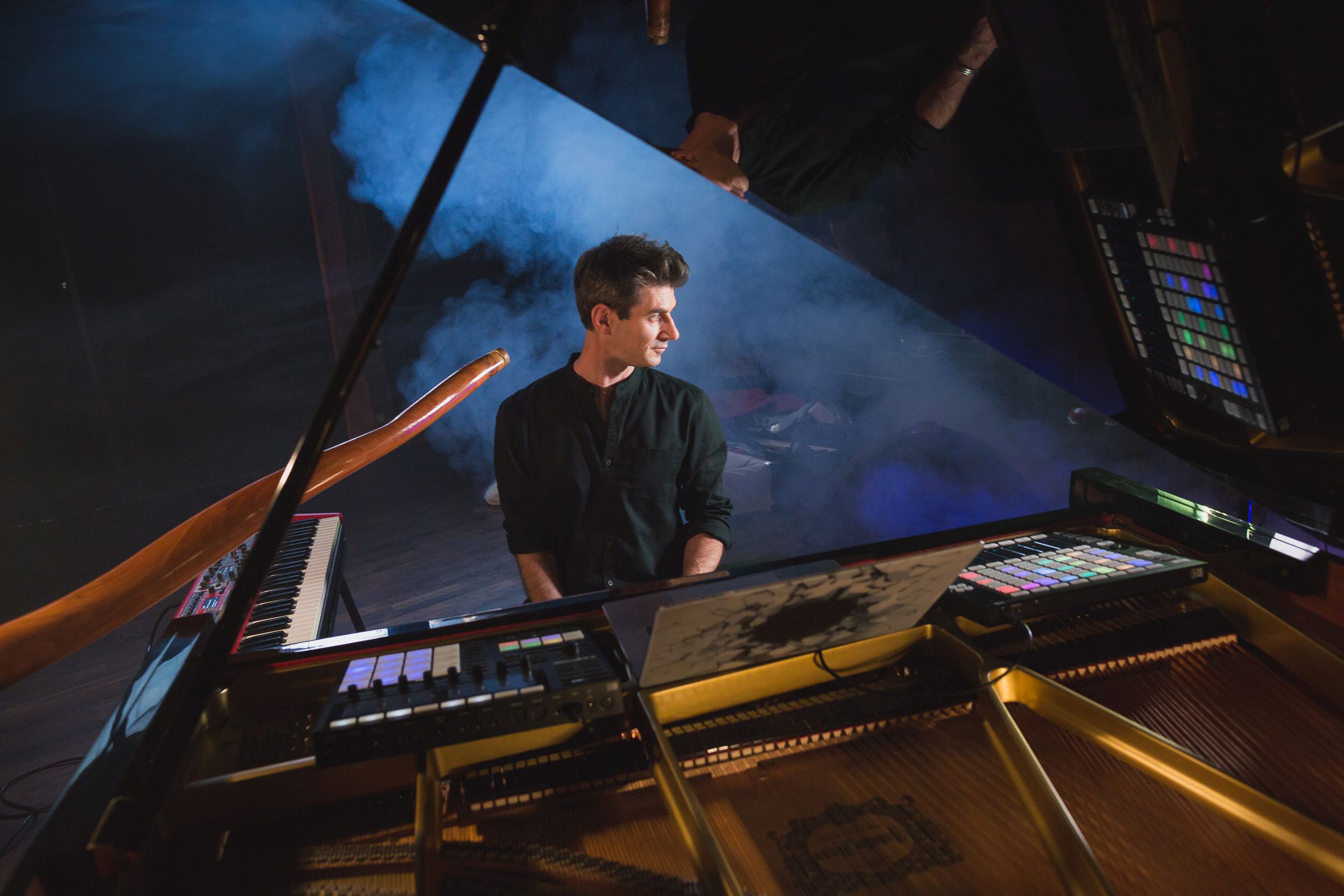
Occupation: Composer, improviser, pianist, didgeridoo player
Current release: Richard Poher's debut album Constellations is out via Live Arts.
Tool of Creation: The didgeridoo
Type of Tool: Wind instrument
Country of origin: Northern Australia
Became available: around the year 1,000
If you enjoyed this Richard Poher interview and would like to know more about his music, visit his official homepage. He is also on Instagram, and Facebook.
What was your first encounter with the didgeridoo? What was it about it that drew you in?
I was told by a friend: “Oh Richard, do you know the didgeridoo? It's super easy, you just neigh into it like a horse and it works!!”
Funny her!! But I believed her, it was my first connection to the instrument.
Just like any other instrument, the didgeridoo has a rich history. What are some of the key points from this history for you personally?
Very true. Well for me, it symbolises the “basis”. The instrument is so simple: it's a tube. And you can do so much with it: rhythms, polyrythms, melodies, textures …
It also speaks to us about the reason for making music, be they spiritual goals or entertainment. It was offered by nature (people don't build them initially). And it comes with this extraordinary circular breathing technique.
What, to you, are some of the most interesting didgeridoo recordings and -performances by other artists in terms of your personal development?
I really love Ondrey Smeykal (solo II), …
… Gauthier Aubé (renaissance), …
... Zalem (Holodidg).
I can't recall the name of Ash Dargan's one, although I really listened to it a lot. They have their own style, offering different features and point of view of this instrument.
What are some of the stand-out features of the didgeridoo from your point of view? How would you describe its sonic potential?
The didgeridoo provides textures. For me, it's the first synthesizer in the universe: Rhythm, polyrhythm, melodies and poly melodies - they can all be combined.
I don't explore this part much on my first album because the choices didn't lead me in this direction. You can't use the melodic potential like you usually would, because there's this drone - it's a challenge.
Overall, the main thing we feel live is the vibration. A low note is not just a low note. When played wiith a didgeridoo, it brings so many different things. People come and see me to witness a physical experience.
So the didg brings an “intelectual” approach as well as a spiritual approach, connecting us to the earth, to our roots.
Instrument design is an ongoing process. Are you interested in recent developments for the didgeridoo in this respect?
Definitely!! I have built so many myself!! I tried so many different shapes!
I finally asked a professional and worked with him to achieve the exact sound I wanted. We shaped my woodslide with Jean Yves Redor! I chose the wood as well (eucalyptus for the first third of it), and it sounds great, really! Using a larger or narrower air column makes such a difference!
I also look into the work of HexSpira, Ujazi, and Didgelement - they're doing a great job!
Tell me about the process of learning to play the instrument and your own explorations with it.
Well, it's about exploring a lot. What also really helps is to meet good players that play directly in front of you. Mirror neurons are great!! Players will also give you tips! I had the chance to meet Zalem and some of his friends!
Then there is the aspect of the gestures and movements that your body doesn't know yet. You need to work on these very slowly and repeat them a lot.
It takes time to get to the stage where you're playing properly. And the work continues by finding where and how you can place this new “style” in your music. So the road can be both short and long and that's what's great about it!
What are specific challenges in terms of playing the didgeridoo?
It really depends on you: You can choose them!
I chose the challenge of producing “new” music with it, with my classical and jazz background, mixing it with the piano. My second challenge is to play both instruments simultaneously.
Another challenge is to find my own grooves and way of playing. But actually this isn't something you really choose, because there are some gestures your body is comfortable with, and others it isn't.
So we all work to get better but we also see that different players have different abilities.
How would you describe your personal style of playing the didgeridoo?
Intuitive! Even if I work my technique and try to understand stuff about playing the didg, I find that what works for me is what feels natural.
As a teacher (I teach piano and music) I love to analyse and work “music materials.” But when I express myself, the natural gestures comes back!
If I wanted to start learning to play the didgeridoo as well – what would be some of your recommendations?
First of all, get a didg, or a tube, even a PVC tube! Then get a sound out of it. After that, I would suggest you do circular breathing (I takes me 14 seconds to make anyone do it).
Then I should ask you what you are seeking with this instrument and music, which will orientate your practices. Finally I would recommend you to meet people, to watch videos.
What interests you about the didgeridoo in terms of it contributing to your creative ideals? How do you see the relationship between your instrument and the music you make?
Very good question!
So the didg is not very known and used in occidental music, and even more in ”savant occidental music” so there's a whole field to be explored. The relationship between both instruments has to be thought about, imagined, created. It really is opening up a new field.
So the relation between the instrument and the music I make is very narrow. Also, placing the didgeridoo next to the piano provides boundaries that are the essence of creativity.
The symbolism it brings is important to me as well: spiritual relationships, trance music, trying to make different times of the world meet, connecting what is not supposed to be connected ...
For your latest project, what did you start with? What role did the didgeridoo play in it?
It all started with a residency where I had a piano, keys, didgeridoos and a computer. I wanted to bring something different but touch a wider public. So the didg was central in this project.
I searched for new music for the didgeridoo which is often played with handpan and jew's harps (which I love). So the didg had a role of founding an “art proposal“ that stands out.
When performing live or in the studio, how does the didgeridoo interact with other instruments?
I improvise a lot, and then, listening, I choose if it accompanies or leads.
If I'm playing with other musicians that don't know the didg, it can be complicated because they don't know what to do with this sound and the playing. The role should be very clear for everyone, as should shaping the sound (playing the didg, you can enhance harmonics or the drone, or anything else).
The didgeridoo can be an accompanying instrument, but is can also be the lead instrument. In as far as it is possible to generalise, what do you think changes in terms of the composition or overall performance in these situations?
That was one of the big deals of this album: getting the right balance between the role given to the instruments. I did want the didgeridoo to take on both roles and even take on a role in the background.
So thinking this way means you need to have an idea of how you imagine the didg as a lead and what, exactly, its role might be (textural, rythmic, melodic?) - and how you get to that lead role, compared to the other instruments?
It's a reflection on these roles and on how to concretise them (rythmic solo, like a drum for instance) which leads to a choice of technique.
What makes the didgeridoo sound great on record and in a live setting? How did you approach that for your new release?
First of all, I searched for the instrument I could make an album with for a really long time. I was looking for a very specific type of sound.
Afterwards, the recording is crucial: The placing of the microphone will make a huge difference! Then the mixing is hugely important. I had the chance to have a very clever sound engineer, Nicolas Signat, who imediately understood my goal.
Live, the raw sound has an effect so it's very different. On the recording, the balance must be very precise, otherwise the ear doesn't understand the right thing: the didg can either take over or disappear.
Are there other didgeridoo players whose work with their instrument you find inspiring? What do you appreciate about their take on it?
Of course, I'm fascinated by the variety this instrument can provide: all the different styles that exist is mindblowing: it's just a tube!!! So it shows how creative humans can be.
It also shows each player's personality, and the difference humans have are so rich and complementary. Ash Dargan, Ondrej Smeykal, Zalem, Kelu, Adèle, Colas, and others ... I learn by listening to them.