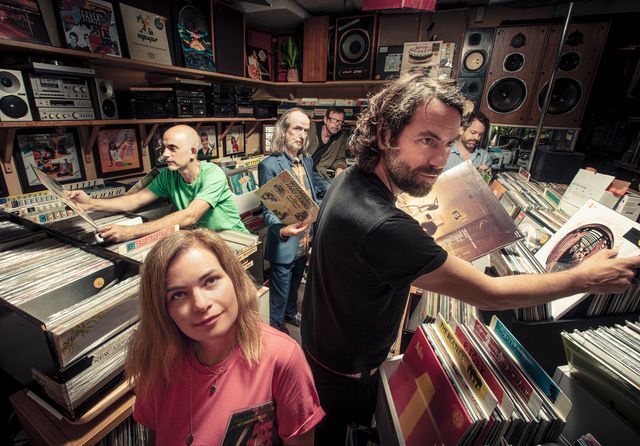
Published
Name: Tunng
Members: Ashley Bates, Sam Genders, Becky Jacobs, Mike Lindsay, Martin Smith, Phil Winter
Interviewee: Sam Genders
Nationality: British
Current release: Tunng's new album Love You All Over Again is out via Full Time Hobby.
Recommendations: Book - The Joy of Living by Yongey Minghur Rinpoche; Song - The Orange by Anna B Savage
If you enjoyed this Tunng interview and would like to know more about the band and their music, visit their official homepage. They are also on Instagram, and bandcamp.
Where does the impulse to create something come from for you? What role do often-quoted sources of inspiration like dreams, other forms of art, personal relationships, politics etc play?
I think it's just how I'm made. Songwriting is one of my ways of processing life. And the impulse to do it feels built in somehow.
All those sources of inspiration are interesting to me, personal relationships especially, but also bigger questions - Why are we here? What is consciousness? An interest in polarity - dark vs light and fantastical vs mundane as they appear in our experience.
But really I just do it because I love it.
For you to get started, do there need to be concrete ideas – or what some have called a visualisation of the finished work? What does the balance between planning and chance look like for you?
It depends on the project - For Tunng and especially for Love You All Over Again, the lyrics and melodies were written almost entirely in a stream on consciousness type way over four days in Mike's studio in Margate.
We'd decided that this album would be inspired by early Tunng so we had a kind of idea that there would be themes … nature, darkness, light, joy, everyday life, fantastical strangeness, a kind of way of describing the world that is inspired by certain English folk mythology. The world of the Wicker Man.
Some of the lyrics are also inspired by personal questions I have to do with consciousness and perception. I'm very interested in the idea of present moment experience as the primary reality of life as opposed to the conceptual thinking that seems to be running the show but often leads us into trouble.
But in a way I'm thinking backwards and trying to work out and explain to you why the words that popped out in the studio popped out ... in reality we just sat down and had fun. I sang words to Mike and we chose our favourites.
Is there a preparation phase for your process? Do you require your tools to be laid out in a particular way, for example, do you need to do research or create?
Well in the case of this record the preparation for my lyric and melody writing was mostly listening to seven or eight musical backing tracks written by Mike and Phil ... When I got to the studio those were the starting points and over four days we added lyrics, melodies, new sections and musical parts and then in the following weeks Ashley, Martin and Becky added their own voices and arrangements.
So I didn't really prepare … other than having been a part of the band for so many years and understanding to some extent what makes a Tunng record tick .... actually, if you want to make a Tunng album, being part of Tunng for 20 years is quite good preparation!
For the last album (Dead Club - an album about death and grief) I did loads of prep - reading, films, interviews etc and it was a brilliant way to work ... but different.
Those songs had quite clear meanings and intentions. There's more mystery in these lyrics. I like that.
Do you have certain rituals to get you into the right mindset for creating? What role do certain foods or stimulants like coffee, lighting, scents, exercise or reading poetry play?
No ... But being in a studio with a nice atmosphere helps ... a little coffee helps if I'm careful not to overdo it … I tend to write better when I'm well slept, healthy, exercised etc … I think being with inspiring people helps most of all and that's one of the great things about being in a band.
My songwriting relationship with Mike is especially easy and productive. I think mainly because we like each other's ideas but have slightly different skill sets.
What do you start with? And, to quote a question by the great Bruce Duffie: When you come up with a musical idea, have you created the idea or have you discovered the idea?
Anything! Anywhere! And it can work both ways.
But often the best ideas feel like they already existed and you just discovered them somehow … as if they were beamed into your mind.
When do the lyrics enter the picture? Where do they come from? Do lyrics need to grow together with the music or can they emerge from a place of their own?
It can work so many ways but when I'm writing for Tunng I'm either writing a song myself in the order of chords, melody, lyrics … or I'm writing a topline over a musical track Mike and/or one of the other band members has written … in which case lyrics and melody kind of come together.
This is the first album I didn't write any ready-made songs for and it's been nice to do it this way. Tunng is always very collaborative and this album especially so.
What makes lyrics good in your opinion? What are your own ambitions and challenges in this regard?
I love that this is really hard to define. You know a good lyric when you hear it but it's hard to pin down what makes them good. Sometimes the simplest stupidest lines are just perfect and at other times people write the cleverest things that really pry your imagination open.
I try and enjoy the process and be inspired. To learn but not get caught up in trying to be something or someone special. I'm lucky to be able to spend time being part of music and lyrics I enjoy.
Ambitions … I try to hold any ambitions lightly and playfully ... (funbitions!) … creativity can get a bit heavy otherwise … especially if you get it mixed up with your self worth somehow … which I try to avoid.
It would be fun to write something as lyrically great as John Grant, Serafina Steer, Anna B Savage. It would be fun to write a simple but amazing pop lyric that people sing at their weddings or in country pub lock ins.
Many writers have claimed that as soon as they enter into the process, certain aspects of the narrative are out of their hands. Do you like to keep strict control or is there a sense of following things where they lead you?
I just want to be part of music I like. Anything else is negotiable.
Often, while writing, new ideas and alternative roads will open themselves up, pulling and pushing the creator in a different direction. Does this happen to you, too, and how do you deal with it? What do you do with these ideas?
Being in Tunng is great because there's lots of scope for including a wide range of ideas and styles in the music. Largely because Mike's production and the band's arrangements are so distinctively Tunng that it creates a lot of freedom in the writing.
But other than that … side projects!
There are many descriptions of the creative state. How would you describe it for you personally? Is there an element of spirituality to what you do?
The creative state of flow and the spiritual state of aware presence are I think essentially the same thing.
They both have that timeless and (in a simple way) joyful quality.
When you're in the studio to record a piece, how important is the actual performance and the moment of performing the song still in an age where so much can be “done and fixed in post?“
Sometimes there are magic moments of performance that you can't really create artificially and sometimes you can totally fake it with gadgets.
I only really care about the ability of the finished product to move me and other people.
Once a piece is finished, how important is it for you to let it lie and evaluate it later on? How much improvement and refinement do you personally allow until you're satisfied with a piece? What does this process look like in practise?
Yes … yes let it lie a little and evaluate it again. I find that the day after is often the big one. If you come back to it after sleeping on it and it's still great … then it's usually great. Sometimes it's a shock how not great it is! Then a week later, and a month later. After that either go for it or move on … or get a trusted collaborator to work on it with you.
Too many revisions by yourself and you can sometimes squeeze the life out of it. It's a dark art though - sometimes many many revisions can really hone a song into something great.
You know what … I don't know! Do what you like!
Even recording a solo song is usually a collaborative process. Tell me about the importance of trust between the participants, personal relationships between musicians and engineers and the freedom to perform and try things – rather than gear, technique or “chops” - for creating a great song.
Chemistry is everything.
Do these people like each other's contributions and are they willing to agree on which contributions end up in the final piece of work? And does that particular constellation of skills and agreements result in a final product that moves people?
What's your take on the role and importance of production, including mixing and mastering for you personally? In terms of what they contribute to a song, what is the balance between the composition and the arrangement (performance)?
They're all very important in their own way. They all have to be done well and with the right flavour for the project.
For Tunng specifically Mike's production is a defining characteristic because his sound is such a beautiful and integral part of what makes Tunng, Tunng.
After finishing a piece or album and releasing something into the world, there can be a sense of emptiness. Can you relate to this – and how do you return to the state of creativity after experiencing it?
I don't experience this too much. I'm so busy with work, projects, being a dad, housework.
I just consider myself lucky to have been part of it and then get the washing up done.
Music is a language, but like any language, it can lead to misunderstandings. In which way has your own work – or perhaps the work of artists you like or admire - been misunderstood? How do you deal with this?
I don't really have a strong example I can think of … other than to say that I think sometimes people get a bit blinded by tribal thinking and end up listening to one kind of music with a certain sound, festival, hat etc and miss a whole world of beautiful brilliant music because they don't want to be suspected of being uncool.
If you notice you like something but don't want to admit it to your friends … tell them! They'll take the piss but they'll respect you more.
Creativity can reach many different corners of our lives. Do you personally feel as though writing a piece of music is inherently different from something like making a great cup of coffee? What do you express through music that you couldn't or wouldn't in more & mundane tasks?
I think the most important things (love/kindness/friendship) probably can be communicated through just about anything.
But for all the other stuff nothing beats a song.