Published
Name: Uli Kempendorff
Nationality: German
Occupation: Composer, improviser, multi-instrumentalist
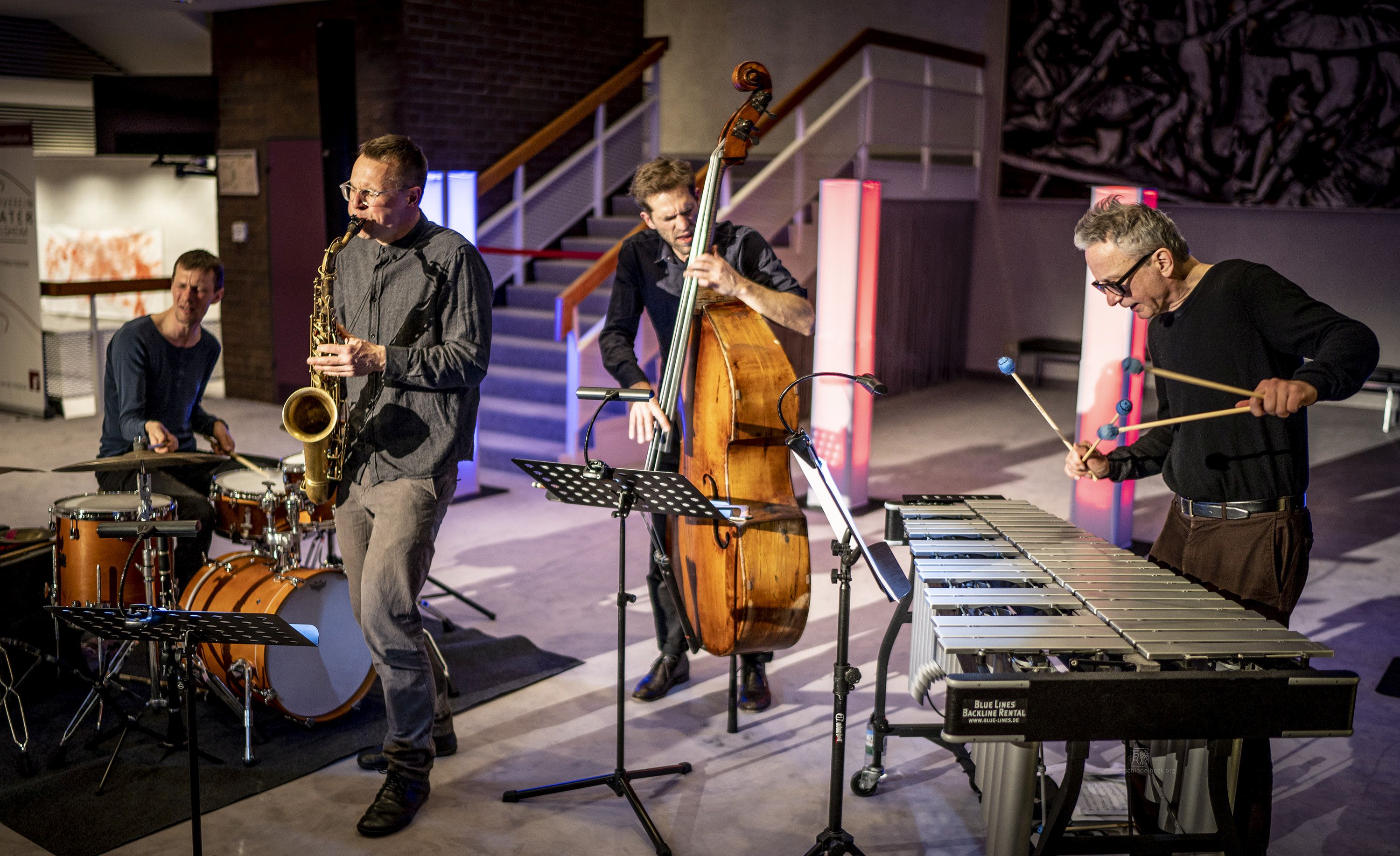
Current release: Uli Kempendorff's new album with his quartet Field, Who Are You Sending This Time? is out via Unit. It features himself on tenor saxophone, Christopher Dell (vibraphone), Jonas Westergaard (double bass), and Peter Bruun (drums).
Recommendation for Berlin, Germany: Best music calendars in Berlin: www.echtzeitmusik.de and field-notes.berlin.
Things I am passionate about but rarely get to talk about: Birds! It makes me sad that a lot of people need a bird app to identify a nightingale. Connect with birds, they are an “in” to your natural surroundings, never mind where you live and can teach you lots of things.
If you enjoyed this Uli Kempendorff interview and would like to know more about his music, visit his official homepage. He is also on Instagram, and Facebook.
When it comes to experiencing strong emotions as as a listener, which albums, performances, and artists come to mind?
I could list whole catalogues by artists but I’ll limit myself to strong first reactions:
Tapes of early Motown Stevie Wonder, endlessly on repeat in my walkman in the car touring orthodox monasteries in Romania in 1987, Bodycount & Ice T, live in Berlin 1994 with my dad.
First listen of John Coltrane’s “Transition”, in the car with fellow tenor player and friend Travis LaPlante, Vermont 1999.
Pierre Boulez' “Sur Incises”, performed by Ensemble Intercontemporain live at Philharmonie Berlin, with Benjamin Weidekamp, ca. 2012. Steve Lacy Trio, live at the Iron Horse in Northampton, MA, with Manon Kahle, 2001. Tobias Delius Trio with Christian Lillinger, Café Niesen Berlin ca. 2009. Urs Leimgruber and Alex Huber, live at Willisau Jazz Festival in 2014.
There can be many different kinds of emotions in art – soft, harsh, healing, aggressive, uplifting and many more. Which do you tend to feel drawn to most?
Conflicting ones, multitudes of them :)
I have to say that for me,“Emotions” in music is somewhat of a loaded subject for me and can be a tricky and quickly contaminated field. Music as (primarily) a carrier for emotions has been so commodified, that in the music I play and write I prefer to stay out of the way of prescribed, preconceived and or re-creatable emotions. I don’t think about them or plan them at all.
At best, this music is communicative, flexible and explorative and should be a vehicle for all of that on stage. It’s not that I don’t want the audience to have an emotional reaction or feelings during a performance, but I don’t want to tell them which ones to have. I respect them too much and trust in their emotional sovereignty :)
For me it’s more important if there was a thought behind a composition, behind a piece of art. Emotions will come, everybody has feelings. There’s a tendency for pre-calculated recreation of emotions in music and it can lead to incredibly dumb, empty and boring results.
One example I’ll give is the epidemic of “emo”-improvisers in the “modern classical style”, mostly solo piano music who improvise with a width of source materials ranging from Ludovici Einaudi to coffee commercial jingles. It’s even managed to drag Minimal Music into the mud and for me violates terms such as beauty and freedom. Unfortunately, this kind of musical nihilism has seeped over into plenty of other musical idioms as well.
So of course I love all emotions transported by music and love having them, but I’m weary of being manipulated into them by smallest common denominator, Captain Obvious B.S. Much more important is the thought or circumstance which fueled that emotion and you can try to recreate that.
And lastly - I find it a little sad when people judge music solely by asking themselves “Did it touch me?” “Did it move me?” I think music is and can do so much more than that.
I have had a hard time explaining that listening to death metal calms me down. When you listen to a song or composition, does it tend to fill you with the same emotions – or are there “paradoxical” effects?
I can relate to your death metal experience. Sometimes music that sounds violent can take your frustrations and carry them away for you, it functions as a release.
Incredibly dense and busy music can, once you relax into it, really stimulate your mind and elevate you. On the other hand, supposedly relaxing or background music can make me very irritable rather quickly. It harkens back to my aversion of planning emotions, I guess.
In as far as it plays a role for the music you like listening to or making, what role do words and the voice of a vocalist play for the transmission of emotions?
I don’t write music with words or for singers but have worked and arranged with many. Having grown up with a canon of “political song” from Germany, I appreciate singers who have thought about all the insinuations and inflections of the lyrics and about their enunciation and pronunciation.
I like if they manage to connect and incorporate these nuances into their phrasing. There’s an immediate gain in meaning, depth and clarity rather than having the song melody merely be a vehicle for your voice as an instrument, if that makes sense.
Also, having the lyrics is a great advantage (or different tool) instrumentalists don’t have so I like it if singers can get into them and coax something fresh out of them every time. Take Billy Holiday, Nina Simone or Johnny Hartman or Gisela May, for example.
When it comes to experiencing emotions as as a creator, how would you describe the physical sensation of experiencing them? [Where do you feel them, do you have a visual sensation/representation, is there a sense of release or a build-up of tension etc …].
For me the easiest way to access emotions is from a point of being positively overwhelmed and having my synapses be on fire.
There’s a joy in having your brain work and stretch out, override your thinking and get to the real stuff.
When it comes to composing / songwriting, are you finding that spontaneity and just a few takes tend to capture emotions best? Or does honing a piece bring you closer to that goal?
I don’t write with the intention of capturing one emotion - emotion or the intention to invoke them doesn’t play a conscious role in the way I write, for the reasons stated above. My main goal is to communicate with my fellow musicians and eventually the audience and I don’t want to have that communication be inhibited by the constraints of expressing a prescribed emotion.
There’s still lots of it in there, though. Just like the effect and excitement of a rhythmic feel might depend on the simultaneity of two more different phrasings (of eighth notes, let’s say), the synchronicity of different emotions being expressed at the same time can be just as important for a rich experience for both listener and performer.
I mean, there’s a whole “genre” of often super upbeat music about the absolute worst that life can hand to you - the Blues. So just like music should make you use your brain and heart at the same time, you might want to play triumphant when it’s sad, and inflict a drop of bitterness into a cup of sunshine.
It’s instructive to look at protest music from different parts of the world like “Venham Mais Cinco” by Zeca Afonso, one the the songs of the Carnation Revolution in Portugal in 1974.
What a soft and beautiful song, subversively calling you to take to the streets and to bring along five friends …
For Who Are You Sending This Time?, what kind of emotions were you looking to get across?
I was looking to create something beautiful that everybody could enjoy and take away some nourishment, encouragement, respite and excitement.
How does the presence of the audience and your interaction with it change the emotional impact of the music and how would you describe the creative interaction with listeners during a gig?
The audience and specific room always play a role and become part of the conversation, it giveth and it taketh …
The emotions that music is able to generate can be extremely powerful. How, do you think, can artists make use of this power to bring about change in the world?
As a German, I am quite aware of that fact. :) Especially when it comes to the part of actively manipulating people’s feelings: The chapter in Thomas Mann’s Dr Faustus where Adrian Leverkühn has a fireside chat with Lucifer (a thinly disguised Adorno) is rather instructive.
Coincidentally, A Fireside Chat with Lucifer is also the title of a great Sun Ra record.
Anyway, the two ponder questions like “What does it mean to compose music in Germany after 1945?” Can you go back to old forms and negate the collapse of civilisation and its instrumentalization of music in the process, its contamination of folk and so much other?
When confronted with the charge his music was “too brutal”, Peter Brötzmann remarked in the late 60s: “In times of Biafra and Vietnam we need brutal music.” It’s not like we’re not facing the same questions today.
I try to take that into consideration but also am wary of the fact that both brutal or deconstructivist music hasn’t really helped us get to different, more desirable real life outcomes. I try to keep it real. You have to keep investigating and searching.
Also, if you consider music and music making an art form, I’d suggest that “bringing change about in the world” is putting a bit too much on it, especially on more experimental music. You will quickly end up like you’re writing a grant application :).
I guess you can have celebrities singing “Imagine” during Covid on one end of the spectrum and on the other you have Rage Against The Machine putting out banger after banger for 30 years but seemingly still bring very little change to the way run things …Yet, undoubtably their music offers support, help and a necessary emotional valve.
Ultimately, the music will only be as political as the listener is political and “gets” certain cues or takes them. Good activists can make pretty terrible music and vice versa. So I am careful on the activist postulations I put on it, even though I have a ton of them. It’s on you to live and embody the values you think your music implies.