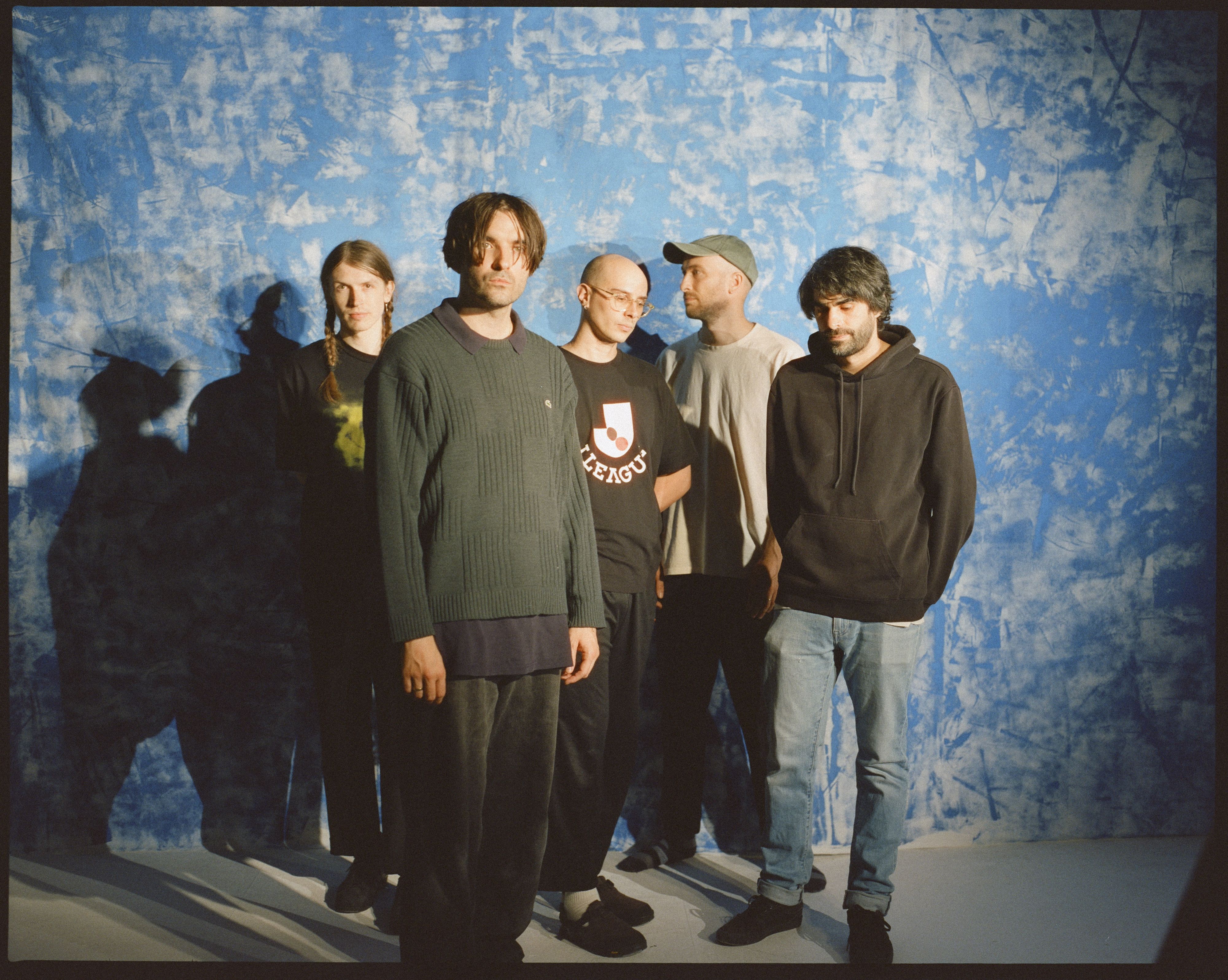
Published
Name: Ulrika
Members: Rhys Edwards (vocals, guitar, piano, keyboards, sampler, electronics), Joseph Stone (keyboards, piano, guitar, sampler, saxophone, electronics), Callum Brown (drums, percussion, electronics), Syd Kemp (bass, electronics), Rhys Jenkins (guitar)
Nationality: British
Current release: Ulrika's new album Expo is out February 6th 2026 via Full Time Hobby.
If you enjoyed this Ulrika interview and would like to stay up to date with the band and their music, visit their official homepage. They are also on Instagram, and bandcamp.
Where does the impulse to create something come from for you? What role do often-quoted sources of inspiration like dreams, other forms of art, personal relationships, politics etc play?
Well I guess it’s something that's been there for a very long time so it’s hard to remember a time without it.
But It becomes a way of being, everything around you all the time has a potential to be inspiration. Although that can be fun in some ways, it’s also quite overwhelming in that you are always working in your mind though often frustrated and worried in the times when you are not finding inspiration in the things around you.
But yes, watching good films, going to art galleries, seeing inspiring shows and listening to forward facing music are all good tricks to ignite something within you.
Is there a preparation phase for your process? Do you require your tools to be laid out in a particular way, for example, do you need to do 'research' or create 'early versions'?
Well I think that thing of always being ‘on’ is mainly the process. But inspiration comes when it comes and you have to act on it when it does come as it’s often a fleeting moment.
A very unspoken tip is to keep your computer in order. Make sure it isn’t crashing when you are inspired and want to work fast. So much of it is capturing magic. It’s a cliche but it’s like fishing all day and waiting for a bite.
But in a more direct answer to your question, for us, there is no research or early versions. Everything is made as it is made, and during the process the meaning and identity of it all reveals itself.
For Expo, what did you start with? If there were conceptual considerations, what were they?
We have always written in a collage based way, bending and warping ideas together to make something more interesting than what would have been created from one source.
I would say on this record we went one step further in that we made a bit of a sound bank of ideas and sampled ourselves making music. There was a lot more use of samplers on this record, there’s something special about recording something abstractly in its purest form and knowing that it has been captured. Then in sampling those things, we knew the ‘magic’ was already recorded, we could then twist knobs and concentrate more on the sound design and how things interacted.
We have never been a jam band, it has always been a jig saw puzzle of fragments. I would say ‘Build A Box Then Break It’ is a good example of this process.
The drums in the verses was just a beat recorded with one mic in a practice room and added to the sound bank. It was then combined with those chimes and waves of synth which were made abstractly.
Once we had made a mood we were able to work more conventionally fleshing things out with guitars, bass and vocals.
Tell me a bit about the way the new material developed and gradually took its final form, please.
So from the sound banks, arrangements started being pieced together and we then got in the same room at ‘total refreshment centre’ in London and started working as a band in the same room. Then we mainly worked on recording drums and layering.
I would say the first year of making this album was the writing and the second was the fiddling, tweaking and mixing. There’s a lot of joy to be taken out of the metamorphosis, it is essentially a bonding experience that you share with friends.
One of our favourite things about our process is that this continues after the record has been completed. It is at that point we need to be together as a unit to figure out how to perform the songs live, they grow even at that stage and continue to grow as you play them live.
What are areas/themes/topics that you keep returning to in your lyrics?
Isolation / loneliness / a constant self aware dialogue between you and yourself. I think this has been recurring themes across our albums, very inward looking in many ways.
Though those themes persist, I would say it’s a more outward looking on this album. A lot of the album’s lyrics were worked on whilst touring America in a quite foreboding period of time politically and socially and were all mainly written in the period of expecting a baby daughter. I think having a child or at least the thought of having a child forces you to not only look within all the time, but to have a little look around you. This can be scary as it makes you wonder what kinda world your child will inherit.
Another example of the album being a little more outward looking is that our recurrent themes (isolation / loneliness etc) are more linked to the online world that engulfs us. It’s quite apparent that the world around us have never been so individualistic, with so many people online vying for attention and recognition. The overwhelming loneliness that this transmits is very much a running theme in the album.
We really tried to embrace working creatively as a group as a special thing, something becoming rarer and rarer. And quite a few lyrics across the album refer to the group dynamic, and that ultimately the collective effort is greater than the individual.
Many writers have claimed that as soon as they enter into the process, certain aspects of the narrative are out of their hands. Do you like to keep strict control or is there a sense of following things where they lead you?
I would say we are quite strict with an early vision of the song, it somehow keeps the train on the tracks, and ultimately makes decision making easier, it is the reference itself that you can hang things off of.
When making music, the possibilities are endless, which is cool but also so overwhelming. The longer the process goes on to contributing a part the harder ultimately it gets. We try to mix magic moments of not thinking too much with ideas that have come out of long contemplation. It’s healthy to take the hands off the wheel sometimes and see where it goes - but without some sort of driving vision it’s easy to end up in a place of aimlessness.
On the track ‘Square Root Of None’ we kinda just let chaos take over though. The tempo was one that almost gave the feeling of a speeding car so we kinda went with that as the vision and allowed ourselves to just throw 100s of ideas at it.
That song is chaos, there is so much going on but we wanted to embrace that, ultimately it always felt forward moving which was important.
Lyrically it follows the theme as well as it is very stream of consciousness, there's a lot of numbers and codes and whether it all made sense wasn’t of great concern. It just had to encapsulate a manic, frantic energy that felt right with the music.
Once a piece is finished, how important is it for you to let it lie and evaluate it later on? How much improvement and refinement do you personally allow until you're satisfied with a piece?
Well in the early days it was easier in that you kinda had to finish when your laptop couldn’t take it anymore. Some say a piece of work is never finished, you just run out of time, and in the example of the laptop being at capacity this rings true.
But generally I think you know, or at least learn to know when you are no longer making things better. The bravest thing is to stop and stand by it. It’s very common to tweak and tweak and never finish because ultimately finishing means you are entering a judgement stage. At some point it is best to share because by doing that you are able to move on to new things, which is so important.
It always has to feel forward moving for you not to feel down and despondent. You cannot truly enter a new room until you leave the one behind you.
Music and the accompanying artwork are often closely related. Can you talk about this a little bit for your current project and the relationship that images and sounds have for you in general?
The relationship between the two have always been very important to us.
In the past we have often had the artwork ready very early on in the process and it has enabled us to work with some sort of visual guide. All album artworks up to now have been done by us ourselves but on this occasion we came across a piece made by an artist online called Nikita Garmash which was early in our album process that just felt right. Like past albums it played as a visual guide, when we hosted early ideas we placed the music with this piece as the visual, so it soon became inseparable and entwined.
Luckily for us the artist was thrilled to have it as the cover. We love the marriage of music and visuals, and take those things very seriously.
After finishing a piece or album and releasing something into the world, there can be a sense of emptiness. Can you relate to this – and how do you return to the state of creativity after experiencing it?
Every time you feel this, and every time you have to remind yourself that things take time. I think on every release after a period of so much hard work the announcement and/or release has left a bit of a void.
But usually within a year you start reaping rewards, or in our example - find yourself on tour far from home with audiences that have truly connected with it. That is very rewarding and no better kick to keep going.
In terms of creating, I feel that comes earlier in that void period, letting go of an album in finishing it opens up a big space for ideas to grow. You of course learn things from each record, and sometimes what you dislike about something informs what you want to pursue on your next work.