

Name: Vadim Neselovskyi
Nationality: Ukrainian, New York based
Occupation: Composer, pianist
Current release: Vadim Neselovskyi's new album PERSEVERANTIA is out February 24th 2026 via Tzadik.
Local Recommendation: I recommend visiting my hometown of Odes, Ukraine. Breathe in the air of the Black Sea. Eat some traditional food and explore the history of this incredible place. Visit the Potemkin Stairs and the Prymorsky Boulevard, go for a concert in gorgeous Odesa Opera Theater and swim at Langeron Beach. I hope this will soon be possible when the war finally ends.
Shoutout: I would like to honor Ralph Towner, a composer, guitarist, pianist, and ECM artist who passed away on January 18 of this year. He is one of the few artists who has had a tremendous influence on me. I think his music is very special. He is a cult figure for many, but I still think his music deserves wider recognition. If readers are unfamiliar with his band, Oregon, or his ECM solos and collaborations with Jan Garbarek, Gary Burton, and John Abercrombie, to name a few, I encourage them to check him out!
If you enjoyed this Vadim Neselovskyi interview and would like to stay up to date with his music, visit his official homepage. He is also on Instagram, and Facebook.
The borders between producers, sound artists, and even songwriters are becoming increasingly blurry. What does being a composer mean today, would you say?
Essentially, as a composer, I'm saying, "Dear listener! I know you have a busy life. Yet, you chose to spend 72 minutes listening to my latest album, Perseverantia. I will do everything in my power to make those 72 minutes worthwhile for you.”
In other words, time is the medium of composers. I fill it with sound and silence. The stylistic labels that we put on music are, to me, of secondary importance. I create music to understand and process the world around me.
Many people perceive classical music and contemporary composition as having high barriers of entrance, both for listeners and musicians. What have your own experiences been in this regard?
My music is a product of my diverse background as both a jazz musician who toured with people like Gary Burton and a classically trained composer.
I've always felt that my music connects with audiences at live concerts. However, this music is harder to market on streaming channels and radio because it requires concentrated listening, which most platforms don't encourage.
However, once you have the opportunity to hear it, I don't think there's a high barrier to entry for my music.
Where do most of your inspirations to create come from – rather from internal impulses or external ones? Which current social / political / ecological or other developments make you feel like you need to respond as an artist?
Inspiration is quite a mysterious thing to me.
I might be practicing the piano, playing Bach, or improvising freely. Then, something catches my ear. A little seed of something. I turn on my smartphone's recorder and try to capture the new idea. Sometimes it’s nothing worthwhile. Sometimes something comes out of it … in ten years.
For me, it’s a nonlinear, subconscious process of accumulating little seeds that grow into something meaningful. In retrospect, I might realize that this music wouldn't have come if I hadn't read that book, watched that movie, or experienced something that happened in the world that day. But again, these realizations happen in retrospect.
However, my current album, Perseverantia, is different. My home country was invaded in 2022. I still can't believe I'm typing these words in the 21st century. Perseverantia became my way of processing and coping with all the events that have happened in my country since February 24, 2022. It became a sort of diary, chronicling my emotional reactions to Bucha, Mariupol, Kharkiv, refugees, shelters ...
Music, particularly instrumental music devoid of lyrics, communicates in a universal language. While I did not intend for this work to be easy listening, I hope its message of resilience, empathy, and hope reaches those who listen to it.
Composing has always had an interesting relationship between honouring its roots and exploring the unknown. What does the balance between these two poles look like in your music?
I believe music originates from the depths of the subconscious. It stores everything: the city where you were born, the songs your parents sang to you as a child, the first pop songs you heard on the radio, and the first concert your mom took you to.
I am from Odesa, Ukraine. I grew up in a cultural melting pot: Ukrainian, Jewish, Russian,Moldovan ... I played Mozart and Bach, listened to Stevie Wonder on the radio, and heard Iron Maiden blasting from my neighbors' stereo.
You can hear all of these influences in my latest album, Perseverantia. Though the instrumentation suggests chamber classical music, traces of everything from Baroque to heavy metal can be found in its musical DNA.
What role do electronic tools and instruments play for your creative process? What does your creative space / studio look like and what tools does it contain?
I love using both modern and old-fashioned approaches to creating music.
I spend a lot of time with Logic Pro and multiple MIDI keyboards, recording multiple tracks. Then, I turn to the acoustic piano and continue my search without any technology. I use notation software but also can't live without pencil and paper. For me, there’s something profound about combining old and new approaches to music creation, and I think my music reflects that.
The trick is that none of my recordings so far—Spring Song, Music for September, Get Up and Go, Odesa, and Perseverantia—used electronics. I love bringing the discoveries technology helps me make into purely acoustic, timeless contexts.
For many artists, life-changing musical experiences take place live. Few works these days, however, are performed beyond their premiere. What, do you feel, does this mean for composers, and the music they write, and how does this reality influence your own work?
Well, I suppose my situation is somewhat unusual since I'm both a composer and a performer who exists at the intersection of jazz and contemporary classical music. I'm accustomed to performing my own music, so the pieces I write continue to be performed beyond the premiere.
For example, my previous piece, Odesa: A Musical Walk in a Legendary City, has been performed over 200 times.
My current project, Perseverantia, is also receiving more and more performances internationally.
There's an interesting challenge when you're constantly performing your own music — you have to love what you wrote. Otherwise, performing something you're not satisfied with every night would become a nightmare. That's why it takes me so long and requires so many revisions to arrive at the final version of a composition.
How, would you say are live performances of your music and your recording projects connected at the moment? How do they mutually influence and feed off each other?
I record every live performance. Then, I listen to- and analyze them. I might do some edits in the score.
With Perseverantia, we toured Europe with the first version of the music. I listened to all the concerts and re-wrote almost 50% of the piece. Only after making all these revisions did I feel that we were ready to go into the studio and record an album of this music.
To some, the advent of AI and 'intelligent' composing tools offers potential for machines to contribute to the creative process. What are your hopes, fears, expectations and possible concrete plans in this regard?
For now, I'm just holding my breath and carefully watching the development of AI in the context of music-making.
I believe that music is a way to express emotions and feelings. As far as I understand, AI may be able to think logically, but that depends on how you define thinking—that's a whole other discussion. But can it feel? Can it have emotions?
Art is a product of human experience, and in that capacity, AI is unlikely to replace us, I think.

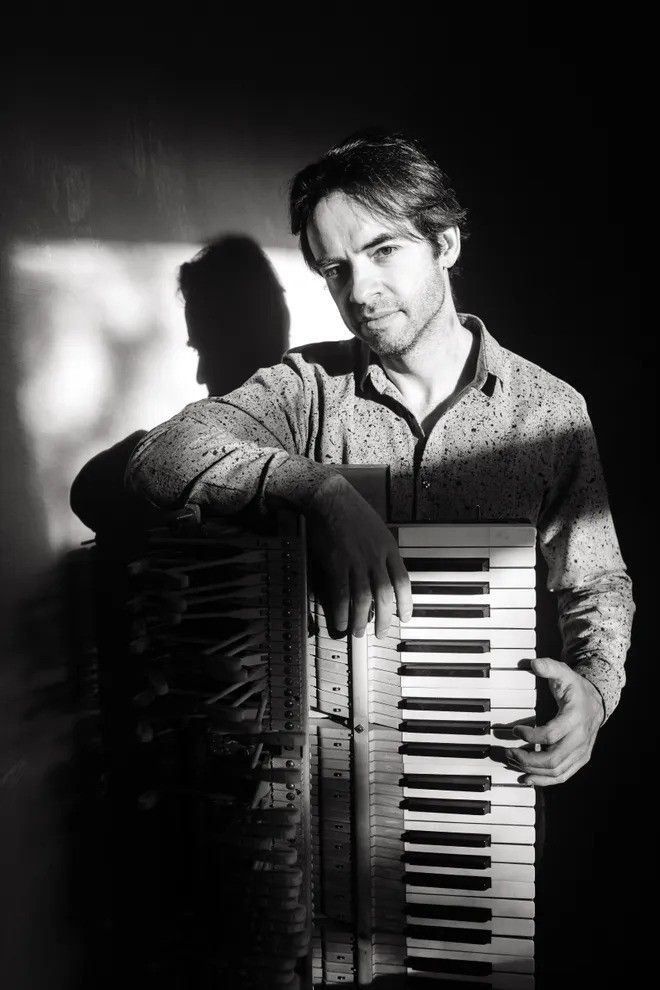 Vadim Neselovskyi Interview Image (c) the artist
“I create music to understand and process the world around me.“
Video
