Published
Part 1
Name: Victoria Pham
Nationality: Australian
Occupation: Interdisciplinary artist, evolutionary biologist, sound designer, producer, editor, writer, founder at EARTHLY FUTURES STUDIO
Current release: Victoria Pham's new album as VP, Cosmosis, is out via Hospital Hill.
Recommendations on the topic of sound: Ooh so many! Here are a few that could be of interest. They are almost all books but many of these authors have done lots of podcasts and interviews that could be worth checking out too!
The Zoologists’ Guide to Galaxy and Why Animals Talk by Arik Kershenbaum
Sounds Wild and Broken by David Haskel
Hungry Listening, Dylan Robinson
Of Sound Mind, Nina Kraus
The Sounds of Life, Karen Bakker
If you enjoyed this Victoria Pham interview and would like to stay up to date with her music, visit her official homepage. She is also on Instagram, and bandcamp. For a beautiful video of the piece "Desert," go here.
When I listen to music, I see shapes, objects and colours. What happens in your body when you're listening? Do you listen with your eyes open or closed?
I have synaesthesia which sounds very similar to what you are describing. I also see shapes, objects and colours shifting and weaving in reaction to sounds. I can also feel them, if that makes sense? In that it’s beyond a visual tactility.
For example, the wolf howling sound in track 4 (“Desert”) feels a little bit like lightweight sandpaper to me.
I can’t explain it, but often I feel as if sounds can be held or that I am inside them.
When I listen to music or to experimental soundscapes, I will either sit quietly in a space (headphones on!) with my eyes closed, or I listen to sounds while I am walking (also headphones on!).
How do listening with headphones and listening through a stereo system change your experience of sound and music?
It depends on where I am going with music or the form I am able to have it with me.
If I am not travelling, then I’m usually listening to music on a stereo system so I have more of a chance to have a “full-body-immersive” experience. You can lie on the floor and move about more easily when the sound isn’t attached to your head through earphones or headphones. It’s not impossible with headphones, but I find the contraption limiting, when I am able to access a large space that the sound and music might occupy.
Having said that, there’s a sense of soothing confinement that I find very comforting with headphones. They let you “make” or “hear” your own world which is particularly nice when you’re not able to access a whole space where you can use a speaker system privately. It allows you to walk with music/sound and travel with it.
The experience is less bodily than what I describe earlier with the stereo setup, but perhaps that has more to do with the circumstances that cause me to reach for headphones. It’s more like the immersion is inside my head and, in many ways, it is more intimate. To carve out a private listening space for your ears in a public zone …
Tell me about some of the albums or artists that you love specifically for their sound, please.
There are so many so I will try keep it succinct, probably because it’s such a diverse kaleidoscope of sounds!
The artists I have long been drawn too are actually sound designers and field recordists. I particularly have followed the work of Mark Mangini for a number of years. I particularly love his work on Blade Runner 2049, and of course, Dune.
Sound designers Gary Rydstorm of Jurassic Park and David Farmer for the Lord of the Rings Trilogy are also a big part of my listening world. Who doesn’t love the sound of a velociraptor or the Nazgul Fell Beast?
I love recent albums such as Eye to Ear by Cosmo Sheldrake – for his way of weaving the natural with the imaginary …
… and the piece ‘Thinking Iceberg’ by Felicia Atkinson.
There is something very calming about those pulsing clarinet-synth sounds make at the opening of the piece. Amongst the rustle of field recordings and what I presume is her voice.
[Read our Cosmo Sheldrake interview]
[Read our Felicia Atkinson interview]
Do you experience strong emotional responses towards certain sounds? If so, what kind of sounds are these and do you have an explanation about the reasons for these responses?
Yes, very much so.
I love the wooden percussion sound of a wooden fish being knocked, there is warmth to it. I used to find it a bit too lengthy when I was a child but the sound of Cải lương, specifically from the Vietnamese show Paris by Night. It reminds of those early experiences of music when you’re a kid.
The sound of cicadas, magpies and peacocks. My mother used to take me to the local nature reserve in Auburn, Sydney when I was growing up. Peacocks are not indigenous to Australia, and yet they were everywhere in this park so their song is very prominent in my memory.
Specific voices and vocalisations are like ignition – the sound of my grandmother talking through her making strawberries and ice, Julie Andrew’s voice from The Sound of Music, the growl of an Allosaurus from the Walking with Dinosaurs series.
One final sound is the sound of a church organ. I used to dislike it, even during my undergraduate studies as a composer I found it too much. It was too loud, too heavy, held too many ceremonial connotations.
But then I went to France and studied with organist and composer, Thierry Escaich and joined at the St John’s Voices choir (when it still existed) during my time in the UK and my relationship with the instrument changed. I love it for its warmth, its intensity and when you’re in a large space where there is this instrument available, it feels like you are inside the vocal chords of the building.
An instrument of both joy and mourning.
There can be sounds which feel highly irritating to us and then there are others we could gladly listen to for hours. Do you have examples for either one or both of these?
Yes, there is a sound that I absolutely adore and it holds a lot of nostalgia for me. A sound that I imagine most people find horrific and uncomfortable. I love the sound of trains breaking.
Specifically, I love the sound of trains pulling into the underground Town Hall station in Sydney. It is both grating (and likely, harmful to your ears) and yet I can listen to this at length.
Almost all my early compositions and recordings as a child and teenager feature the Sydney public transport system, usually trains, haha!
Aside from the sounds of trains, I can listen to soft rainfall, bass sounds like seismograph recordings and Australian magpie song continuously.
The sounds that terrify me are nature’s broadband noise: Gale force winds where you can hear lots of trees shifting and waterfalls. I cannot stand either of them, in a recording or in real life.
Are there everyday places, spaces, or devices which intrigue you by the way they sound? Which are these?
I often love the sound of things through other objects and mediums. It’s a reality of living in urban environments that we can, as much we want to suppress noise, hear one another at all times.
I am currently living Paris which means we are living communally in apartment-styled spaces. I am aware of everyone else as they are of me, and privacy and peace of mind has just as much to do with noise as it does with visibly being able to see one another.
We are very fortunate with where we live. I can barely hear my neighbours and the lift in the building, and apparently, they can barely hear us (even when I am playing Black Sabbath very loudly on my speakers). But when I’m in the bath, with my head under the water, I can hear the conversations of the people in the kitchen one floor above me with astounding clarity.
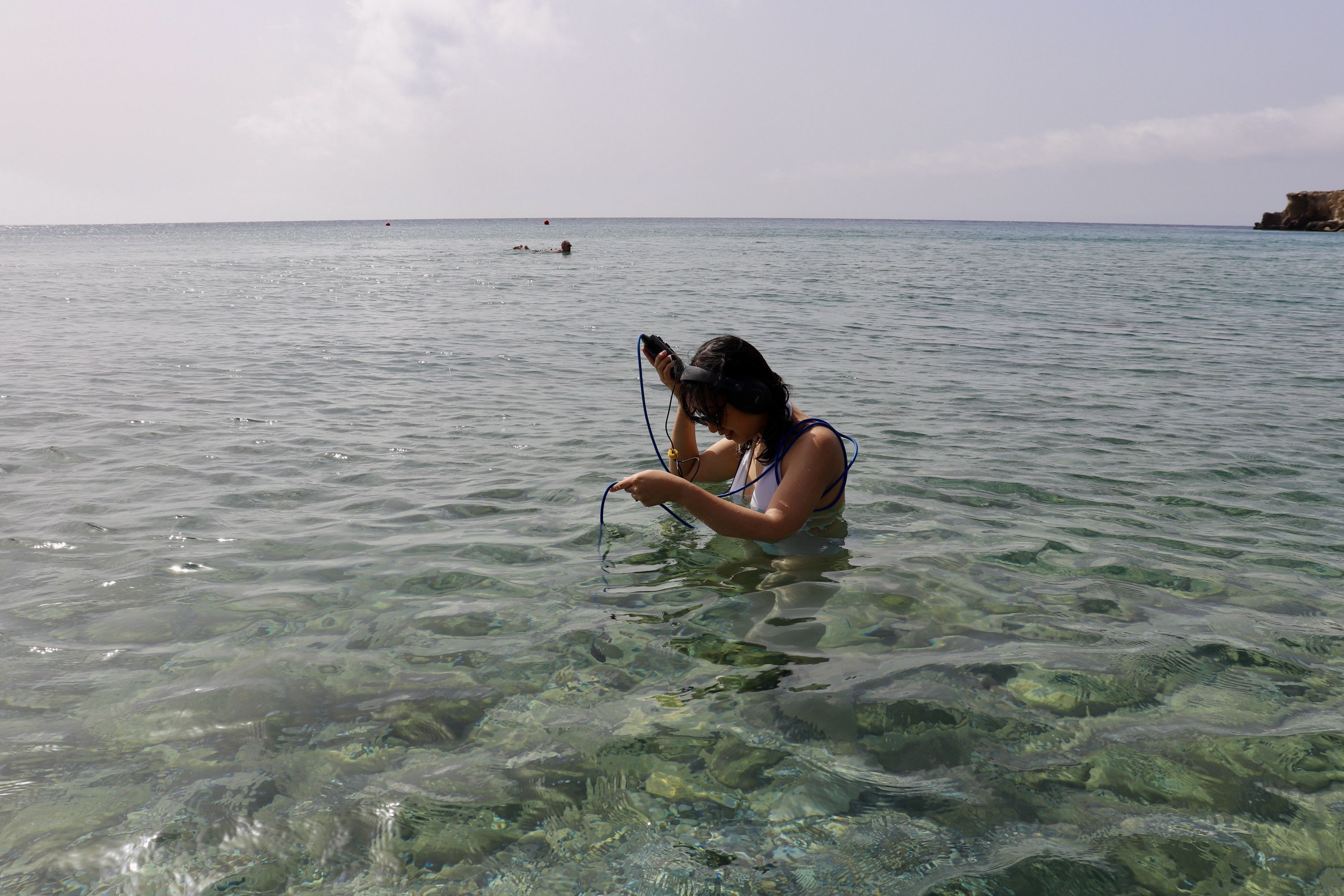
Of course, I’m not in the bath deliberately to eavesdrop, but it surprised me very much the first time it happened. Perhaps it is particularly the act of listening through water I am intrigued by …
Have you ever been in spaces with extreme sonic characteristics, such as anechoic chambers or caves? What was the experience like?
I have been in both. I am not a fan of the anechoic chamber and I love caves.
I have only been in one anechoic chamber, the one located in the IRCAM, Paris, and I greatly dislike how dry it is. So dry that I felt dehydrated, like my heart is beating inside my mouth. I feel parched even thinking about it right now.
But back to caves! They’re organic, ancient, present and ever-so wet. There is one cave site in Catalunya, Coves del Toll, where I did solo archaeoacoustic fieldwork back in 2018. I spent two weeks recording the acoustics of its two karstic cave complexes; Cova del Toll and Coves Teixoneres.
Perhaps it’s not the place most people would wish to spend many hours in isolation, especially if your imagination is particularly strong, and especially if you are aware that there were burials in the area, but I adored the ecosystem. It’s quiet and resonant, as if you are deep inside the organs of a mountain.
Something about standing alone in a cave compels you to listen backwards through time.
What are among your favourite spaces to record and play your music?
Outside for both answers!
The first is my preferred method of recording as the majority of my work, even commercial sound design and composing, is rooted in a practice of field recording. Playing music outside always poses technical and logistical challenges, but I adore the blending of my use of field recordings with the outside-uncontrolled world. It’s always an exciting way to braid together the roots of what was recorded outside and playing it back to the outside.
A close second for performing would be on an amazing sound system (I’m looking at you GRM and 4D Sound …) or maybe a cave!