

Name: Vijay Iyer
Nationality: American
Occupation: Composer, pianist, bandleader, producer, writer
Current release: Vijay Iyer's Trouble, the first recording of his orchestral works, is out via BMOP/sound.
Recommendations: These two pieces of music are beacons of their moment. Each one harnesses the charged feelings of a historical circumstance and expresses something timeless:
Nina Simone, “Why? (The King of Love is Dead)” (1968)
Jimi Hendrix, “Machine Gun” from Band of Gypsys (1971)
If you enjoyed this Vijay Iyer interview and would like to stay up to date with his music, visit his official website. He is also on Instagram, and Facebook.
For the thoughts of some his collaborators, read our Arooj Aftab interiew, Matana Roberts interview, and Hprizm interview.
Where does the impulse to create something come from for you? What role do often-quoted sources of inspiration like dreams, other forms of art, personal relationships, politics etc play?
It usually comes from my gut. Whatever I make needs to have its own reason for being, and the way that comes into being is often mysterious to me. I think I’m known as a “political” artist, but I think all artists are lightning rods, constantly receiving some kind of energetic information about the state of the world around us. It’s hard for us to ignore it, so we just find a way to work with it.
A lot of the music on my album Compassion (2024) was animated by the simultaneous experience of mourning for those we’d lost in the pandemic era and the joy of returning to making music in public after the shutdown year - so it’s haunted, in a way, but also has this emotional weight, all of which felt very much of its time.
The piece “Maelstrom” was part of a suite written in summer 2021 that was commissioned to perform in Prospect Park as a memorial/ritual commemorating victims of the pandemic and offering a way forward. It contains this alternation between darkness and exuberance.
The piece “Prelude: Orison” comes from a longer piece I wrote that fall, titled “For My Father.” He passed away that summer shortly after that premiere, and it is a prayer written for him. The pieces fit together so seamlessly that they appear side by side on the album, and often in performance as well.
Trouble consists of compositions written from 2017 to 2019, which were, at the time, some of the ugliest years we’d ever had as a nation. So then I was trying to make music that would start from there but then get somewhere better. (Of course, we’ve had worse years since then, to the point that I don’t find myself using “nation” as a frame of reference as an artist anymore.) It was a time when we witnessed the public reemergence of outright white supremacist violence and hate speech.
The actual piece “Trouble” is a concerto written in 2017 for the violinist Jennifer Koh, and one of its movements is “For Vincent Chin,” who was the victim of racist violence in 1982. It was a moment that mattered to us and seemed to have relevance to our present, and this moment of the piece became a space of concentrated emotion.
For you to get started, do there need to be concrete ideas – or what some have called a 'visualisation' of the finished work? What does the balance between planning and chance look like for you?
It usually starts from a feeling - literally, a sense of what a piece or a project will feel like, and how it will move.
I’m often creating for specific occasions - ensembles, gigs, concerts, premieres, recording projects and so on - so that creates a set of real-world constraints, which are often helpful for creativity. I pay close attention to who’s involved, what they are capable of, what is important to them – and also who’ll be bearing witness in the space, and what would matter to those people in that context. Some of my work involves real-time creation at the moment of performance - we sometimes call it “live composition” - but it always still has some formal details built in.
The piece “Combat Breathing” on Uneasy (2021) has a form that is eleven nearly empty bars, a modified blues progression. This piece was originally created to accompany a protest action in 2014 in the aftermath of the NYPD’s public execution of Eric Garner. The piece was meant to invite movement and unity.
On this studio recording, the group fills in the blanks and brings it to life. The final few minutes involve a one-measure bassline that is repeated like a chant, becoming the substrate for a forthright and unified expression from the group. 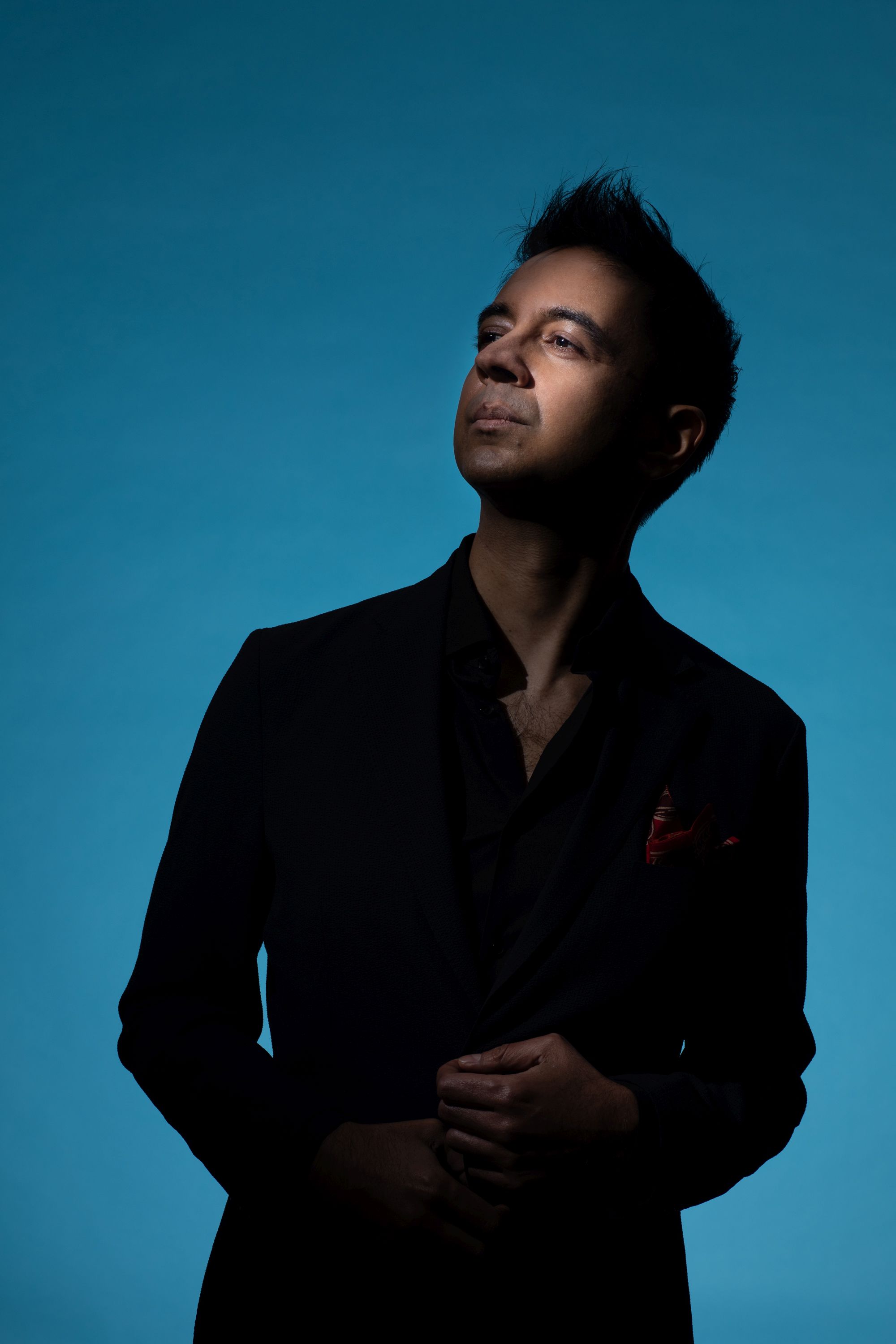
Vijay Iyer Interview Image by Ebru Yildiz
What do you start with? And, to quote a question by the great Bruce Duffie: When you come up with a musical idea, have you created the idea or have you discovered the idea?
I often find it helpful to start with formal constraints. Sometimes it’s a rhythm or metric cycle, other times it’s a mode or a set of intervals.
The piece “Passage” that opens my 2016 duo album with the great Wadada Leo Smith, A Cosmic Rhythm with Each Stroke, uses a certain mode - Db, E, F, G, Ab, B, C – and a five-beat cycle. I developed this harmonic progression out of this mode, and I gave him a series of melodic shapes in that same mode which he could play at will anytime across what I was doing, and that he didn’t have to worry about where I was in the form. On this recorded version he delivers it with breathtaking elegance and strength.
Later we were doing an interview and he told the journalist that this piece is about “the right of all human beings to move freely across the planet.” It was a radical interpretation of this piece in a time of refugee struggles and mass migration due to climate change and war – and I realized that he was absolutely right. So in this case, it’s as if the idea discovered me.
[Read our Wadada Leo Smith interview]
In the piece “Mutation VI: Waves,” a brief, fully notated movement from Mutations I-X (composed in 2005 but recorded and released on the album Mutations in 2014), I started with this idea of rhythmic moiré patterns. And I decided to toggle between two diatonic environments, A minor and B major. I wanted to see if something this elemental would be enough to create a satisfying shape for a listener.
So this was again just a formal proposition, with nothing really exciting about it. But as I played out this idea, the piece acquired drama and warmth that I didn’t expect. I don’t know if I discovered anything – it’s more that it arrived, it crossed a threshold into this world, sort of like being born.
Once a piece is finished, how important is it for you to let it lie and evaluate it later on? How much improvement and refinement do you personally allow until you're satisfied with a piece? What does this process look like in practise?
Usually the music’s identity reveals more about itself in the playing of it. So I don’t think of a piece as ever finished; it’s merely documented at some phase of its life, whether as a score or as a recording. Music comes to life in performance, and it can bloom in unpredictable ways.
The trio piece “Hood” (from Break Stuff, 2015) was originally written in 2011 for a sextet with three horns, inspired by the electronic music of Robert Hood. Then on trio tours we started experimenting with a “dub” version of the piece, just the rhythm section backbone of it, and that took on its own life. So I try to remain open to possibilities like that.
The process is never really done. My friend and colleague Yosvany Terry put it succinctly: “The score is alive.”
When you're in the studio to record a piece, how important is the actual performance and the moment of performing the song still in an age where so much can be “done and fixed in post?“
In acoustic music, which is most of what I do, the sense of “liveness” really matters. So I tend to stay faithful to full “takes” and capture genuine moments of musical connection and interaction.
Sometimes if there are intricate or difficult notated passages we might need a couple of tries, or might need to fix a note here or there.
Creativity can reach many different corners of our lives. Do you personally feel as though writing a piece of music is inherently different from something like making a great cup of coffee? What do you express through music that you couldn't or wouldn't in more 'mundane' tasks?
I’m not much of a cook, but I think composing is more like coming up with a recipe for something. It’s more like the coffee maker and the instructions for use. The doing of it needs to be carried out with care, by and for people, for it to even exist, let alone for it to matter to someone.
The act of performance is like “making a great cup of coffee” for somebody. The generosity of the act is what matters. Alice Coltrane-Turiyasangitananda said, “The key to being an artist is giving abundantly.”

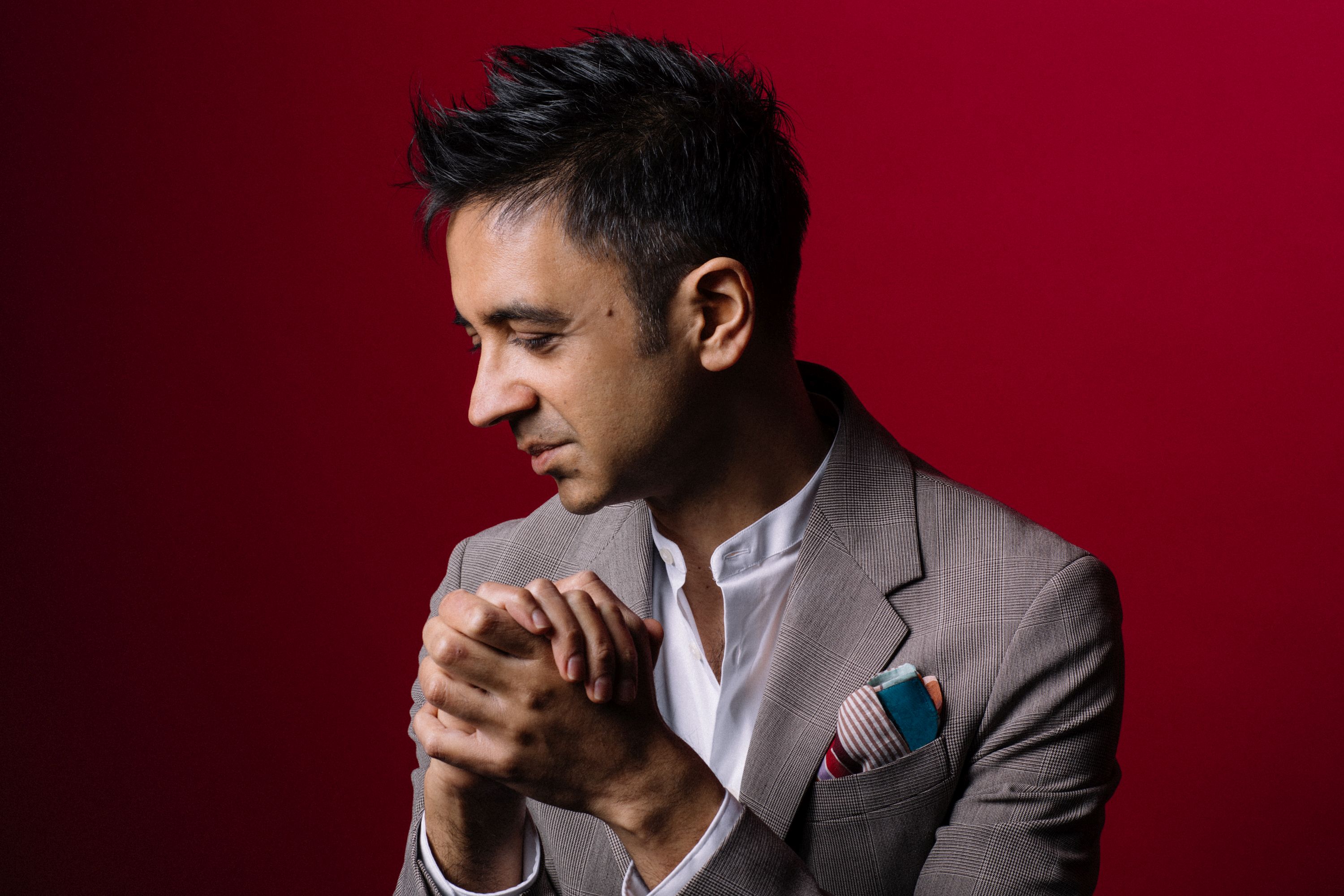 Vijay Iyer Interview Image by Ebru Yildiz
“Music comes to life in performance, and it can bloom in unpredictable ways."
Video
