Published
Name: W4RP Trio
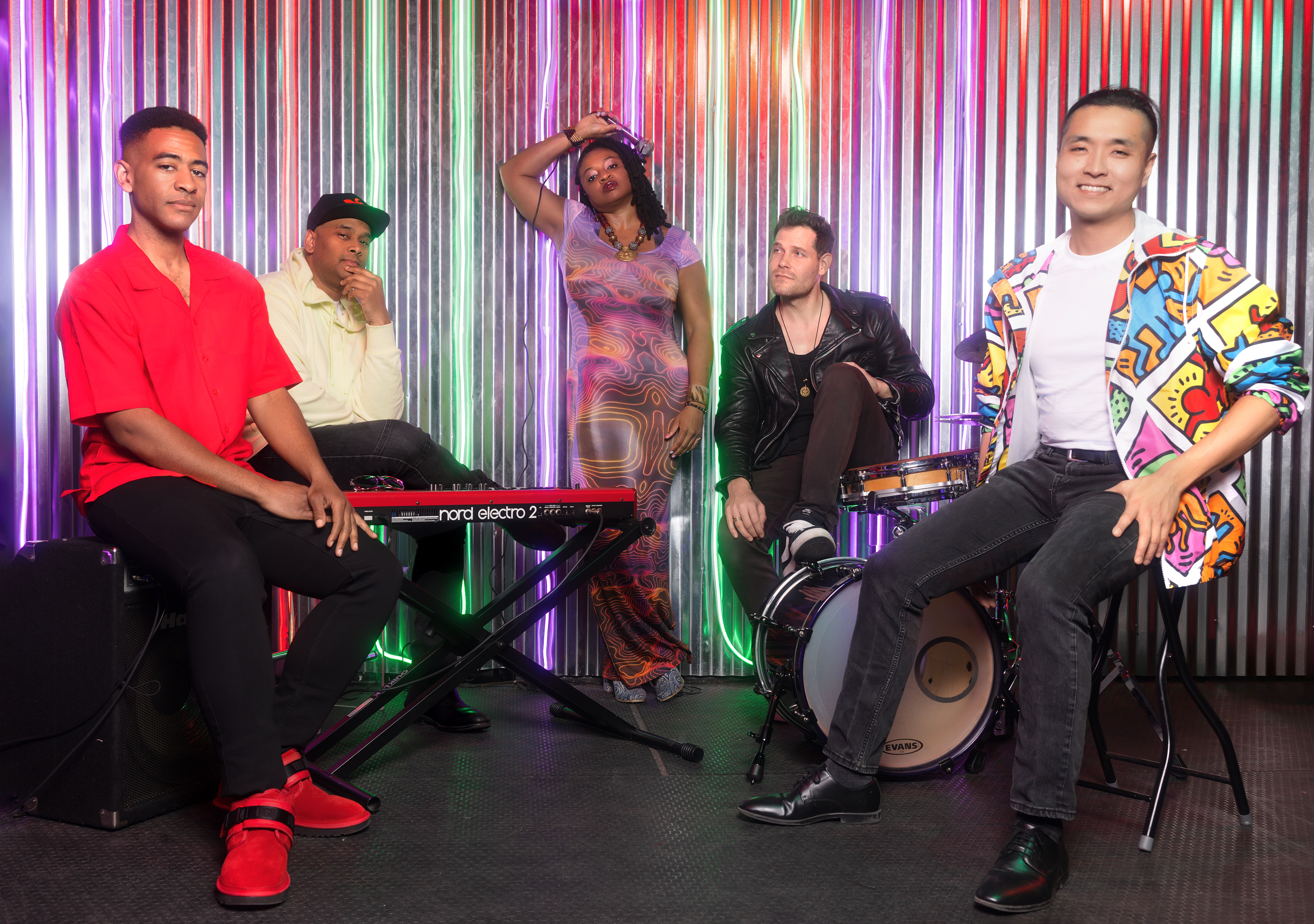
Members: Mikael Darmanie (Piano/Keyboards), Josh Henderson (Violin, Electric Bass, Guitar), J.Y. Lee (Cello), Rick Martinez (Drums, Synths)
Interviewee: Josh Henderson
Nationality: American
Current Release: W4RP Trio's new album Sermon of the MatriarK, featuring LiKWUiD, is out via Phenotypic.
Recommendation for Josh's hometown: My home of New York City is home countless tales and treasures, and if one truly has time to take it all in (i.e. you’ve knocked out the tourist items), I would say visit Van Cortlandt Park, the last stop on the 1 train in the Bronx. Maybe it is because of living there, but it seems so unreal that this peaceful and pretty extensive park with its trails and horse stables is part of New York City.
That or the Beach, which is also a very interesting micro-culture. *
[Read our LiKWUiD interview]
If you enjoyed this W4RP Trio interview and would like to know more about the band and their music, visit their official homepage. They are also on Instagram, and Facebook.
When did you first start getting interested in musical interpretation?
Speaking as a violinist/violist coming from a classical background (in terms of formal education), we tend to spend a large amount of time learning the mechanics of our instruments, and largely via the rich tradition of Euro-centric Classical music and subsets of pieces (and recordings of pieces) that "direct traffic” so to speak and eventually lead to proficiency on an instrument.
I am by no means a child prodigy, so a substantial amount of time during my grade school and college years was spent refining my technique and chasing the sonic qualities of violinists from ages past. What I might have thought was interpreting was really attempting to recreate whatever the editor of whatever piece I was working on had left on the page.
All of that being said, I think I genuinely started truly interpreting music after college years and though I cannot pinpoint an exact date, the confluence of doing more composing, improvising, and arranging - and integrating more of a composer thought process while learning new music - and of course having to prepare concerts, recitals and such without the guidance of a teacher (and also, just finally obtaining control over my instrument) led to me to begin to think more about not just recreating notes, but how I could continue to tell the story from a composer, with a little of mine own story as well.
Which artists, approaches, albums or performances captured your imagination in the beginning when it comes to the art of interpretation?
The first time I head someone write their own cadenza really got me started thinking about how one can always have a fresh take on music (old and new). This was the violinist Gilles Apap performing Mozart’s 3rd violin concerto and he incorporated improvisation, singing, and pure unapologetic FUN during his wild cadenza break.
While it would be some years before I began writing my own cadenzas the feeling of learning that this level of freedom was possible never left me.
Are there examples for interpretations that were entirely surprising to you personally and yet completely convincing?
I teach at a couple Universities, and a part of that involves sitting in on auditions for young prospective students. One of the more impressive auditions I witnessed was a young person performing a movement of solo Bach with a surprising and unconventional bow stroke; however, they performed it so well and with such conviction, it did not matter at all.
And therein lies my entire philosophy on interpretation - if you convince someone, it works!
What do you personally enjoy about the act of interpretation? Are you finding that this sense of enjoyment is changing over time?
If one does not approach music as the type of game that has clear winners and losers, or one with a final victory at the end of a quest, but rather a game where the world is ever expanding and there is no clear goal, just to experience the game for better or for worse and take in all of the stimuli, then interpretation is the crux of the game.
The never-ending-ness of this quest is calming to me, and if there were a final goal in music, the prospect of reaching that and then winning is terrifying.
How much creativity is there in the act of interpretation? How much of your own personality enters the process?
Very much dependent on the composer, how much agency is given to the performer, how much the performer knows about the composer/time period/ life situations, and of course how much, if at all the performer actually cares about any of that.
Could you describe your approach to interpretation on the basis of a piece, live performance or album that's particularly dear to you, please?
I recently made a recording of the Biber Passacaglia for a radio segment, and was very much inspired by some research a friend of mine did on a 16th century violinist, Ortiz, and the stylized imaginings of music of that time period. He really leaned into particularly the African and new World influences on forms such as the Sarabande (Zarabanda) and ran with the possibilities of what the freshness of a newly invented form could cultivate in an audience.
I approached the Passacaglia as as a vehicle for improvising and attempting to emulate the audacity of sonic textures that must have been so groundbreaking for the original audience.
What was your own learning curve/creative development like when it comes to interpretation - what were challenges and breakthroughs?
We have those pieces of music that particularly resonate with us, whether by nature or nurture and in those instances when that particular synergy is there, I feel that I am ready to dive in and know immediately what I want to do.
The opposite is also true, and I’m still trying to figure out how to play things I learned as a child!
In many cases, the score will be the first and foremost resource for an interpretation. Can you explain about how “reading” a score works for you?
You want to go in giving the composer the benefit of the doubt, so at the onset of discovering a new piece, just do what the score says, and after that, Interpret.
I am infinitely fascinated by radically different or even “wrong” interpretations – the tempi of Toscanini, Kempff's Goldberg Variations. Are there extreme interpretations that you enjoy as well? Do you personally draw a line – and if so, what happens when we cross it?
Standing by earlier statement of, “If you convince someone, it works!” However, I am admitting the very real possibility of distorting or misconstruing a composer’s intentions.
For example, the famous Shostakovich/Bernstein anecdote where Bernstein told Shostakovich the metronome marking for the ending of the 5th symphony was wrong, and that it should be much faster - where according to the story the composer had a completely different idea behind the music that was a contrast to the triumphant spirit the conductor interpreted.
True or not, I think about this when I hear some extreme renditions (or when I come up with my own), and also how do we really know what the composer wanted? Does it matter? And how much?
Josh Henderson Interview Image (c) the artist
When you have the score in front of you, what's your take on taking things literally, correcting possible mistakes, taking into account historical aspects etc?
The score is a great place to start, and the composer themself plays a big role in how literally one takes in a score; meaning that not every composer is going to desire the same level of control over the performance/interpretation. If they are alive, you can always ask them, and that is great.
For much older pieces, the composers are gone, and even the most esteemed modern day interpreters were themselves not there with the composer, so at the end of the day, no one really knows do they?
I think there is no merit in doing things out of ignorance, so for myself, start with the score and actually learn and respect the score, and then, maybe see what happens.
With regards to the live situation, what role do the audience and the performance space play for your interpretation?
Completely different experience when one factors in an audience, and space as well to an extent. The idea of having spontaneity, humor, etc … is defenestrated when there is no audience. What is the point if no one is on the journey with you?
Technically speaking, making decisions on pacing, tempi, extremities of dynamics, can be dependent on audience reactions (or potential reactions), and also, verbally talking about a piece before performing puts audience and performer in a different headspace for taking in the work.
Some works seem to attract more artists to add their interpretation to it than others; some seem to even encourage wildly different interpretations. From your experience, what is it about these works that gives them this magnetic pull?
As we are promoting a New Music Hip Hop Album and I’ve been talking a bunch about Western Classical Music, would like to jump to the record and use our track “The Devil Went Down to Cackalacky” as the example for this question.
So, our track is a re-imagining of the Charlie Daniel’s Band classic, “The Devil Went Down to Georgia”, a tune that has been covered and re-interpreted since its inception. Our version replaces the protagonist Johnny, a hot-shot fiddle player, with Johnnie Mae, a talented rapper.
To me, tracks like the Daniels original exude a certain timelessness either in their storylines (the tale of selling one’s soul to the Devil for preternatural gains has been around since the concept of the Devil originated) or their musicality (with familiar melodies or harmonic content altered just enough to ensure lasting brain imprinting).
I think that timelessness coupled with the passage of time invokes more and more artists to keep on re-interpreting and evolving the familiar story for their respective day and age.
A female rapper using Charlie Daniels as a vehicle to embolden and empower other females would have been wild in the late 70s when the original tune came out, but now in 2025 we can have Johnnie Mae triumphantly conquer the devil and send a message of empowerment to all.
Artists can return to a work several times throughout the course of their career, with different results. Tell me about a work where this has been the case for you, please.
For me (and many other violinists) I would have to say the Bach Chaconne from the d minor Partita. Something about the inherently simple conceit of a repeating ground bass for 15 minutes is a launchpad for infinite multiverses of nuance on top of the already complex work.
Most people learn this piece rather young, however this is definitely one of those works that as one ages, they are able to dramatically re-contextualize its nature and evolve their opinions on its meaning and how to convey that to an audience.
Part of the intrigue of interpretations is that the process is usually endless. Are there, vice versa, interpretations that feel definitive to you?
I’m more in the camp of limitless ideas.
However I do think it is good to acknowledge widely accepted successful interpretations, as those responsible have convinced a large number of people one way or the other of their validity and at the very least should be studied.