Published
Part 1
Name: Wilson Tanner Smith
Nationality: American/Finnish
Occupation: Composer, improviser, performer, cellist
Current release: Wilson Tanner Smith's new album Perpetual Guest is out via Sawyer Editions.
If you enjoyed this Wilson Tanner Smith interview and would like to stay up to date with his music and upcoming live dates, visit his official homepage. He is also on Instagram.
When I listen to music, I see shapes, objects and colours. What happens in your body when you're listening? Do you listen with your eyes open or closed?
It so often depends on context for me – the place and the performance style, for example, as well as just the sound. I think when it’s at it’s best, it’s more a feeling of stillness and presence – not stillness in the sense that “nothing is happening,” but more stillness and full presence in [this] sound/place/group of people.
It’s much easier for this to happen when my are eyes closed and I’m almost completely focusing on the sound because I’m less distracted or critical of what’s going on in the room, or what's going on in the performance and embodiment.
But I love those elements of live music, the social aspect – seeing how other people are feeling/connecting (or not), how the performer is going about their work, whether swept up in their own world, or reaching out energetically to get some feedback from the audience.
Lately when improvising, I’m spending a lot more time with my eyes closed, really focusing on the playing the other musicians are doing, connecting with them and the sound we’re making together. But sometimes I get a bit worried that an audience might feel excluded if I do that.
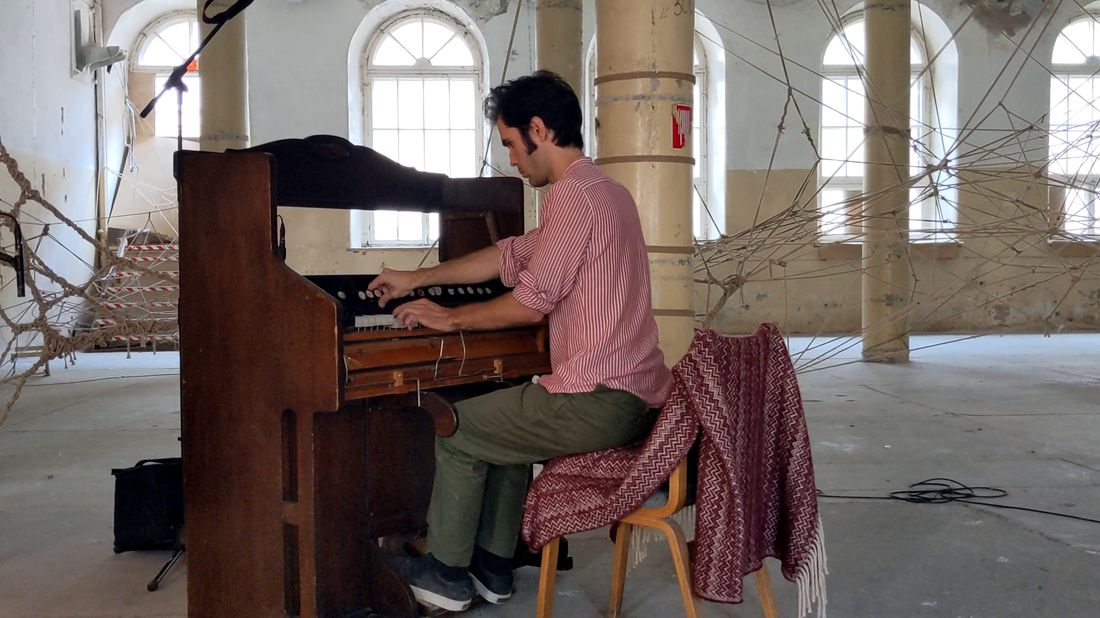
In the live recording on this record, the first time I’ve publicly performed on harmonium or any “big” keyboard instrument, it was the first time I had to decide whether my back should be facing the audience (them seeing what I’m doing on the keys and stops), or facing them but with a large instrument blocking almost everything (my body, probably much of my face, and what I’m doing with my hands).
It felt a bit odd to physically shut out the audience in that way, but it did help me to settle down and focus on the playing – still trying to energetically sense a bit the feeling in the room, but really focusing on the sound and the playing.
I think if I had an easier view of the audience, I might distract myself by checking in visually on how people seemed to be feeling, which would have taken me out of it and probably made for a worse experience for everybody … And hopefully they felt invited to sit back into the space and moment themselves.
How do listening with headphones and listening through a stereo system change your experience of sound and music?
They change it entirely!
In the headphones I’m in more of a non-place in my own head, or in the sound-space of the recording session or DAW … Or in the case of site-specific or live recordings, feeling a bit like a nice simulation of uncanny presence there, though perhaps through the filter of old/bad recording technology or setups, so maybe like looking at old grainy film stock.
But it can be such a luxury to feel this closeness and enveloping sense, like with detailed recordings that make you feel really “in” the instrument or right up close to it. Sur-real, hyper-real.
When I worked on my first solo album, my recording engineer friend turned me on to Colin Stetson’s recordings, with lots of close up sax noises. This kind of approach which puts you [here] and [somewhere else] is really important to me; something Olivia Block said along those lines has stuck with me, music that doesn’t transport you somewhere else, but puts you right here. A bit of both can be a nice thing too.
[Read our Olivia Block interview]
[Read our Olivia Block interview about Sound]
I had the luxury of using something like 6 or 8 microphones spread across the instrument and warehouse room where I recorded this at the Kreenholm Manufactory in Narva, getting a detailed sound of the harmonium and cello themselves, but also their resonance in the room at various distances and places in the architecture.
EQing and mixing this down to stereo was a fun challenge, and there was always the question of which environmental or accidental instrument sounds to try to correct or let be. In the end, I just hope it can be a rich and enveloping, put-you-there-in-that-space and also put-you-in-your-presence experience for people listening to it.
This headphone vs stereo thing is also so context dependent – listening to dance music in the kitchen while cooking is so much lighter with a stereo, easier to dance to, vibrating out in the room. In headphones the same thing does still get me dancing and all, but taking them off and returning to the “actual” silent, comparatively energy-less room is always so uncanny.
If it’s like, long and deep meditative stuff, I can really zone out to either in a really nice way if the mood is right .… But now I live in a big shared house, so I don’t often have the chance to put something loud on the stereo and lay on the floor for 45 minutes – much easier in headphones!
Do you experience strong emotional responses towards certain sounds? If so, what kind of sounds are these and do you have an explanation about the reasons for these responses?
The sounds of cicadas and catydids – things I miss dearly living in Europe now! They’re different here, anyway. The triplet-singing catydids we had in the area where I grew up in the Philly suburbs have always had such a calming sense of “home,“ and summer. And the choruses of cicadas that sing across Philly and Chicago in the summer – just the best!
I guess these are so much associated also with the good feelings of summertime as a child, nostalgia; and then just the relative novelty of loud blaring insects in cities. In urban environments, we don’t often get the intrusion of non-human sounds into daily life in the way I’ve heard with cicadas.
Musical sounds which elicit strong emotional responses – this is more difficult to pin down. Also the definitions of “emotional“ vs things like “visceral“ or “embodied“ or something like that. I can spend a long time with simple dyads and slowly changing harmonies—on “Cherry Picking“ on this record, for example, …
… or even the “Green Desert“ track on my first album.
I’ve been curious about and drawn to the sound of the harmonium for a long long time – this might have started with a fan organ that was kind of just stored in my childhood bedroom since before I was born, and later on I started messing around with a little hand-pumped one (an old thing my dad had picked up a long time ago in India or New York (he said the former but I suspect the latter) which by my lifetime was out of tune in just [this] way) …
That one shows up a bit in “Morsel 1“ on my little pandemic EP, Tasty Morsel.
With the residency project that partly turned into this album, I took it as an excuse to put a full-size pump organ (€30!) inside the giant empty abandoned spaces at Kreenholm factory (by then I’d started feeling like the cello wasn’t giving the real long sustain I wanted), and the explorations that followed really sucked me in so so easily.
This wasn’t “emotional“ per se, but more like just grabbing me at the core of mind/body/spirit(?) in just the right kind of way. Visceral, especially these low deep reeds – right as the pitch starts sounding it really sounds like a kind of breath.
Deep listening factored in here, as well as, I’d say, “deep touch.“ I spent a few days getting carried away trying to fix the thing before the shows, and this process of getting inside the instrument, getting confused, making things better, making things worse, and overall just spending time appreciating how such a thing as [this] musical instrument can be made, the life it can have, and then my stewardship of it (haphazard or not) …
I was thinking a lot about touch as it relates with sound and music; touch, toccata, as discovery and finding in that stillness-and-presence way I mentioned before, through the body-intuition.
I was mesmerized by how so many subtle shadings are possible on that harmonium – key pressure or partially-pulled stops allowing more or less air in, causing funky pitch fluctuations, mismatched octaves and unisons, forte pedals which also change/filter way these frequencies resonate … it was so much!
Not to mention listening to the 8-seconds these sounds spent ringing out in the space, the wind and the birds outside …
There can be sounds which feel highly irritating to us and then there are others we could gladly listen to for hours. Do you have examples for either one or both of these?
I think volume is the biggest factor for me – I get stressed when things are getting too loud, or more that I can be worried whether the player knows where they’re putting me as a listener (but I’ve also not often been one for harsh noise music).
I think some high frequency, beating, or I’ve already gushed about deep harmonium notes – my love for them definitely carries through on this record, as well as on the cello. Small subtle slides and shifts that can change the complexion of a thing entirely … Mesmerizing hocketing rhythms also can carry me for a long long time.