Published
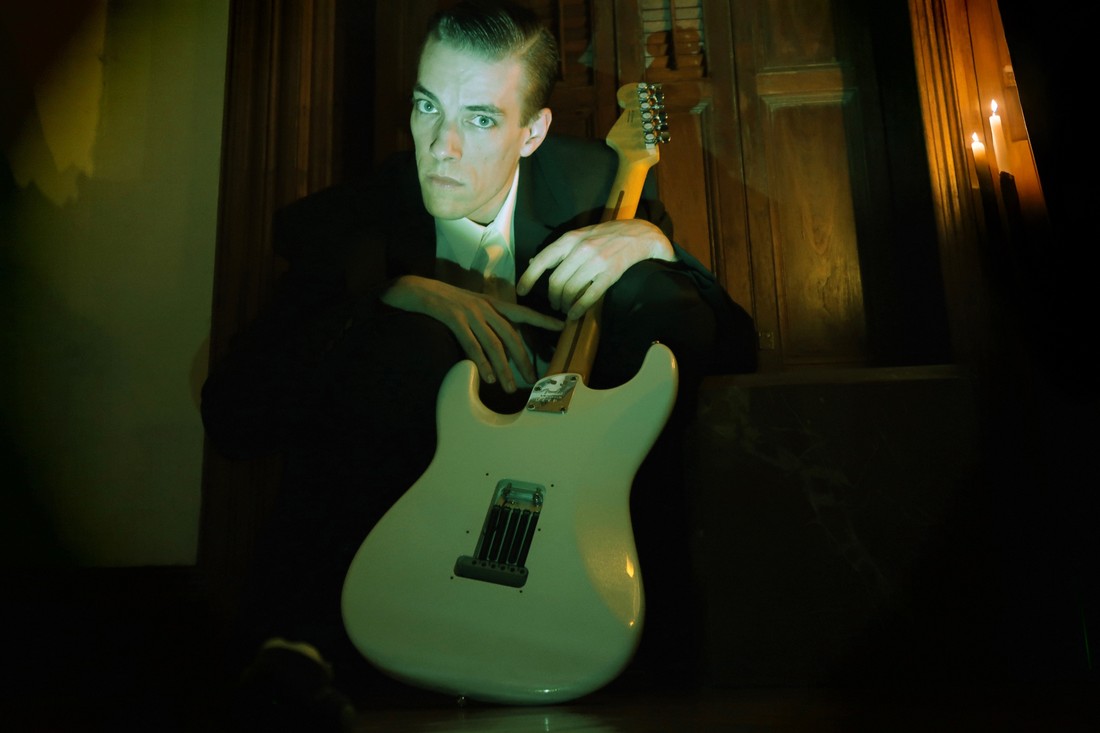
Name: Mauro Hertig aka Xol Meissner
Nationality: Swiss, NY-based
Occupation: Composer, guitarist, vocalist
Current release: Xol Meissner's new album Excess of Loss is out via Birdwatcher.
Current Event: Catch Xol Meissner live on his upcoming European tour:
Feb 19, Basel, Rittergasse 25
Feb 21 Zurich, venue tba
Feb 22 Munich, Zielstatt Studios
Feb 25 Paris, Péniche Adélaïde
Feb 26 Montreuil, Les Nouveaux Sauvages
Feb 27 Arles, Les Collatéraux
Mar 4 Warsaw, Chmury
Mar 5 Bratislava, Nová Cvernovka
Mar 6 Vienna, das Lot
Mar 7 Graz, HALLE FÜR KUNST
Recommendations for New York, USA: The New York Public Library at Bryant Park 42nd St. One of the most beautiful spaces in the city. I have spent my first two years in New York composing there. The Public Libraries are the last inside spaces in the city where you do not have to consume in order to be welcome. And all the drama that happens around you, what people read, study, when they fight over spots at the tables - it is like theater.
Topics I am passionate about but rarely get to talk about: Berthold Brecht‘s epic theater - Its Verfremdungseffect and the opposite of what is usually understood as "epic.“
If you enjoyed this Xol Meissner interview and would like to stay up to date with his music and upcoming live performances, visit Mauro Hertig's official homepage. He is also on Instagram, and bandcamp.
When did you first consciously start getting interested in singing? What was your first performance as a singer on stage or in the studio and what was the experience like?
Weirdly, singing was a means to an end for me.
I had worked as a classical composer for close to a decade, active in experimental improvisation, writing scores for other people. But I also had loads of poetry lying around, which I had written on trains when travelling between rehearsals.
The voice was a way to bring the practices together by way of song
If you're also playing other instruments, how does the expressive potential of these compare to your own voice?
I am a trained guitar player. In contemporary classical music, I have written a lot for guitar, using extended techniques that involve hitting the strings, brushing them, stroking them really in any way apart from the usual plucking.
Gently hammering them with two metal slides was the one that ended up being the technique that worked best to sing along. It creates a shimmering, ethereal sound which allows for a low, dreamy voice to melt into.
My friend Gryphon Rue called the technique a mix of Eddie Van Halen and La Monte Young - I hope it was meant as a compliment, though am not sure. It is both relaxed and full of tension.
Singing is an integral part of all cultures, and traditions. Which of these do you draw from – and why?
I am very drawn to the interplay between intimacy and drama of the German Kunstlied in the Romantic Period.
For the lyrics, I take from the medieval Bard and Troubadour tradition a lot - a lower class musician singing for an upper class court. Typically sung upwards, in the direction of the balcony to a courtly lady - the fact that the singer can never be with her in real life creates its spiel.
What were some of the main challenges in your development as a singer/vocalist? Which practices, exercises, or teachers were most helpful in reaching your goals – were there also “harmful” ones?
Once I started singing a lot, I was always disappointed after two hours or so that the voice stopped voicing.
I asked a classical soprano friend of mine for advice, and she just laughed out loud. Turns out there is a natural limit of high performance for any voice and two hours is usually already pushing it.
What are the things you hear in a voice when listening to a vocalist? What moves you in the voices of other singers?
Weirdness - an element of confusion that puts itself between the lyrics and the sound.
I love Zsela, the way she makes a low voice work in unexpected ways.
I love Thomas Azier, for the mix of tenderness and drama.
And Dietrich Fischer-Dieskau, because he had this one very particular color that only he had and no one knows how he did it and no one ever will.
And, obviously, Nico
How would you describe the physical sensation of singing? [Where do you feel the voice, do you have a visual sensation/representation, is there a sense of release or tension etc …]
Singing as Xol Meissner means becoming the protagonist of dramatic text, almost like in theater. It means becoming violent, sarcastic, infinitely loving and potentially lost.
It has to be dark, soft and always slightly scary for myself.
We have a speaking voice and a singing voice. Do these feel like they are natural extensions of each other, ends on a spectrum or different in kind?
I write my lyrics with an inner speaking voice - the rhythm of the words has to be right. And the vowels have to make a beautiful sound when spoken.
For example, in the opening lines of “Pyramid” - I let him hit / only the tip of the pyramid / brick into another brick / coupled in gloom. It is a play of woven vowels until the hard consonant in “brick” triggers “gloom”, which sounds different and opens the next phrase.
The melody and rhythm of the language is always the first layer. The guitar and actual pitched melody is then added to it, with its tonal harmonic context and instrumentation.
What are the potentials and limits of your voice? How much of your vocal performance can and do you want to control?
I have been experimenting with falsetto voice a lot recently. There is something special about the very limited control of the voice up there, especially when switching between chest and falsetto within a song.
I would love to lose control more, but it is really difficult to do that while also playing this tricky technique on the guitar.
As a singer, it is possible to whisper, scream, reveal deep secrets or confront them with uncomfortable truths. Tell me about the sense of freedom that singing allows you to express yourself and how you perceive and build the relation with the audience.
I have had very extreme reactions to my concerts.
Probably because the voice, on the surface, might sound faintly classical, but also very 60s-chanson. But the music around it - the guitar, the live-electronics, the percussion - is quite experimental. I think it creates a chasm that at first might be a bit hard to accept as a listener. I am not sure.
I'd love to know more about the vocal performances for Excess of Loss, please, and the qualities of your voice that you wanted to bring to the fore.
Patrick Higgins (of Zs, AEAEA), my producer, was extremely helpful in finding the right vocal approach to taping my record Excess of Loss.
He would say things like: The membrane of this mic is held into air by horse hair from the 1940s. John Coltrane recorded his sax on this. You have to get to know its spirit, breathe with the mic and communicate with it.
Strain is a particularly serious issue for many vocalists. How do you take care of your voice? Are the recipes or techniques to get a damaged voice back in shape?
When Bjork is touring, she tapes her mouth with gaffer tape whenever she goes dancing after gigs.
I self-impose non-verbal communication the day before the concert. Might have to use the tape trick when I go on tour next month …
How has technology, such as autotune or effect processing, impacted singing? Has it been a concrete influence on your own approach?
As a composer I had experimented with autotune and mutual influence a lot - instruments controlling each other's pitches via networks of force and dependence. The results of these have influenced the recent lyrics as much as my current sound. They have bled into the drama of it. The lyrics speak of control, force, interface, processing.
But I also pitch-track my guitar, which in return triggers a sampler of granular vocal samples, all auto-tuned and processed, messing with the panning in small psycho-acoustic explorations.
For recording engineers, the human voice remains a tricky element to capture. What are some of the favourite recordings of your own voice so far and what makes voices sound great on record and in a live setting?
The voice always sounds best when recorded on the phone - strongly compressed and off the cuff. This is what you are up against when recording in the studio.
It took us a long time to find the right space for the voice, because there is so much of it to fill, so much silence around the guitar and the other instruments. It started clicking once I became the character of each song, with its body and movements.
It is the opposite of being a session musician in an ensemble. I had to claim all the available space, the voice is the center and the weight of the Xol Meissner sound.
Motherese may have been the origin of music, and singing is possibly the earliest form of musical expression, and culture in general. How connected is the human voice to your own sense of wellbeing, your creativity, and society as a whole?
Singing saved me.
I was at a point where I was fed up with the music I had created. Singing with friends, with family had always been a communal practice with warmth and connection.
I have now extracted that and made it my main tool of channeling creative energy - surely without danger of ever isolating, overusing or perverting it, haha.