Published
Part 1
Name: The Young Mothers
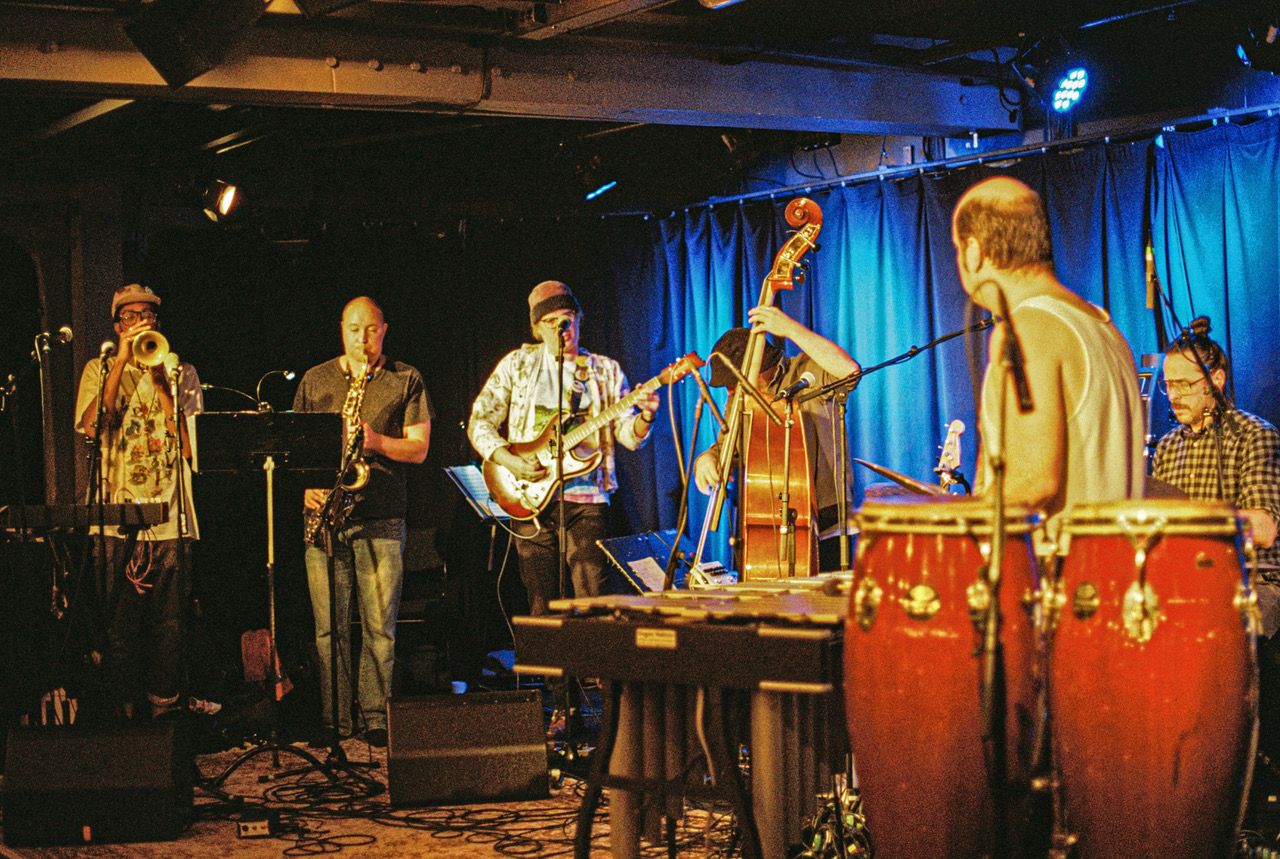
Members: Jawwaad Taylor (trumpet, rhymes, electronics, programming), Jason Jackson (tenor- and baritone sax), Stefan Gonzalez (vibraphone, drums, percussion, voice) Jonathan F. Horne (guitar), Ingebrigt Håker Flaten (acoustic & electric bass), Frank Rosaly (drums, electronics, programming)
Interviewees: Ingebrigt Håker Flaten, Stefan Gonzalez
Recent release: The Young Mothers' new album Better If You Let It is out via Sonic Transmissions.
Shoutouts: Ingebrigt: Big Ears, Blow Out, We Jazz, Le Guess Who?, Berlin Jazzfestival..++.. International Anthem, Relative Pitch, Edition Records ++... Sofia Jernberg, Rob Mazurek, Ben LaMar Gay, Sanem Kalfa, Mette Rasmussen, ØKSE, Petter Eldh, Ole Morten Vågan, Moor Mother, Amirtha Kidambi … there are so many more !! Amirtha Kidambi, Elder Ones - Eat the Rich (live at Jazz Cerkno) ØKSE feat. E L U C I D - "Skopje" [Official Video] BIMHUIS TV Present: TRONDHEIM JAZZ ORCHESTRA & OLE MORTEN VÅGAN LORIMER feat. Savannah Harris
[Read our Ingebrigt Håker Flaten interview]
[Read our Frank Rosaly interview]
[Read our Rob Mazurek interview]
[Read our Ben LaMar Gay interview]
[Read our Mette Rasmussen interview]
[Read our Amirtha Kidambi interview]
If you enjoyed this Young Mothers interview and would like to stay up to date with the band and their music, visit them on bandcamp. Also, check out the Young Mothers playlist.
What were some of the musical experiences which planted a seed for your interest in jazz?
Ingebrigt: My musical journey began in Norway in the late '80s and early '90s. At that point in time, jazz there felt more like an open language of improvisation and freedom than just a genre. Influential artists like Jan Garbarek, Terje Rypdal, and Jon Christensen—especially through the ECM label—shaped that soundworld.
A key turning point for me was hearing a moment during a bass solo by Swedish bassist Palle Danielsson (RIP), transitioning into a piano solo from the Keith Jarrett Scandinavian Quartet on the My Song album.
That energy sparked a curiosity that launched a lifelong exploration of sound and expression far beyond my imagination. Seriously no joke!
I started studying Jazz at the Music Conservatory in Trondheim in 92 (after my third attempt) and it all snowballed from there. Over the years, I've been very fortunate to collaborate with and learn from so many incredible musicians, and I still do. I am still learning every day.
One highlight (among MANY) was working with Neneh Cherry on The Cherry Thing.
I’m currently reading her biography, A Thousand Threads, which offers powerful insight into her life as the daughter of Don and Moki Cherry, growing up between Sweden and New York, and later becoming part of the punk, hip hop, and pop scenes in the UK. Her story is so deeply inspiring and worth reading.
Fun fact: there were early discussions about a second Cherry Thing album, where Neneh hoped to invite Ornette Coleman as a guest—but sadly, it never came to be.
Stefan: I grew up in an extremely musical and artistic environment. My father was a trumpeter who played free jazz. I grew up with the giants of this music cycling in and out of my childhood home for rehearsals and recording sessions: Louis Moholo-Moholo, Paul Rodgers, Andrew Lamb, Paul Plimley, Charles Brackeen, Malachi Favors, Kidd Jordan, Carlos Ward, Alvin Fielder, Andrew Cyrille, Fred Hopkins etc. etc.
Although I wasn't terribly interested in playing jazz as an adolescent learning drums, it served as a huge inspiration to me to be surrounded by these people who were so passionate and determined to live a life of creativity. When I came around to listening and appreciating jazz music in my later teen years, and really understanding it's importance to music history, I was blown away to find that I was in the presence of these absolute masters of jazz, avant garde, free improvisation.
One performance that really planted a seed was getting to see a trio consisting of Kidd Jordan, Peter Kowald, and Alvin Fielder, live in New Orleans when I was around the age of 15 or 16. Unforgettable!
What does the term jazz mean today, would you say?
Ingebrigt: For me, jazz has always been about refusing to be boxed in. I see that same spirit in a lot of younger musicians today.
With The Young Mothers, I try to approach genre boundaries with as little respect as possible—we are letting free jazz collide with hip-hop, punk, noise, and whatever else feels honest at the moment. I see jazz as an attitude—about exploration, risk, and reinvention. I like pushing the music as far as it can go while still acknowledging the roots that shaped us. I believe that this mix of influences is part of why our music in The Young Mothers connects with both jazz listeners and people who may not usually listen to jazz.
Artists like Don Cherry had a huge impact on me. His openness, his boundary-pushing approach, and the way he lived—especially during his years in Sweden with Moki—left a lasting mark on the Scandinavian scene, and definitely on me.
One of the bands that been most important to me, The Thing, had our initial meeting as a recording session playing music by Don Cherry curated by Mats Gustafsson.
This led to 20 years of touring, lots of amazing collaborations and a bunch of albums!
Stefan: It's more a point of reference to the vibe of the music, but many see the word jazz in a negative light as it was originally used to put down black musicians in the United States. Literally an institutionally racist reaction.
It feels dirty to say it sometimes, because as anyone in the so called free jazz scene knows, this music's power cannot simply be minimized to one defining genre title. It boxes us in. But anyway, it's very difficult to always give this long and drawn out perspective everytime someone asks me what kind of music I play.
That being said, jazz today means ... what it means to you, what it means to the people listening, what it means to the people playing. If you listen to our latest album Better If You Let It, you can sense that we are unhindered by being worried about what is or isn't technically jazz.
It's an important historical point of reference, an improvisational springboard to a world without limitations.'
As of today, what kind of materials, ideas, and technologies are particularly stimulating for you?
Ingebrigt: Aside from always trying to find new pathways and sounds on acoustic and electric bass, electronic tools and production techniques play an important role in shaping my sound, and I find that process really inspiring.
For example, the intro of the title track on our last album was produced by Jawwaad using material we recorded in the studio—he built a loop that eventually merged back into the live performance.
“Lijm” is another example of how we try to integrate electronic elements into our music. I love including these types of elements in lots of projects I am working on today. This kind of processing opens up new possibilities.
The ongoing challenge is keeping the raw energy of improvisation intact while using modern production tools to support, not dilute, the music. Staying true to that balance is just as important when playing live.
Stefan: I'm not huge into technology. I want to get my hands dirty and cut up a little. My chosen approach to any composing these days exists primarily in the vibraphone, and secondarily on the drum set.
Additionally, I write a lot of poems, lyrics, and intellectual concepts as well, but most ideas I write down don't make the cut for being presented to anyone other than myself.
Where do most of your inspirations to create come from—internal impulses or external ones?
Ingebrigt: Improvisation is a way of life for me.
I often feel that our music reflects the urgency of what’s happening around us—socially, politically, and personally. The way we shift between structured grooves and chaotic improvisation mirrors the unpredictability of life today. Each time we play, the music changes depending on what’s going on in the world and in our own lives.
Given the current state of things, I’m really curious to see where the music will go the next time we come together.
Stefan: A mixture of both internal and external, however overall I think it is probably more internal. I'm not one of these people that are constantly documenting every little idea that comes to them. If it's that important I will know.
But I also believe strongly in letting one's internal tension and storm of creativity rage, until it naturally explodes out of you.
We need to be more discerning about not just impulsively sharing every little creative thing that occurs to us. When it is worthwhile and undeniably authentic you will know.