Part 1
Name: The 5 Point Palm Exploding Heart Technique'
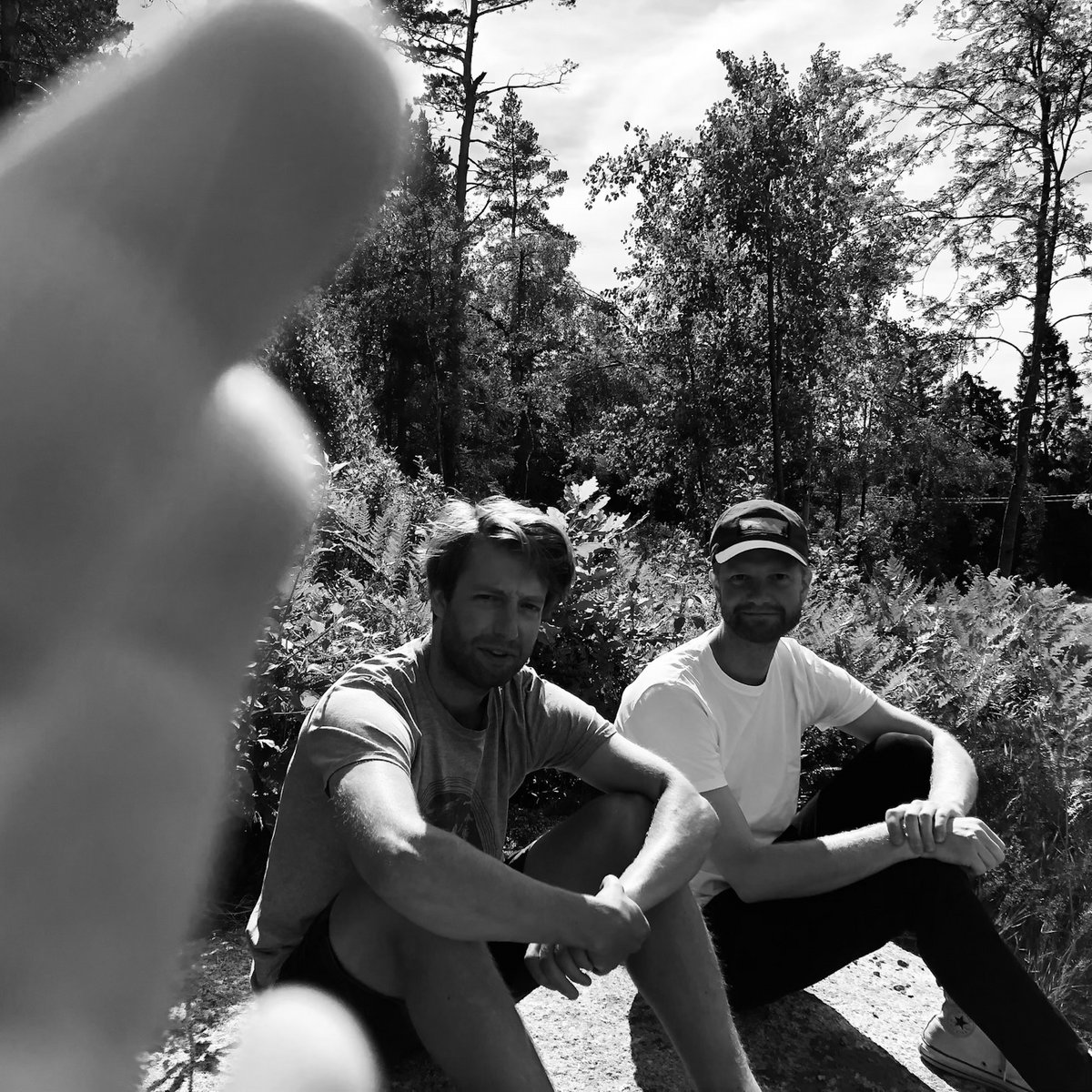
Members: Lars Løberg Tofte, Arne Mathisen aka Rural Tapes
Nationality: Norwegian
Recent release: The 5 Point Palm Exploding Heart Technique's In Transit is out now.
If you enjoyed this interview with Lars Tofte and would like to find out more about The 5 Point Palm Exploding Heart Technique, visit the duo on Instagram.
For a deeper dive, read our earlier 15 Questions Interview with Rural Tapes, as well as our conversations with him about his creative process, and production.
What were some of your earliest collaborations? How do you look back on them with hindsight?
It feels like I’ve played with Arne for forever.
It's like he’s always been behind the drums whenever I turned to see with my bass guitar around my neck. Either on stage or in a sweaty rehearsal space. Me standing next to his ride cymbal, and him beating the hell out of his set, while banging his head so hard the headset or hood of his jacket (or both) would fall off. Or calmly anticipating the next part of the piece we were playing, with his mouth half open quietly hitting his hi-hat made of two crash cymbals (the word “quietly” might be a bit misleading).
Specifically I think I asked him if he wanted to start a jazz band the summer we were fifteen, knowing he could play both the piano and drums, but first and foremost for just being the greatest and most stand-up guy, “whole wood”, as we say in Norway. Norwegian wood, I guess.
I had discovered artists like Chick Corea, Miles Davis and Weather Report from music cassettes lying around from my older brothers, and it gave some direction for a longing only teenagers can have, and opened up for a much broader horizon musically than I ever thought possible. Venturing there myself however, wasn’t as easy as I’ve hoped.
I think Arne answered “no” giving the reason we weren’t skilled enough, but I’ve always felt it was more to it. Maybe it was because he was more into punk at that time, maybe he felt it was a little too uptight of a project, or maybe he just didn’t want to do it. Being “skilled” has really never been of any focus for us either way, so I think it was just because he didn’t want to do it. And making Arne do something he doesn’t feel like, well, better men than me have broken their backs trying. It’s a trait that frustrates me deeply and also one of the things I admire the most about him. It has time and time again kept me from losing my way, both musically and in life in general.
Anyways, we started a rock band with two of our best friends a couple of weeks later. It changed the course of my life. After only a short time playing together we developed a unique connection I’ve never experienced with any musician or friend. We could just look at each other, or not look at each other, and it was like we always knew what it meant, what the other was thinking, where he was going, and even a little like Elliot and E.T.; feeling the other’s feelings. Having such a friend and collaborator in life is just beyond measurement. It’s so natural and easy both on and off stage, so it’s easy to take it for granted, but it truly is something remarkable.
“Varanasi” is an example of this chemistry. I think we created the whole thing during take one, and take two is what you hear on the record. Just like that. It’s almost like it was always just out there in the void somewhere, and all we had to do was look at each other and make it audible. Knowing how hard it can be to compose sometimes, it’s crazy how easy it can be too.
I vividly remember asking myself through the years, if I am even capable of making any music at all without Arne. On that the jury’s still out I guess. Luckily we’re still playing together.
There are many potential models for collaboration, from live performances and jamming/producing in the same room together up to file sharing. Which of these do you prefer – and why?
Well we have to be in the same room. At least that’s when we can truly inspire and have an effect on each other, shaping ideas and bouncing off lines and sounds, letting one thing take the other. Me being me, requires us to start off in a quiet space both mentally and sonically, without any audience. In other collaborations and bands (like Heroes & Zeros), we’ve composed totally new pieces of music live on stage.
But there seems to me there’s always some sort of structure or platform there to begin with whenever I feel safe enough to break the rules, so to speak. I know Arne is more prone to just cast himself off a cliff into deep water. I prefer to check the surroundings first, having some sort of an idea how high it is and what to do after I break the water. In that sense I think we complete each other in a good way; when my contributions containing some sort of structure or system (being a natural sciences nerd) gets a bit on the heavy side, Arne just being natural gives me the confidence to just let things flow and not to overthink it. It’s not like we’re total opposites or anything; combining our contributions in the moment just makes the duo more than one plus one.
I don’t know if we would have the same effect on each other in a file sharing project, we’ve never tried. The idea can appeal to me, but when it comes to pressing the red button, I always prefer having Arne there. And to me part of the deal of being together in a band is actually being together; the sharing of space in a room, the effect of the pressure waves in the air between us hitting our ears (and body when playing really loud, and yeah we do!), the mere presence of each other. I think it’s something rooted deep inside us humans, that shouldn’t be ignored.
File sharing has some amazing perks, but it’s a different process. To me, nothing can beat just sitting down playing music together, hanging out, sharing a meal, and then go at it again.
How did this particular collaboration come about?
We have played together for over two decades in different bands and collaborations, and recorded stuff together just for fun, just like “what are you doing this weekend? I just borrowed this recorder, wanna come over and find out how many tracks it has? Bring some instruments, or if not, we’ll just do with whatever we find in the basement!”
After we left the den, Arne went to Trondheim studying music for a year while I travelled around the world for six months. This was back in 2001. Several of the samples on the album are recorded on that trip, in different parts of the world, from India to Fiji to Paris. And also a blackbird from my backyard in Oslo, fittingly on the track called «Transit» (it’s not there anymore, maybe it’s migrated?).
I think the waves you can hear on “Indico” are from a small, secluded beach somewhere in Mexico.
I’ve always tried to record stuff when I’m going places, like when I managed to get a street poet named Richard Alan Maguire captured on my hard disc recorder in 2009 in Miami. Him freestyling on a corner downtown can be heard on several tracks on our previous record “1”.
However on this trip back in 2001, the world was a little different in terms of affordable, portable recording devices; I brought my Sony minidisc Walkman MZ-R70 with a small condenser microphone the size of a golf ball and a bunch of empty minidiscs. I’d be walking through a dense patch of jungle somewhere keeping one eye out for snakes and the other on the input signal, worrying about the quality of the recording.
Back in Norway, we both moved to Oslo in the fall of 2002, and started playing together very loud, just the two of us. It was a lot of fun, but then Hans Jørgen Undelstvedt joined us one Saturday evening, a microphone happened to be on and he started singing, and it was all whirlwind, heat and flash. It was obvious to all we were a trio from that moment on, and it was the start of Heroes & Zeros.
However, a tiny spark from that fall eventually also led to the duo The Five Point Palm Exploding Heart Technique many years later, fittingly named by Hans Jørgen. After all it has always felt natural to play with Arne, so it’s not so much “How did this collaboration come about”, but more “How could it not!?!”. It’s the natural way of things; snow is cold, rain is wet, playing together feels like home again after travelling, and when the world seems like a big and scary place, being in a barn in the woods with a close friend caring about making music is feeling very right.
Tell me a bit about your current instruments and tools, please. In which way do they support creative exchange and collaborations with others?
I think it’s fair to say that we use the instruments we have. It’s unfortunately not quite as romantic as just using the first bass guitar I bought for $50 when I was fourteen. (I still got that bass though, an Ibanez Roadstar II series with five nails through the pickguard, it’s in a case on top of my closet in my bedroom. Still regret pulling the frets out, it might still be my go to if I hadn’t).
But I guess to some extent it’s like we just use what we have and coincidentally have been playing for one reason or the other. You stumble upon an instrument, you get fascinated, and you learn to play it in a way that makes sense to you, and it just feels right. The sound you make on it, the way you make it sing or whatever, it can be quite special, and it’s not given you can make the same magic on a different instrument. And it eventually becomes your sound too, when you kind of make that instrument part of you. Or part of the band or collaboration.
I can think of a band I played in, and it’s like “That band’s sound is that bass guitar.” Like they can’t be separated, without making everything slightly different. And different doesn’t have to be worse, it’s just … different. It’s totally possible for me to define periods of my life in terms of bass guitars. Different eras with different projects and different sounds. At this point in my life and with this duo, I just go by my gut. I couldn’t explain why I used the Epiphone Rivoli semi-hollow on that track or the Fender J-bass on that specific part in terms of sound or dynamics in a technically way, it just has to feel right in a way.
Whether our instruments support creative exchange in a special way I don’t know, but we try out different things and combinations for different ideas, and switch it up if we don’t strike a nerve. Sometimes it’s just the P-bass straight into a Bassman 100, and we play together and some kind of landscape emerges in the focal point between the bass and the drums that just hits the spot. I think Arne is on his second set of drums since he first started out, and more than switching to have another sound, it feels like he makes them sound how he wants.
I mean we love gear, but mostly we love using the gear we have and combining stuff to make sounds and texture that appeals to us right there and then. It’s nice to be in his studio barn in that sense, with some old zither in a corner and some weird percussion in a box, and a partly broken metallophone up on the wall with a wonderful harmonium under it. When you suddenly forget time and place, and just are so present and focused, you might just look around and grab that metallophone and yell “press record!” and capture that idea that just bounced off something else.
Like on “Magen min” we struggled a bit with conveying the idea of the melody on the a-part in a way that made sense to us. We thought we were on to something, but it didn’t sit right, and we tried blasting it out with amps on 10 and full distortion. That didn’t work at all. After a cup of coffee on the grass in the sun, we went inside again, Arne started messing around with an old drum machine from Eastern Europe with lots of knobs, and I started playing the part again really soft on a different bass guitar. We added some drums, and then one thing led to another, more and more ideas seemed to pop out of thin air as we continued.
On this track we also added some layers together, like making the bass guitar into a wailing sea-creature; me standing in front of the amp fighting for the feedback with a bottle neck while Arne controlled the filters on an Electro-Harmonix microsynth and delays.
Creating music together like that is really inspiring, and Arne knows his studio and gear so well in a very creative way, he works very intuitively. We don’t spend much time getting every mic placing perfect or the sound-noise ratio up to max after the fundament of the track is in place, rather we record the ideas there and then on the nearest suitable mic, and let things flow.
Making things sound state of the art is not a goal in itself for us, we’re more concerned about the texture of each element and how it contributes to the whole, often wanting to add some “resistance” in the mix. Again, it has to feel right.
The majority of the producing is done as we move along, like pushing the drums through the preamp of a Roland Space Echo or running them backwards there and then, it’s part of the creative process, and the result will in turn foster new ideas, that wouldn’t have come if we’d waited until some post-producing phase.
Although it has to be said that Arne is an early riser compared to me, and often gets outlet for some exciting sound processing or tape-loop-ideas on something we recorded the night before, while I’m still in bed or chilling on his porch with a damn fine cup of coffee. I can walk into the studio finding him lurched over an old tape machine and just listen to some brilliant new take on something we’ve struggled with the day before. Sometimes I wonder where he gets his ideas from, maybe his dreams are made of old tapes?
Over all, using the studio and gear like this is a great way of collaborating, and doing most of the work “outside the box” makes it easy for us to bounce ideas off each other, I think we both very much like the hands-on approach, the tactile feel of turning a knob and listening to what it does.