Part 2
Can you talk about a work, event or performance in your career that's particularly dear to you? Why does it feel special to you? When, why and how did you start working on it, what were some of the motivations and ideas behind it?
I recently composed the score for Suneil Sanzgiri’s film Two Refusals, which is about the Portuguese occupation of Goa, India and Angola and Mozambique in Africa and their interconnected liberation struggles. It was my fourth time working with him but it was a longer film and the format was unique as an exhibition at the Brooklyn Museum.
I worked on it collaboratively with Booker Stardrum and it was a very meaningful experience. Suneil had interviewed a 94-year-old freedom fighter in Goa who was imprisoned by the Portuguese as a teenager. In these interviews she talks about how the Portuguese soldiers beat her, knocking out all of her teaching and breaking many bones in her body in multiple places.
She also sings freedom songs that she composed in prison orally, so I decided to learn them. As I was singing them, I gravitated toward one of the modes and melodies and used that as the starting point for all the material.
It felt very organic and also meaningful to connect to that anti-colonial history from my motherland as someone living in diaspora, especially at a time where we are seeing so many conflicts with colonial underpinnings and history.
How do you feel your sense of identity influences your collaborations? Do you feel as though you are able to express yourself more fully in solo mode or, conversely, through the interaction with other musicians? Are you “gaining” or “sacrificing” something in a collaboration?
I feel almost entirely interested in collaboration. I love having a band, and Elder Ones has been such an important project for me. Each line-up of that band has shaped me. I don’t write for instruments, I write for people, and each of my bandmates over the years has shaped my voice and my compositions.
It is such a fulfilling experience and this new line-up is absolutely beyond my wildest dreams. The band now is Jason Nazary on drums and modular synthesizer, Lester St. Louis on bass/cello, Alfredo Colon on tenor sax and Matt Nelson on soprano. 
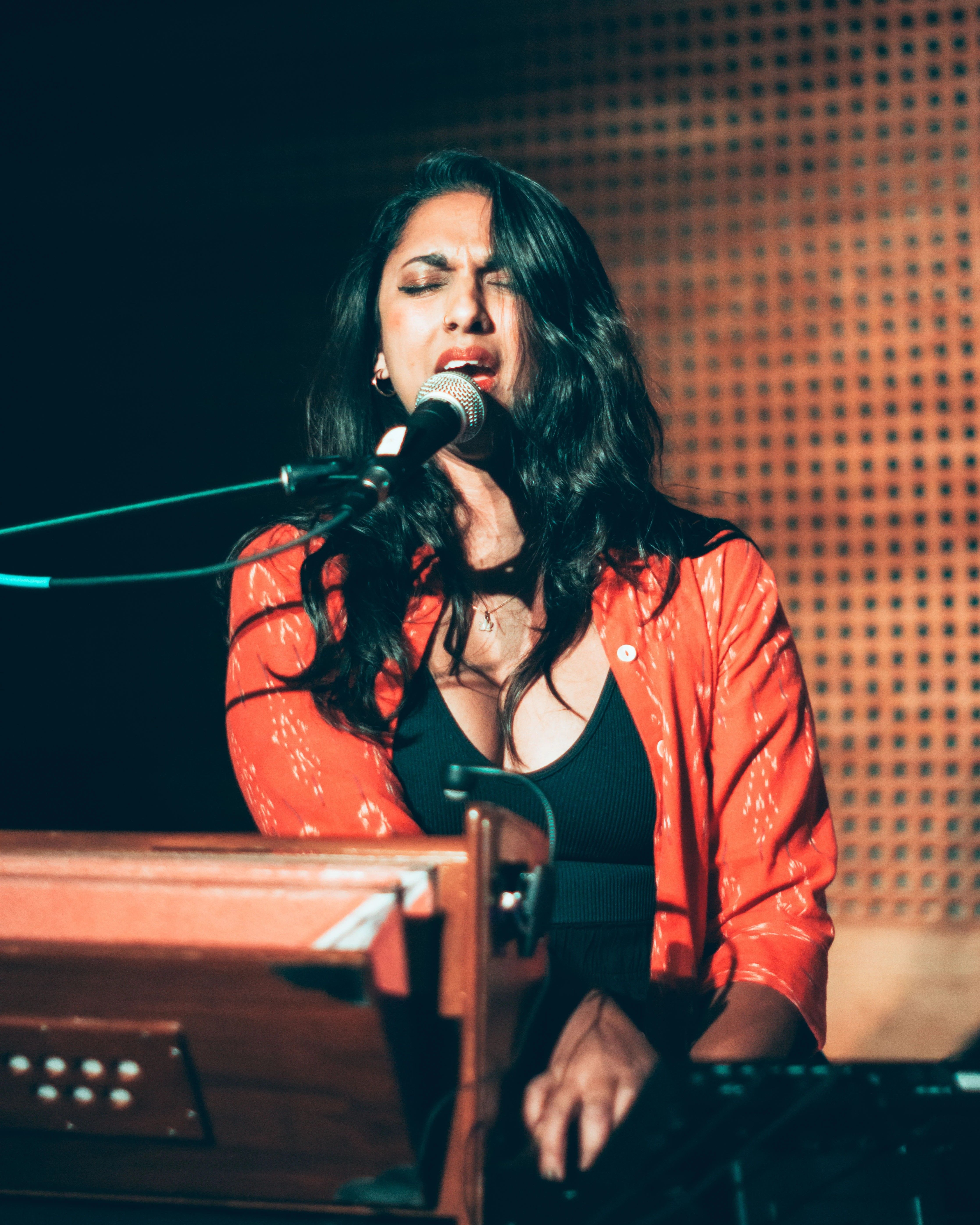
Amirtha & Kidambi Elder Ones Interview Image (c) the artists
I think our latest record New Monuments is the work I’m most proud of so far and the band sounds incredible. I try to keep my compositions as open as possible so people can really explore their full vocabulary. Each person has their own electronics setup and there’s rarely a time I can remember ever saying no to a band member or telling them not to do something.
I’ve never been super interested in playing solo, though many musicians have told me it’s important to do. I guess I don’t really want to do it unless I feel really strongly compelled to. The few solo sets I’ve done didn’t really feel like they “worked” for me, so it’s something I’ll go back to only if there’s a strong reason.
I just really feel like collaboration always opens up ideas I would never have on my own and there’s an alchemy to it that is so compelling and I seem to be obsessed with duos because I have so many with musicians such as Luke Stewart, Darius Jones, Maria Grand, Lea Bertucci, Matteo Liberatore and Matt Evans.
Derek Bailey defined improvising as the search for material which is endlessly transformable. Regardless of whether or not you agree with his perspective, what kind of materials have turned to be particularly transformable and stimulating for you?
I agree with that. With Elder Ones for example, I don’t make the record until we’ve played it live a lot. I actually write while we play and continuously edit and adjust.
For our latest record New Monuments, I started writing the material in 2020, and we have been playing it in some form since 2021, but by the time we recorded it in late 2022 it had changed so much. We got to do some tours and each performance influenced my understanding of the music so much, because of the improvising and the contributions of my collaborators.
Even now that the pieces have taken some final form on the album, every iteration is so different. I feel like we find something new every time, and can continuously dig deeper on in every performance. It always feels new. I use repetition a lot in the compositions as well, because on each iteration there is the opportunity to transform it more and more.
There are many descriptions of the ideal state of mind for being creative. What is it like for you? In which way is it different between your solo work and collaborations?
For me the most ideal state is to be in my body rather than in my head. There is a kind of ego destruction that needs to happen to get out of the way of my ideas and let something flow.
Sometimes I notice when I am most sleep deprived, I end up doing really wild things. I remember Elder Ones having a crazy travel day in Europe where we woke up in Oslo at 4:00 in the morning and took two flights to Venice, then drove a couple hours to get to a festival in Slovenia.
By the time we played, we were so out of it and tired, and it was one of our best sets ever. We couldn’t overthink anything, we just had to survive.
How do you see the relationship between sound, space and performance and what are some of your strategies and approaches of working with them?
I always think about the space when I perform. That might mean the social implications of the space, like what does it mean to play in a collectivist DIY or punk space, versus Carnegie Hall or a museum with huge endowments and shady politics?
I often make sounds and play in public spaces, even at protests, and think that sound is an important intervention in public space. I am also really drawn to acoustics as a vocalist, and for me the acoustic space is really an extension of my instrument.
I try to approach every room a bit differently depending on how it responds. This has become especially important as I work more with feedback, as I’m finding that every room has different tones and properties.
In a way, improvisations remind us of the transitory nature of life. What, do you feel, can music and improvisation express and reveal about life and death?
Improvisation is very much a part of daily life to me. It is one of the tools we use to survive.
I think my attraction to it has always been the sense of impermanence and ephemerality, like a Buddhist mandala made of sand that can be blown away at any moment. Coming from the Hindu philosophy, birth, life, death and rebirth are all kind of improvisational transformations.
We don’t really think of the body as anything but a transient vehicle, constantly shifting forms and changing. Improvisation helps me tap into something beyond the physical world, the divine, the spiritual, something not on this plane.
I have a project called Neti-Neti with drummer Matt Evans where we both use a lot of feedback and electronics, which is a project that is essentially a meditation on grief. Both of us lost people very close to us in 2019 and the project has been a way to create space for processing grief together and to help a community process grief.
[Read our feature with Matt Evans about Touchless Touch, Grief and Death]
Death is always present for us, individually and globally. In improvisation, I think you become very in touch with the idea of impermanence.
Impermanence was the name of our first Neti-Neti record, thinking about presence and absence when someone is no longer available to us in their physical form.