Published
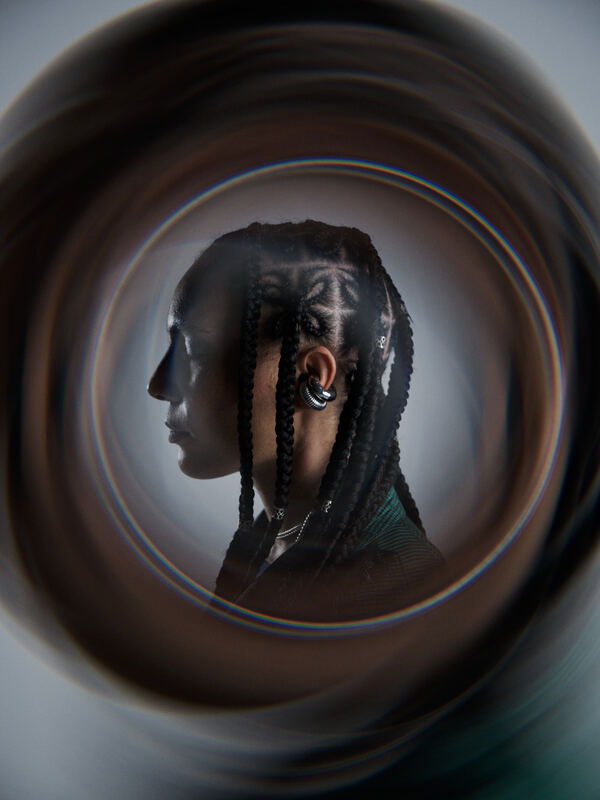
Name: Anaïs Maviel
Nationality: French-Haitian
Occupation: Composer, artist, vocalist, multi-instrumentalist
Current release: Anaïs Maviel's new album listen to the rain is out via protomaterial. Next to Anaïs Maviel on voice, kamele n’goni, and singing bowl, it features the string quartet of Leah Asher (violin, voice), Marina Kifferstein (violin, voice), Carrie Frey (viola, voice), and Meaghan Burke (cello, voice).
If you enjoyed this Anaïs Maviel interview and would like to stay up to date with her music, visit her official homepage. She is also on Instagram, bandcamp, and Facebook.
For a deeper dive, read our earlier Anaïs Maviel interview.
Many people perceive classical music and contemporary composition as having high barriers of entrance, both for listeners and musicians. What have your own experiences been in this regard?
I am a firm believer that anyone can enjoy high quality art, complexity and spiritual depth. However, the systems & discourse that surround contemporary music are fostering exclusion. I was confronted with those barriers at social and economical levels. I wanted to learn cello but somehow ended up with a flute. Then quickly lost interest in classical training because it was overlooking my orally transmitted music background.
Even at the “jazz” conservatory later on, nobody deemed it necessary to give me access to harmony classes - as a vocalist I wasn’t expected to have that knowledge. I forged my unique path with a good pair of ears, but could not hope for “high level” music education at the French conservatory that selected students based on music reading skills. I had close to none - so no composition for me.
When I moved to the US, I realized “free” improvisation would never give me what I wanted to hear. “Free” is always revealing of one’s hidden structure, the one created by culture, practice and relation.
Thankfully, Alan Pierson from Alarm Will Sound heard me perform my music on the n’goni, and dug how I had tuned my instrument, how I was singing, and making all these tonalities heard at once, all within my “deceptively simple” songs (that’s the journalist description from that show that got me “exposed” to the New York contemporary classical music community).
[Read our feature on the n’goni]
I hadn’t waited for this opportunity to be a composer - in fact, I had already composed “listen to the rain” - but getting a commission from a major chamber orchestra got me to approach instruments I would have never written for, and to learn orchestration and music engraving - basically the composition bootcamp I had been dreaming of.
So, this story is to say: everything is possible. High art is indeed accessible to people who highly value their own experience.
This sense of value based on one’s experience is of course connected to one’s relationship to one’s purpose in life: if one’s purpose is only to survive, that person will be less likely to value their experience, and will focus on goals rather than process - therefore overlooking the benefits of music that isn’t playing the sensory overload and gross emotions game. So, allowing oneself to enjoy music really is connected to how one perceives themselves, their own life, their place in society, and among nature and the cosmos.
This is not necessarily connected to class although structural oppression does influence those aspects of one’s life, therefore making the young person that I was, feeling I didn’t belong being a composer - until I reclaimed my own experience and values.
I believe that as composers, music publishers, writers, organizers and community members, we need to put a lot of care in the discourse around the music we put forth, so that it remains as welcoming as possible, and can be a heaven for all kinds of people to bask in their unique experience of art and music.
One thing that needs to change at the societal level, besides education, is the codifying of concert experiences - such as the shame around clapping or falling asleep. A lot of the contemporary classical audiences nowadays are going to concerts like they are to prove their worthiness, most often intellectually.
You can feel the servitude in concert halls, people are supposed to passively receive music in this one way relationship, and they follow tacit rules with pride and the feeling to be part of an exclusive club. That’s what contemporary classical and avant-garde jazz’s marketing strategies have suggested, sadly.
I say we don’t need exclusivity in order to emphasize the high value of contemporary creative music. What if we put the power back in audiences’ hands, to evaluate music’s worthiness rather than music evaluating theirs? We can dismantle cultural conditioning around high art music if we question and dare to change the ways we organize concerts, communicate around them and welcome people into a listening space.
As an artist, I am big on staging and crafting the whole experience of the listener, with an emphasis on reigniting audiences’ sovereignty, which got me in trouble with venues, because every place, whether a jazz club or a concert hall, has their own codes and agendas, that are often quite controlling of the audiences’ behaviors. I think that control is in the way of accessibility and genuine social experiences.
Oops just started a manifesto … Title: “The stakes of receptivity in contemporary creative music: a feminine approach to healing social fracture.”