Part 2
What are areas/themes/topics that you keep returning to in your lyrics?
I keep returning to the inner life, the part of a person you don’t see from across the room. The private world behind the public face. That often shows up in my writing as light and shadow, weather, gravity, time, distance, memory.
I’m drawn to the tension between wanting to escape and wanting to belong, between being seen and staying hidden. “Dreamer” is literally about that: protecting an inner world, staying wild on the inside.
“The Color of Your World” is about memory and time, and the question of what happened to someone’s brightness, but it’s not a simple nostalgia song, it lets complexity into the ending. “Gravity” is about longing for a life that feels lighter, and “The Revealing Light” is about love as illumination, becoming closer to the man inside of you.
I also like the viewpoint of a quiet observer that notices that beautiful, mysterious character on the street, scenes that hint at a bigger story, and places that feel slightly unreal but emotionally familiar.
I’m not trying to write headlines. I prefer symbols, because symbols last longer than news.
Do you tend to start writing with what will be the first line of the finished lyrics? The chorus? At a random point? What are the words that set the process in motion?
Mostly random, often just a couple of lines. I’m very scene-based, so sometimes it starts with one image that feels charged, and I write toward it.
Sometimes it’s a phrase that arrives like a thesis and the whole song grows around it. “Gravity denies me” is a good example of a line that can hold an entire emotional argument. “Tell me, how’s the color of your world?” is another kind of anchor line, a question that becomes the song’s spine.
When I was younger I definitely used a thesaurus like a weapon, trying to make language more extravagant or unusual. Over time I’ve learned that “interesting words” aren’t the same as interesting meaning. Now I’m more interested in precision, and in how a line feels in the mouth when sung.
I don’t usually think “verse-chorus-verse, etc ...” at the beginning. I’m not sitting there hunting for hooks. I follow the music and the idea and let the structure reveal itself. Repetition shows up when it earns its place, when it works like an incantation, not just because it’s a rule.
I'd also like to add that a lot of songs just start up with a cool riff on the guitar or a cool cord progression with no lyrics yet in my mind.
When you're writing song lyrics, do you sense or see a connection between your voice and the text? Does it need to feel and sound “good” or “right” to sing certain words? What's your perspective in this regard of singing someone else's songs versus your own?
Yes, I feel a connection between voice and text, and it’s surprisingly physical. Certain words just don’t sing well in certain registers, and certain consonants land differently depending on tempo and phrasing.
Mouth-feel matters. If a line doesn’t feel right to sing, I’ll rewrite it, even if it looks good on paper. I’m always listening for that moment where the lyric “clicks” with the breath, the melody, and the character of the song.
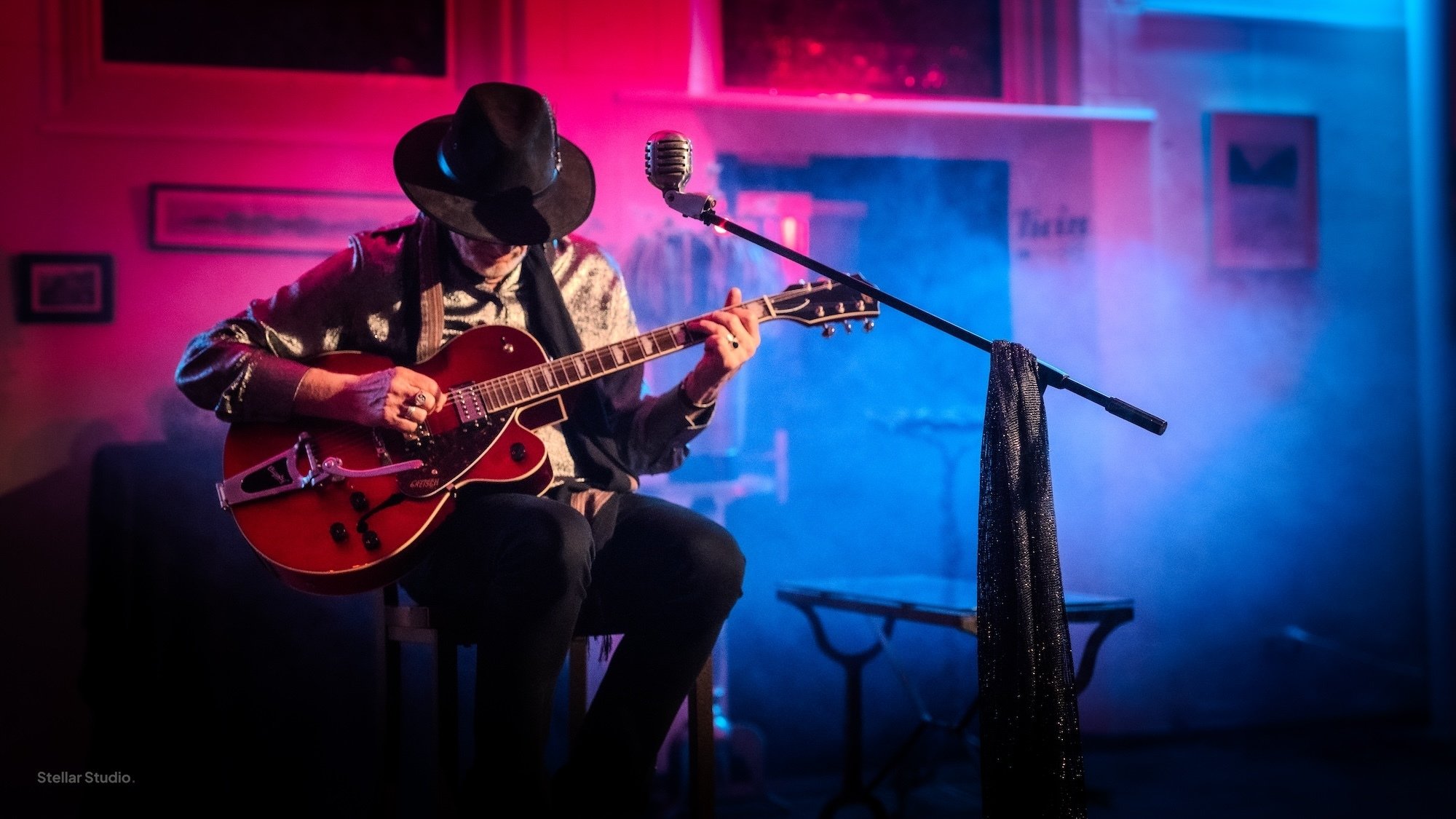
My voice has also changed over the years. I might not say it’s “better,” (actually I do think it is better) but it’s matured, and I’m more comfortable with it now. Lately I’ve also felt more open to just let go when I sing on stage, and that has surprised me in a good way and the reactions mirror my sentiments.
It’s resonating for me internally, but, as I mentioned, I’m also getting more positive reactions about my singing when I’m on stage, which is encouraging. It makes me trust the idea that the “perfect” vocal isn’t always the goal, the honest one is.
And in today’s world, where so much is polished, tuned, and edited until it’s almost frictionless, I actually value the opposite: the human fingerprints. I want a vocal to sound lived-in, like someone is really there, telling you something that matters.
Singing someone else’s songs is a different kind of honesty. With covers, you’re stepping into another writer’s world, but you still have to mean it. Sometimes I enjoy what I’m doing vocally on covers because the story is already built, and my job is to inhabit it and deliver it with feeling.
With my own songs, I’m responsible for everything: the world, the lyric, the emotion, and the delivery. That’s more vulnerable, but it’s also more rewarding when it lands, because the voice and the text come from the same place.
I would love to know a little about the feedback you've received from listeners or critics about what they thought some of your songs are about – have there been “misunderstandings” or did you perhaps even gain new “insights?”
Interestingly, I haven’t often had many conversations with listeners about detailed interpretation, at least not directly. I wish I did, because I’m genuinely curious what people “see” when they listen.
People do say they like my my songs, one that stands out is “Gravity,” I get that requested a lot playing live. With “Gravity,” some people hear it as escapism, others hear it as an abstract scene being described in the song, with that feeling of being pulled down.
It’s funny, it’s actually based upon a recurring dream I had about flying (in a clumsy manner - that’s me sometimes, clumsy) while I was hugging a pillow, which in some way enabled me to fly, and sometimes the pillow would sometimes run out of “gas” and I would start falling, ha ha, so there.
With “Color of Your World,” people can hear the nostalgia and tenderness, but not everyone catches the darker shift at the end, and when they do, the song becomes a different kind of story.
On my second album, “The Plight of Lady Oona” is a deeper narrative, and it comes from a very real place.
It was written about a real person in my life, a beautiful woman from Argentina I cared for deeply, who survived a fire that damaged her face and forced her into a long, painful recovery. Watching her go through that, from far away, and watching how the world can be both tender and cruel at the same time, stayed with me.
The song becomes a kind of fairytale on the surface, but the emotion underneath it is completely true. I’ve never told anyone the story behind the fairy tale because it's pretty personal, but I guess now I have.
And that’s where “misunderstandings” can become meaningful. Sometimes a listener hears a different story than the one that sparked the song, but they still land on the emotional truth. In fact, sometimes that’s how you learn what the song is capable of holding.
Creativity can reach many different corners of our lives. Do you feel as though writing song lyrics or poetry is inherently different from something like making a great cup of coffee? What do you express through music that you couldn't or wouldn't in more 'mundane' tasks?
Making a great cup of coffee is a craft: attention, repetition, small adjustments, timing, taste. Music is also craft in exactly that way. You show up, you refine, you listen, you adjust. In that sense, the “mundane” trains the muscles for the artistic.
But music goes further. With music, I’m not just aiming for “good,” I’m aiming for meaning, atmosphere, and emotional impact. I’m chasing those rare moments where a song hits you in the chest and you don’t even fully know why, you just know it’s true.
And I’ll add something else: I’m often drawn to drama (emotion) in art and music, depending on my mood, and I sometimes strive for that in my own work.
I’ve been dancing Argentine tango for many years now, and it’s the same thing there. I find it amazing to embrace and dance with a woman I just met (or someone I dance with often) to beautiful, dramatic tango music because it gives you permission to feel everything at once: intensity, tenderness, longing, danger, joy. It’s like a little film you’re inside of for three minutes.
Actually I often live my life as if I'm in the movie that I'm creating, even if I'm the only moviegoer enjoying the film. But I admit, I love that world that I surround myself in.
That’s what I want to be able to affect others in my own music too. I want the listener to experience a kind of drama, to feel like they’ve been somewhere, not just heard something. Coffee can be wonderful, but music is where I try to touch the unspeakable.