Published
Name: Babon
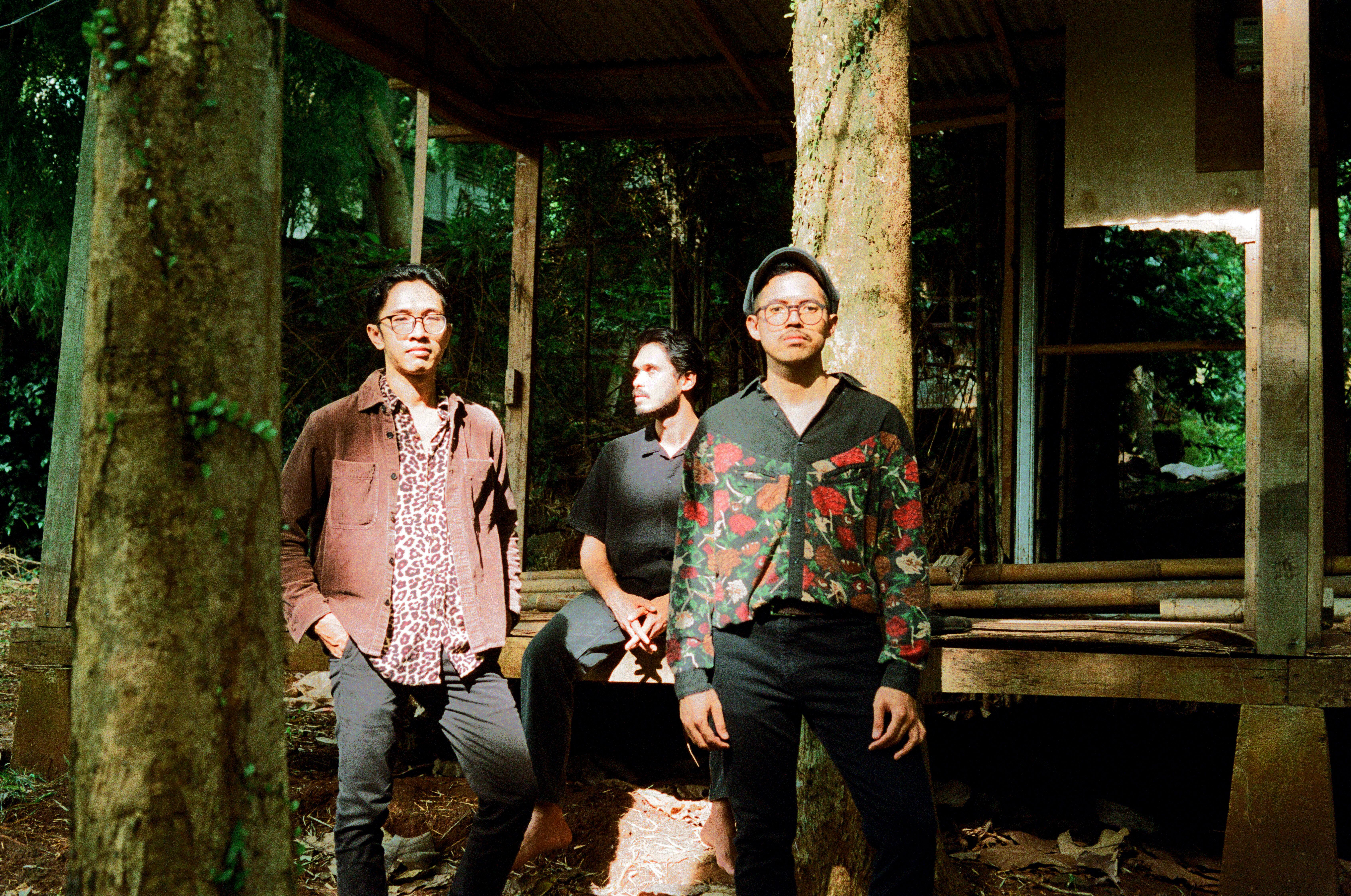
Members: Rayi Raditia (synthesizer), Rori Jiwa (guitar), Wahyudi T. Raupp (drums, percussion)
Nationality: Indonesian
Current Release: Babon's debut album Tropical Desert is out September 26th 2025 via Wonderwheel. Pre-save new single “Mirage”.
If you enjoyed this Babon interview and would like to know more about the band and their music, visit them on Instagram, and bandcamp.
For a deeper dive, read our earlier conversation with Babon about Indonesia's legendary Lokananta Studio and the Indonesian Digital Archive.
What were some of the musical experiences which planted a seed for your interest in jazz?
Rayi Raditia: My early taste in music came from whatever my sister was into—which, looking back, was probably just her boyfriend’s CD-R mixtapes (haha).
That meant a lot of R&B, soul, and some hip-hop. Even though I was learning classical piano at the time, I found those genres super catchy. The beats, the chords, the little melodic runs—they just felt alive. I didn’t realize it back then, but a lot of it was rooted in jazz.
That sound made me want to try playing by ear. I’d sit at the piano figuring out chords without really knowing what they were—just chasing whatever sounded cool. Then I started digging around Limewire (classic) for more stuff with that same vibe.
But my real intro to jazz came in high school, when my friend Kevin played me A Love Supreme by John Coltrane. I remember thinking, “What the f is this?!” It gave me chills I’d never felt from music before. It felt wild and free, but still emotional and lyrical—even without words. It blew my mind.
And on that same day, Kevin also played me Flying Lotus—Los Angeles, if I’m not mistaken—and that sent me in a whole different direction.
It felt like jazz pulled through a wormhole: experimental, textured, floating over fragile hip-hop rhythms. Total brain melt.
You can definitely hear FlyLo’s influence on our track “Cacti Traveler”—that behind-the-beat boom-bap groove in the verses, and those dreamy, ambient electric piano layers? All a little tribute to him.
Shoutout to Kevin for that double drop. That day seriously changed how I hear “jazz”.
What does the term jazz mean today, would you say?
We’d say jazz today is pretty subjective. For some, it still means lush chords, complex rhythms, virtuosic improvisation—even those signature bendy vocals. But for many, it’s become more of a label, often limited by tradition or certain expectations.
Honestly, we relate to what Miles Davis used to say—he didn’t even like the word jazz. To him, it was a box around something that was meant to stay free, always evolving. It was all about moving forward, not being pinned down by definitions or fixed sounds. That really resonates with us.
These days, jazz feels more like a mindset than a style or genre. Sure, there’s still that idea of the “jazzy sound,” but to us, it’s really about exploring new grounds—about expression, curiosity, and pushing boundaries. And that spirit isn’t limited to traditional jazz. You can find it in rock music, electronic music, or even visual art. It’s about the drive to innovate.
But to push boundaries, we feel that it is important to understand them first. Knowing the history, the theory, the techniques—anything that gives you a solid foundation—helps you create something more personal and honest. It’s what lets you go beyond.
After all, music is a language.
As of today, what kind of materials, ideas, and technologies are particularly stimulating for you?
The world we live in today is already overflowing with stimulation—sometimes it feels like a satire of itself. Strangely, that’s part of what fuels our creativity. The chaos, the contradictions, the layers of history, the present moment, and the probable future—they all feed into how we think, write, and create.
In terms of technologies, AI has been surprisingly inspiring. We're not super “techy,” but we’ve found it to be a really useful tool— not in the “prompt your way into a career” kind of way, but more as something that enhances the creative process. From smart plug-ins to generative tools, AI can help smooth out technical stuff and free up mental space to experiment more. That said, there’s definitely a need for balance—clear boundaries and proper regulation—to keep things ethical and fair.
We’re also curious about blockchain tech. Beyond the hype, there’s something interesting about how it could help artists take more control—whether it's around ownership, authenticity, or building fairer economic systems through smart contracts.
It’s still early days, but it feels like it could open up new paths for sustainable creative work outside the usual gatekeepers.
Where do most of your inspirations to create come from – rather from internal impulses or external ones? Which current social / political / ecological or other developments make you feel like you need to respond as an artist?
For us, inspiration comes from both internal impulses and external forces—it’s always a mix.
Sometimes it's the noise in your head, like a rhythm or a thought that won’t leave you alone until you pick up an instrument. Sometimes it’s more visual—like seeing something under your eyelids that makes you reach for a notebook or hit record on a voice memo. It’s spontaneous, but deeply felt.
But most of the time, it’s the stories unfolding around us—the lived experiences, the histories we carry, the world we’re part of—that really spark something in us. Social, political, and ecological issues definitely play a big part in what drives us.
Both of us (Rayi and Wahyudi) come from similar backgrounds—we’ve have been involved in sustainable design projects that focus on agroforestry and renewable energy. Being hands-on in that space exposed us to the raw reality of ecological collapse and the personal, emotional weight that comes with it.
That’s the core of our album Tropical Desert—it's a reflection of what happens when no action is taken. A warning, really. The idea of a tropical region turning into a desert isn’t just metaphorical—it’s already happening in some places.
But we’ve also grown skeptical of the whole "sustainability" industry. It’s become a buzzword, stripped of context or impact. For us, environmentalism without addressing social class is an empty gesture. You can't separate the climate crisis from economic inequality and social justice— they're part of the same system.
The track which really brings all of this together is “Big Cat Small Jungle.”
In it, we imagined a burning forest from the perspective of its animals.
The first half is a chaotic rush—rhythms collide, distorted guitars mirror the panic of animals fleeing, protecting their young, just trying to survive. Then in the second half, the mood shifts. It becomes the imagined final words of a tiger, just before it dies. It’s not just a song—it’s a scene, a story, and a protest in its own way.
What role do electronic tools and instruments play for your creative process?
Electronic tools and instruments are at the core of our creative process—no doubt about that. Whether we’re producing, composing, sketching or just experimenting with sounds, electronics give us the flexibility and range we need to bring ideas to life.
Sure, acoustic and organic elements have their own vibe, depth, and a certain romanticism, and we love blending those in. But let’s be real: we can’t do much without electronics. Whatever it is—you name it—it’s all running through some kind of electronic system now.
Thanks to technological advances, collaboration has become a lot easier. What have been some of the most fruitful collaborations for you recently and what approaches to and modes of collaboration currently seem best to you?
To be honest, we’re pretty introverted and don’t socialize a whole lot, so when we first started this band project, our connections with local musicians were super limited—we barely knew anyone.
We actually ended up collaborating with a lot of musicians from around the world through a freelancer website / platform / application. This platform made it really easy to communicate and give clear direction for how we wanted things executed.
Most of the brass you hear on our album came from musicians we met there—like Frank Grillo, a trumpet player from Venezuela. We also worked with illustrators and video artists through the same platform.
Freelance platforms like this can be a huge help when you’re building something independently. The range of talented professionals out there is amazing, and it opens up so many creative possibilities without needing a big network or budget.
How much potential for something “new” is there still in jazz? What could this “new” look like?
Like we mentioned earlier, for us, jazz is about pushing boundaries and expressing yourself in limitless ways.
With all the tools we have now—electronics, new media, recording tech, evolving production techniques—and with so many sub-genres and niche scenes finding their own space and audience, there’s a ton of potential for something “new” in jazz. It could show up as electronic music, experimental rhythms, sound design, or even through cross-disciplinary collaborations with other art forms.
The idea of jazz doesn’t have to stay tied to tradition—it can evolve into something more interactive, more immersive, and maybe even more emotional in unexpected ways. It’s all about how people choose to express their feelings and ideas in today’s context.
For many artists, life-changing musical experiences take place live. How do you see that yourself?
No doubt about it—live performances almost always give you that extra something you just can’t get through a screen.
That’s why we’re always trying to find gigs and do our best to play live, so people can really feel the full experience. For us, it’s not just about the music—visuals and other cross-media elements are also super important to help bring the whole vibe to life.
There are definitely technical issues and other factors that can make live shows a bit rough sometimes. But when everything clicks, there’s nothing like it.
How, would you say are your live performances and your recording projects connected at the moment? How do they mutually influence and feed off each other?
We are constantly looking for gigs and continue developing our lives shows. Our recordings serve as the base for what we do live. During our performances we feel that we uncover our compositions, find spaces and sometimes discover new ways of playing. These discoveries give us insight into what is possible for future compositions.
Furthermore, since our compositions are deeply tied in storytelling, we are exploring ways to accompany them visually. We feel that this will cause for a stronger performance and delivery of the stories within the songs.
Ímprovisation is obviously an essential element of jazz, but I would assume that just like composition, it is transforming. How do you feel has the role of improvisation changed in jazz?
Yeah, we’d say improvisation in jazz has definitely evolved. It’s no longer just about virtuosic solos or one instrument taking the lead—it’s become more cross-instrumental, cross-disciplinary, and even textural. That core spirit of improvisation is still there, but now it’s happening through different media and approaches too.
As we mentioned earlier, with all the tech and tools available now, people are improvising in new ways—not just with musical notes, but with atmosphere, structure, and even across different art forms. It’s exciting, and it keeps jazz alive and constantly reinventing itself.
What, would you say, are the key ideas behind your approach to improvisation?
For us, the key idea behind improvisation isn’t just about soloing—it's about how spontaneity can live inside structure.
Sure, solo improvisation still plays a role in our music, but what really excites us is improvising within the composition itself. We love experimenting with form— blending genres, throwing in unexpected chord progressions, rhythmic shifts, or sudden changes in direction. That’s where we feel most creative.
We're also influenced by how composers like Chopin approached improvisation. His impromptus, for example, feel like they were born from improvisation—they sound fluid and free, even though they’re fully composed.
That balance between freedom and form really resonates with us, and it’s something we try to explore in our own way.
Are there approaches, artists, festivals, labels, spaces or anyone/-thing else out there who you feel deserve a shout out for taking jazz into the future?
Oooph, we feel everybody – not just in the music industry – deserve a shout out in taking jazz into the future.
We specifically like to answer with this quote by Herbie Hancock and Wayne Shorter:
“We are not alone. We do not exist alone and we cannot create alone. What this world needs is a humanistic awakening of the desire to raise one’s life condition to a place where our actions are rooted in altruism and compassion.
You cannot hide behind a profession or instrument; you have to be human. Focus your energy on becoming the best human you can be. Focus on developing empathy and compassion. Through the process you’ll tap into a wealth of inspiration rooted in the complexity and curiosity of what it means to simply exist on this planet.
Music is but a drop in the ocean of life.”
The Montreux Festival intends to preserve its archive of recordings for future generations. Do you personally feels it's important that everything should remain available forever - or is there something to be said for letting beautiful moments pass and linger in the memories of those that experienced them?
Absolutely. Any form of documentation or archiving is incredibly important for the growth of any culture—and even for our development as human beings.
It’s what keeps us connected to our roots and grounded in our sense of identity, if any.