Published
Part 2
From the earliest sketches to the finished piece, tell me about the production process for Always Moving, please.
For the album Always Moving, the first sketches actually came out of a four-day jam session I did with some of the musicians featured on the record. That was in early 2023.
Among them were Declan McDermott — who played bass, guitar, and keyboards on a few tracks — and Rossano Snell, a super talented pianist from Brazil. I also worked again with Nico Saropulos from Australia, who had already been part of some of my early Freerange releases.
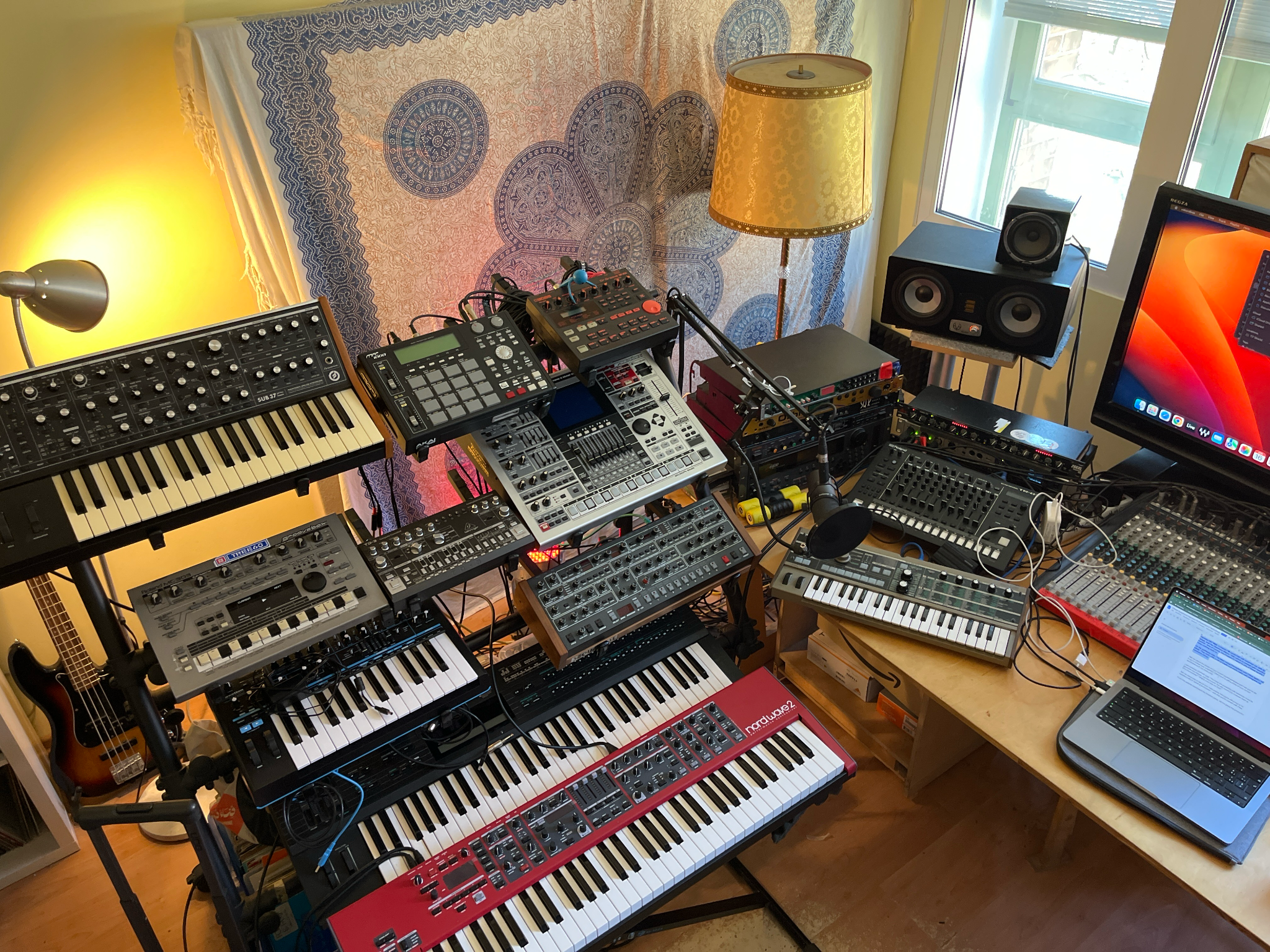
The production process was long and quite complex. After the jam sessions, I had a lot of raw material — hours of recordings — and from there, I started cutting, re-shaping, and rearranging those parts into new forms. In many cases, I used bits from totally different moments and built completely new tracks out of them. So the final pieces barely resemble the original sketches — it was more like deconstructing and then rebuilding everything in a new context.
It was a very intuitive and hands-on process, more like sculpting than assembling, if that makes sense. The energy of the jams is still there, but it’s been filtered and reshaped through a lot of focused work in the studio.
There are seemingly infinite parameters to change, influence and shape the sonic results. From your experience, what actually makes a piece better and what sets a “finished” version apart from one destined to linger in the archives?
Like most producers, I’ve got hundreds of tracks sitting in that weird limbo — not really finished, but not completely abandoned either. It’s part of the process.
For me, what makes a piece feel finished is pretty simple: if I can listen to it multiple times — five, six, ten times — and I’m still not tired of it, that’s a strong sign. If it keeps my attention and still gives me a vibe after repeated listens, then I know it’s working. On the flip side, if I start skipping parts or losing interest while listening back, then it probably still needs work — or maybe it’s just not meant to be finished.
So yeah, the test is in the repeat listens. If it still feels good, it’s ready.
How do you see the relative importance of arrangement versus sound design versus composition (including, potentially, lyrics)?
Like a lot of producers, I sometimes get caught up in trying to make things sound perfect — obsessing over the mix, the sound design, making sure everything sits just right. But I’ve learned that chasing perfection can also be dangerous. There are moments where you have to let go and move forward, even if something isn’t technically flawless.
For example, maybe the bass doesn’t sit 100% right, or there’s a little distortion or saturation somewhere. At first, I might feel the urge to fix it — but then I realize that those imperfections actually give the track its character. It’s not always easy to recognize that in the moment, but over time I’ve learned to trust it.
Composition, arrangement, and sound design all play important roles, but sometimes it’s about knowing when something needs more and when it’s already doing what it’s supposed to do. On the album, there were a few tracks that felt right in terms of vibe and aesthetic, but still felt like they were missing something. In those cases, adding a vocal really tied everything together.
For example, there’s a track called “Electrical.” The instrumental felt good, but I knew it needed a voice to bring it to life. That’s when I reached out to Marlena Dae, who’s featured on a few tracks on the album.
She brought exactly what the track needed and really helped shape it into what it is now.
How, would you say are your live performances and your recording projects connected at the moment? How do they mutually influence and feed off each other?
At the moment, I’m not really performing live in the traditional sense.
I’ve always been a DJ, and I’ve kind of kept my DJing and my production work as two separate worlds. I’ve been DJing for over 20 years now and have built a pretty deep collection, mostly centered around house music. But I’ve always had this urge to explore all the different shades and variations that house has to offer — it’s such an endless spectrum.
My productions, on the other hand, are often more introspective. They’re definitely dancefloor-oriented in parts, but also meant to be listened to — there’s more depth and emotion in them. When I DJ, it’s more about reading the crowd and creating energy in the room. Sometimes I’ll go deeper, sometimes a bit harder, depending on the context, but there’s usually a strong groove or drive behind it.
That said, I’m actually about to perform live for the very first time — on May 9th, the same day my album Always Moving is being released. I’ve put together a full band for it: I’ll be on drums, Marlena Dae on vocals, Declan McDermott on bass, and Nelson of the East — who also mixed the album — will be playing keyboards.
The show will be in Berlin at a club called Prince Charles. It’s a big step for me, bringing the music to life in this new way, and I’m really excited to explore what that side of things could evolve into.
Have you used AI or generative music tools for your own productions? If so, in which way and what did they add?
Personally, I haven’t used AI or generative music tools in my own productions yet. It’s not that I’m against it — I just don’t feel ready for that step. I’ve seen some fellow producers experimenting with it, and I have to say, the results are impressive — especially when it comes to vocals. The technology is moving fast, and it’s pretty wild what’s possible now.
But for me, it still feels a bit strange. I’m not quite convinced yet, and I don’t feel like I need it at this stage. That’s not to say I’m refusing progress or shutting the door on it completely — I’m just more focused on keeping things personal and hands-on for now.
One big question resulting from the use of "intelligent" production tools and AI is whether the results are as important (or even more important) than the process (and the joy of creating). How do you see that yourself?
This kind of ties into what I mentioned earlier — I don’t feel like the results you get from AI are as important, or definitely not more important, than the process of creating something by hand, in real life. I’m not rejecting the technology, but it just doesn’t feel right for me at the moment.
For example, I don’t believe an AI-generated vocal can carry the same weight or emotion as a real human voice. Same with a bassline — I’d rather hear something played by a real musician than something generated by code.
I see AI as a tool that can be useful for people who might have certain limitations or are looking for a specific shortcut.
But for me, the real value lies in the hands-on process — in the feel, the mistakes, the connection. That’s where the music lives.
How much potential for something “new” is there still in production? What could this “new” look like?
I think there’s still a lot of potential for something “new” in production — but for me, that “new” doesn’t have to come from the latest tech or tools. It can come from a new collaboration, a different way of playing, or just approaching things with a fresh perspective.
Sometimes, newness is in the feeling, not in the gear. As long as the music stays honest and emotionally driven, that’s what really matters to me