Published
Name: Butcher Brown
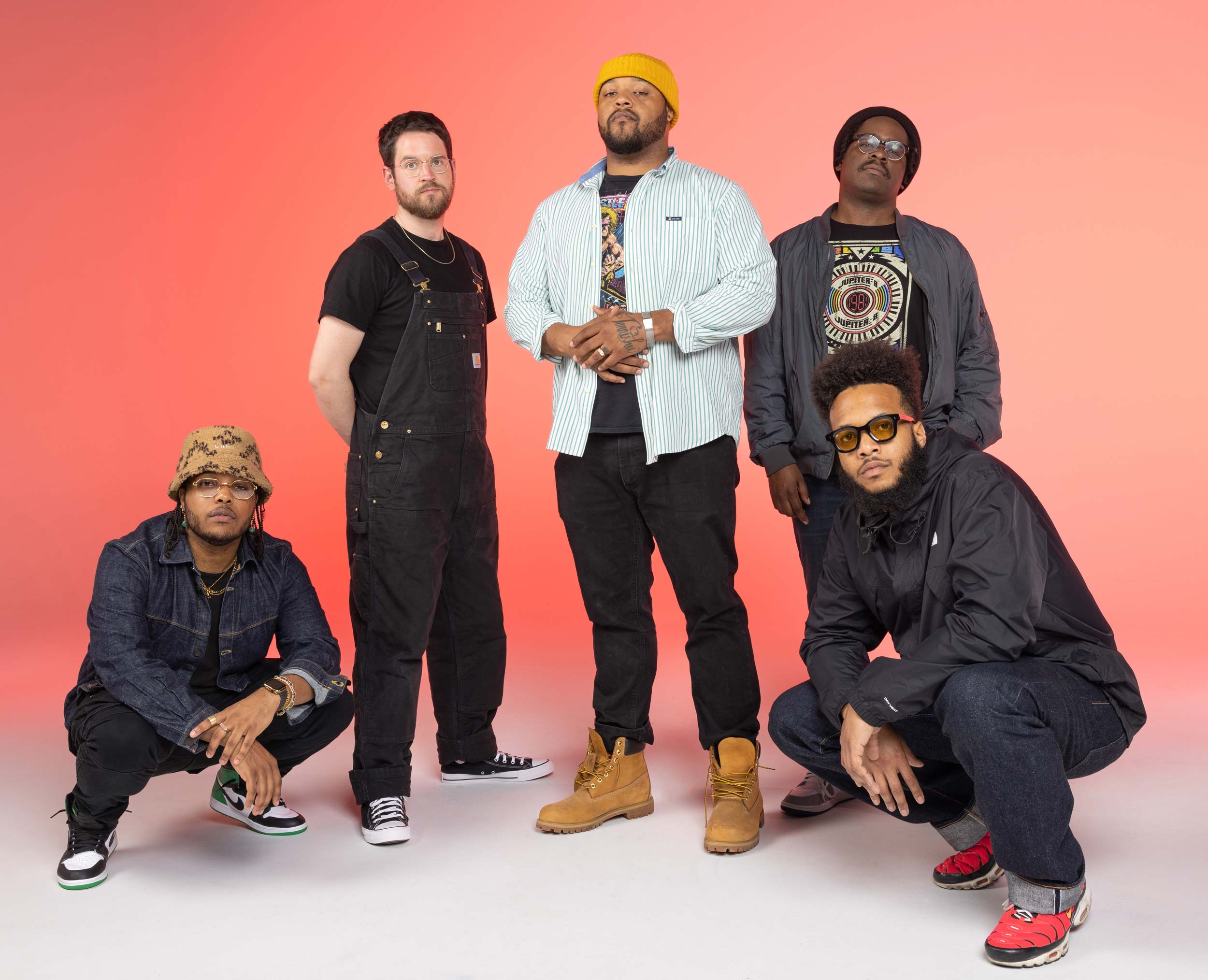
Members: Marcus Tennishu (vocals, trumpet, saxophone), Corey Fonville (drums), Devonne Harrison (keys), Andrew Randazzo (bass), Morgan Burrs (guitar)
Interviewees: Corey Fonville, Marcus Tennishu
Nationality: American
Current event: Butcher Brown will perform at the North Sea Jazz Festival in July 2024. For more information, head over to the festival's website.
If you enjoyed this Butcher Brown interview and would like to know more about the band and their music, visit their official website. They are also on Instagram, and Facebook.
The 2024 edition of North Sea Jazz will once again present a colourful roster of artists from all corner of jazz. To dive deeper, you can read interviews with acts on the roster here:
[Read our Henri Texier interview]
[Read our Ibrahim Maalouf interview]
[Read our Arooj Aftab interview]
[Read our Matthew Halsall interview]
[Read our Manu Delago interview]
[Read our Sasha Berliner interview]
[Read our Yin Yin interview]
[Read our Candy Dulfer interview]
The North Sea Jazz Festival is just around the corner. Tell me just a little bit about your performance at the Festival, please.
Corey Fonville: Expect to hear a blend of genres that we appreciate, more than anything – the fusion of all the music that we love, from bossanova to jazz to house, disco, hip-hop, rap and a dash of southern rock.
Just imagine yourself in a record shop and you’re going through the sections selecting different albums. That’s what Butcher Brown brings.
How, would you say are your live performances and your recording projects connected at the moment? How do they mutually influence and feed off each other?
Corey Fonville: They definitely influence each other. The studio is a place where we really thrive and it has an impact and helps us better understand music. You’re in a vulnerable space in the recording studio, because the mic is always on and you hear everyt hing, all your flaws, all the positives, it requires patience and all of that.
But the songs evolve, we recorded these records a couple years ago so there's always gonna be some change that occurs because we’re inspired by something new constantly. You’re always going to hear the most updated version of us because we’re constantly reaching for something new.
The studio is where we continue exploring new ideas, and then we get on stage and the same thing happens. They each influence the other.
In as far as you have any experience or insights, what's your view of the Dutch jazz scene?
Marcus Tennishu: The Dutch jazz scene is amazing, they have a lot of players I've seen over the years coming from the Netherlands and the scene is very vibrant.
The people there seem to be receptive to new sounds, and people are pushing the boundaries of old sounds and it’s always a great place to play.
Music has become a lot more global and incorporating elements from other parts of the world or the musical spectrum is commonplace. Do you still think there are city scenes with a distinct, unique sound? What holds these communities together?
Marcus Tennishu: I do think there are distinct communities that have distinct sounds.
I think music in general is still very regional and I think that those distinct pillars that make music regional are also what is holding up the music industry at large. Because that’s what’s providing the variety that’s laced in a platform like Spotify. You couldn’t have that without crazy varieties within regions.
And what holds it together is whatever was able to forge the art in the first place. The reason why we still get cultural boundaries being broken and pushed is because people are still being pushed all over the planet and that’s a reflection of humans. It’s what we do.
One of the cornerstones of the North Sea Jazz philosophy has been to showcase this global proliferation of jazz and the way musicians from different cultures are working with it. Which of these, if any, interest you right now?
Marcus Tennishu: The proliferation of it is interesting because records cost money to make and promote, to market, manufacture and sell, and there’s a lot of different people whose businesses depend on those different facets going the way that everyone planned on it going – because that plan is what got everyone on board in the first place.
So I think that in a world where we can all go to a store and get a laptop and make an album, and if it can then go in the same marketplace I'm interested to know how much proliferation has a direct reflection on the value of what we’re doing. Supply and demand are principles that don’t go away just because we’re in a different industry. So if you proliferate the market with a whole bunch of music that is not of the same quality as other things, it’s not going to be as valuable.
It’s a universal law, and I don’t understand how we can make all these records without there being consequences for the industry. That’s the part I’m most interested in.
What does the term jazz mean today, would you say?
Corey Fonville: I think jazz always means Black music. It means something different for everybody but it means freedom, self expression – it’s all about the imperfections, not about being perfect. It should be about showing your personality, heart and soul more than anything else. It’s a platform that can allow artists to be them and not think so hard about what they’re gonna play.
Just play with love in your heart and a lot of conviction, and I think you’ll be able to get your point across to a lot of people.
Derek Bailey defined improvising as the search for material which is endlessly transformable. As of 2024, what kind of materials are particularly transformable and stimulating for you?
Marcus Tennishu: The particular materials that are important and worth studying to me are ones that I find the most foreign. When I find people that have different thoughts than I do, I want to talk to them about where they’re actually coming from. When people see things that I don’t see I want to talk to them about what they saw and how they interpret it.
I find a lot of times that we reduce people’s interpretations to ‘that’s your opinion’ and I’m like yeah, tell me. I know what I think but I want to know what’s coming from over there.
Thanks to technological advances, collaboration has become a lot easier. What's your view on collaboration and its ongoing role for the music you make?
Corey Fonville: It's beautiful because there’s people that we probably wouldn’t rub shoulders with if it wasn’t for our phones or the internet and social media. There’s good and bad to everything, but it’s really cool to see what people are doing in other parts of the world. We’ve done collaborations with people from other countries just because we’ve discovered their music on streaming or on Instagram.
I think that technology is a plus in that regard because you realise there are so many talented artists out here. If we just relied on record labels we would miss out on so much. But now that it’s fair game, we have the opportunity to upload music on our own and we can find a hidden gem that may not have a ton of listens yet but it’s just that they didn’t get a chance or the right person hasn’t heard them yet.
But sometimes you find incredible music that could spark a really dope collaboration.
In terms of the results, the process, and the satisfaction, how do making music in the same room together versus filesharing compare to you, real concerts vs live streams?
Corey Fonville: It’s just like a phone call versus being in the same room. You can’t beat the energy of a live show. Doing a live stream was fun and all during the pandemic because that’s all we had. But I look at concerts like a relationship with us on stage and the people listening. When you get something back from the people, and they are responding back to you it goes both ways.
So when we play live and the crowd is reacting to something they heard – even if it’s just a hand clap – it’s going to shift how we play. As opposed to a livestream, which is even different than a recording studio because you’re on video but no one is there. You have to create that energy for yourself, which is fine.
But having an audience, it’s certainly a relationship. A live performance is always going to reign supreme.
Ímprovisation is obviously an essential element of jazz, but I would assume that just like composition, it is transforming. How do you feel has the role of improvisation changed in jazz?
Corey Fonville: With jazz and improvisation we’ve reached a point of technical exhaustion.
Everyone can play now – it’s like sports, everybody is more athletic, they’re stronger, faster, can do crazy moves. There’s an evolution. I think that improvisation is great, and everyone has developed incredible technical skills on their instrument. But at the same time I feel that we have to be careful because we can’t lose sight of why we are doing this first and foremost.
The reason we play this music is to express ourselves. When it becomes too much about the technicality as opposed to the heart and soul, that’s when I think we are kind of missing the point. We have to be careful when straddling that line. As long as we don’t lose sight of playing with emotion, as opposed to playing to impress, this music will be in good hands. But we have to make sure that we don’t lose the feeling, because that’s what it’s all about.
We want this music to make somebody feel good, to cry or feel joy. It’s supposed to be a gift and a sharing experience for the listener. That’s why I do it, and everyone in Butcher Brown feels the same way.
Playing jazz specifically is about maturity, having discipline and reading the room. Because it’s a social experience – Miles Davis always said jazz is social music. You have to understand how to play the space and read the room. If you have something to say, play it, but you don’t always have to be talking. This music is just like having a conversation, it’s the same thing. If you’re talking over somebody you’re not getting your point across.
We all have to remind ourselves that we’re serving a bigger purpose when we improvise and try to create these moments.
What, would you say, are the key ideas behind your approach to improvisation?
Marcus Tennishu: Some of the key ideas behind my approach are listening to records over and over again. When I’m learning new pieces of improvisation and new ideas to provide in that environment, I want to be sure about the sounds I am putting out there. So I like to listen to records to really understand what’s happening.
Another element of what I like to do is listen to instruments that are not the one I’m playing. So if I’m really trying to work on trumpet, I’ll listen to sax players, piano players because it really forces your ears to listen across different barriers. So you really got to dig deeper.
And another element is not being scared, I just dive in there. Even if you’re in the wrong key, if you don’t know the song, just go – it doesn’t matter. You’re a musician under the hood, most people don’t hear all those notes as fast as you can. So you hear a mistake but in actuality everyone thought it was good.
How would you describe your own relationship with your instrument – is it an extension of your self/body, a partner and companion, a creative catalyst, a challenge to be overcome, something else entirely?
Corey Fonville: The instrument for me has changed over time, I’ve been playing the drum set for 31 years since I was a toddler. So playing and understanding the instrument, and now getting into this heavy production role of producing informs the drumset. Maturity has played a huge role for me, and I certainly have a better understanding of how sound works, how the drums work, how everything around me fits with the other instruments, and it helps me understand how to play drums.
My relationship with the drumset is always going to be fun. I don't look at myself as a just drummer, that’s an extension of who I am at this point in my life. Because I listen to so much music, writing, producing – the drumset is a piece to help put the puzzle together.
Over time I’ve slowed down, I’m not so anxious in a sense of I don't need to play as much. There’s an understanding now of how to play a room, volume, space, it’s all important to have a successful career in this industry. The drumset has turned into more of an extension of who I am now.
The term identity is an important aspect of many communities. Are you acting out parts of your identity in your improvisations which you couldn't or wouldn't through other musical approaches? If so, which are these?
Corey Fonville: Anyone that hears me play drums, I feel like my personality is similar to how I play the instrument. I’m not a loud person because I play drums. It’s evolved over time and my identity on the drums is coming from a place of growth. I sound different than I did five years ago, and you just have to go along with that and accept change.
That’s the beauty in creating your own universe in a band like Butcher Brown – it allows all of us to explore without any rules. We’ve all known each other son long, we’ve practically grown up together playing this music and we’ve seen each other grow. It changes night after night I feel – when we go to Amsterdam or Rotterdam, we’re influenced by the culture there and it’s going to have an impact on the show.
I have always been fascinated by the many facets of improvisation but sometimes found it hard to follow them as a listener. Do you have some recommendations for “how to listen” in this regard?
Corey Fonville: You have to listen with an open mind. if you’re not familiar with improvisation, everything might not be for you – it’s like a buffet, you have to pick and choose what you like, what makes sense for your ears.
Sometimes it’s better to not think when you turn that music on. There’s a way of listening to music – some people listen with all their attention, really focused on it. But I prefer to listen to jazz in a casual manner when it comes to improvisation. It’s not about analysing because those musicians weren’t playing like that. They’re just listening with their eyes closed and they’re playing, responding to something they heard.
So if the listener is new to this music, they need to realise that this is all happening in real time for the players. All the legends, they just play with their heart, in that moment. They probably couldn’t tell you what they played the next day, they wouldn’t remember.
And that’s the fun part, it’s all about being in the moment.
In a way, improvisations remind us of the transitory nature of life. When an improvisation ends, is it really gone, just like a cup of coffee? Or does it live on in some form?
Marcus Tennishu: I think when improvisation ends, it’s gone. You’ll never play those same notes or that exact riff again.
That’s what makes it beautiful.