Published
Part 2
How do you feel your sense of identity influences your collaborations? Do you feel as though you are able to express yourself more fully in solo mode or, conversely, through the interaction with other musicians? Are you “gaining” or “sacrificing” something in a collaboration?
I feel my gift is composition and I surround myself with the most creative and amazing improvisers I can find to have a conversation on my music. I am happy to do that. I bring the topic and we debate on the topic, each using our unique voices.
Derek Bailey defined improvising as the search for material which is endlessly transformable. Regardless of whether or not you agree with his perspective, what kind of materials have turned to be particularly transformable and stimulating for you?
We need to be ourselves but also push ourselves to take risks if we are to move forward. By taking risks, musicians are able to play above what they know and by doing this they find new levels and new places of freedom that they did not know existed.
I call this ‘playing on the edge of wrong’.
You see, great artists are never satisfied in staying in the same place in their work and have a need to explore and find new ways to create new works.
As George Bernand Shaw writes in Man and Superman,
“the reasonable man adapts himself to the world; the unreasonable one persists in trying to adapt the world to himself. Therefore, all progress depends on the unreasonable man”
When you're improvising, does it actually feel like you're inventing something on the spot – or are you inventively re-arranging patterns from preparations, practise or previous performances?
The artistry of composition based on improvisation – as in art – is that having learnt all the techniques of mixing colour etc. the artist then puts his brush to canvas, forgets everything and lets inspiration take over.
It is all about intuition.
The most common everyday improvisations are our communications with one another in speech. Just like language, we study and memorise the grammar slowly at first so that it can become a natural extension of who we are, embedded in our subconscious. And when we have a conversation we draw from the natural information that is embedded in our memory. No one can decide beforehand what words they will use as their intuition will guide them, and thus every conversation will be unique.
This is improvisation and composition, and the better prepared you are, the better your conversation and communication. The more we study language the more possibilities we have of making more beautiful and meaningful sentences and phrases, and the quality of our conversation will improve.
However, concerning your question, yes, there are articulations and phrases that I naturally use more than others that make me sound who I am, and I am not scared to repeat them as that is who I am.
To you, are there rules in improvisation? If so, what kind of rules are these?
“Works of art make rules, but rules do not make works of art”
Claude Debussy
It must be emphasised at this point that even though learning the rules and the language are vitally important and will make a major contribution to one's playing, improvising is about breaking through these barriers and rules – to the next level - and playing what comes from the heart.
In a live situation, decisions between creatives often work without words. How does this process work – and how does it change your performance compared to a solo performance?
A musician’s canvas is space, silence and time. Before he or she can make a note there has to be the space in which to play it.
That’s how the process starts.
There are many descriptions of the ideal state of mind for being creative. What is it like for you? In which way is it different between your solo work and collaborations?
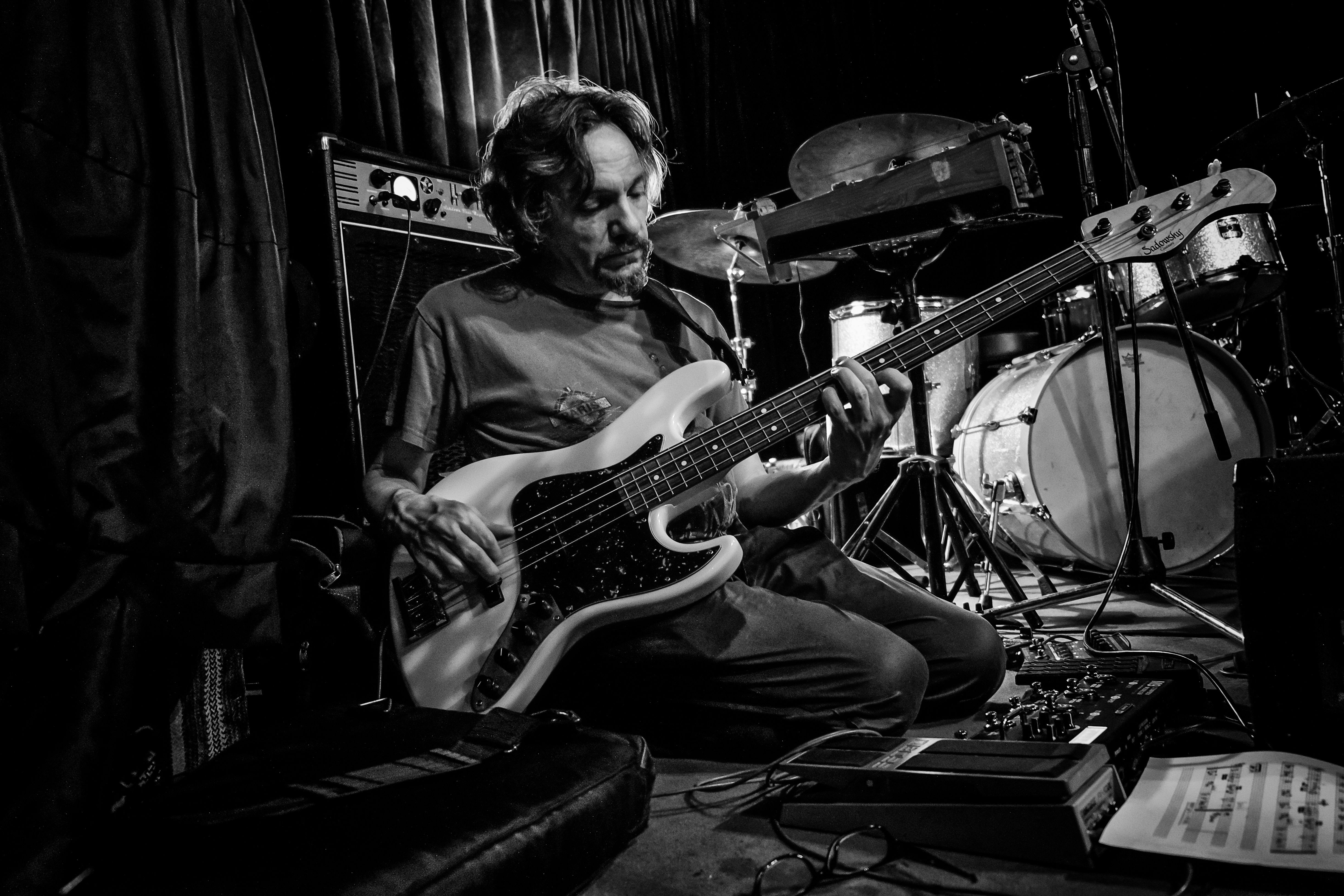
I seldom play solo. However, I did compose a whole series of Solo Bass Etudes during the Covid lockdowns that eventually became the material for my next trio recording called Lullaby for Planet Earth with Wolfgang Muthspiel on guitar and Jorge Rossy on drums and vibes.
When I collaborate with other musicians that have the same head space it is easy and that’s what I look for. We do not need big discussions and I bring my composition. If we are all on the same page from the start, we can make the music sound magical.
Lullaby for Planet Earth took a long time to compose as the compositions arrived slowly. But when we recorded the music, it was so easy and the recording was done in a day and a half.
I would like to add that the spatial sound setup must be great for it to flow. You need a great sound engineer which we had.
How do you see the relationship between sound, space and performance and what are some of your strategies and approaches of working with them?
I do not spend my time trying to analyse these relationships as they just happen naturally. However, I would prefer to add another important element to this conversation called melody.
Melody is for me one of the most important parts of creating a great composition or a great improvisation. When I listen to music I am always attracted to and touched by the melody of the music. It is this that brings me into deep listening and it is melody and tone that touches my soul.
All the greatest works, no matter what the genre have the most amazing melodies and if I can find that melody - simple or complicated, I have achieved something in my sound, space and performance that will last forever.
I believe that melody is a time capsual. If example, my mother sung a certain lullaby to me as a young child and I heard this later after many years in my life, - the moment I hear that melody it will transport me back to the memory of those early years when she first sang the lullaby.
In a way, improvisations remind us of the transitory nature of life. What, do you feel, can music and improvisation express and reveal about life and death?
Music must uplift you, transport you through stories, challenge you and touch your inner being. It keeps a record of time, history and culture, and unites us in a song.
Through music we give thanks and rejoice. It comforts people in their mourning and sorrow, and brings some form of hope and faith, - and in the end we all sense that music is some sort of a miracle.