Published
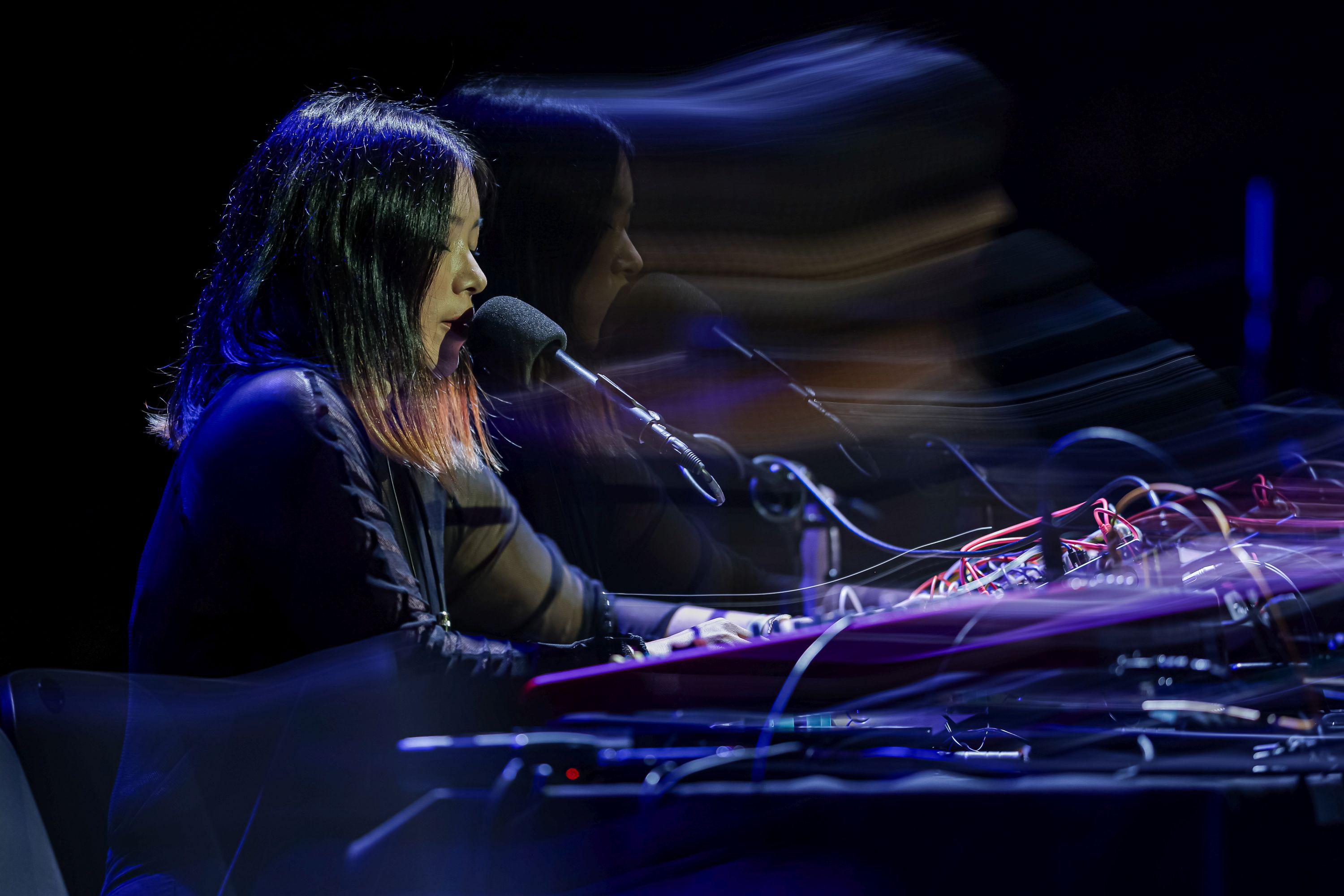
Name: Charmaine Lee
Nationality: Australian
Occupation: Vocalist, improviser, performer, composer
Current release: Charmaine Lee's new album Tulpa is out October 31st 2025 via Kou.
Current events: Charmaine is currently on an extensive American tour. For live dates, visit her homepage.
Recommendations on the topic of sound: Pauline Oliveros’ writings on Deep Listening are essential. Joe Morris’ Perpetual Frontier: The Properties of Free Music lays out the principles of improvisation that he taught me and that continue to inspire my approach. Klaus Lang’s essay “Freedom. Time. Politics.” in Blank Forms is a concise but profound meditation on sound and temporality. And Anne Carson’s Gender of Sound is a text I return to often for the way it reframes listening and voice through history and myth.
[Read our Pauline Oliveros interview]
If you enjoyed this Charmaine Lee interview and would like to stay up to date with her music and current lives dates, visit her official homepage. She is also on Soundcloud, and bandcamp.
When I listen to music, I see shapes, objects and colours. What happens in your body when you're listening? Do you listen with your eyes open or closed?
I feel listening in my chest and stomach before anywhere else — a kind of pressure, warmth, or vibration that anchors me.
My eyes don’t matter so much; I can be equally immersed, open or closed. When I’m performing, though, I often keep them half-opened, similar to Zen meditation techniques — not to “look” but to stay focused on the space I’m in.
How do listening with headphones and listening through a stereo system change your experience of sound and music?
Headphones collapse me into a kind of interior cinema — the sound feels like it’s inside my skull, intimate and sometimes even claustrophobic. A stereo system restores air and dimensionality.
With my own work, I need both: the micro-inspection of headphones and the bodily encounter of sound in a room.
Tell me about some of the albums or artists that you love specifically for their sound.
Eyvind Kang and Jessika Kenney’s records have always stunned me with their depth of tone and patience.
[Read our Eyvind Kang interview]
Ikue Mori’s electronic language taught me to hear glitch and fracture as something lyrical.
And the raw immediacy of early Meredith Monk recordings showed me that a voice could be an environment, not just a singer.
Do you experience strong emotional responses towards certain sounds?
Absolutely. The low rumble and the crackle of a lo-fi microphone light me up — I can sink into those textures for hours.
I’m also deeply moved by the extremes: sounds way up at the edge of perception (22kHz and above) or deep below (100Hz and under). Those frequencies feel physical, like they vibrate the whole body. I often lean on that territory in performance — pushing my voice into the sub-bass or amplifying the noise floor of a microphone so it becomes alive.
But I can’t stand the screech of fingernails on a chalkboard — it makes my nervous system recoil instantly!
Here’s a video of me very recently performing live on tour last week in DC demonstrating the breadth of microphone fidelities and frequencies:
There can be sounds which feel highly irritating … and others we could gladly listen to for hours. Do you have examples?
I could listen forever to cicadas at dusk, the resonance of an old bell, or even the wind-up whirr of old DSL modems and analog electronics — there’s something hypnotic in their mechanical rhythm.
In my own recordings I sometimes chase that feeling by letting feedback loops or broken cables sing on their own.
On the other hand, I ironically struggle with the piercing beep of appliances and alarms. Those sounds feel weaponized, meant only to jar or disrupt, and I can’t tune them out.
Are there everyday places, spaces, or devices which intrigue you by the way they sound?
The NYC subway is endlessly fascinating. Each station has its own resonant fingerprint, and the brakes of the trains can sound like entire electronic scores.
The incredible saxophonist Tamio Shiraishi performs often in various stations around the city and that I find very inspiring.
A few years back, I created an album that served as the audio guide to an outdoor exhibition for Martha Tuttle’s exhibition at Storm King Art Center — the open-air setting inspired me to approach the music from an environmental and geological perspective.
Have you ever been in spaces with extreme sonic characteristics?
I performed last year in an abandoned mining facility in Norberg, Sweden, where my voice seemed to multiply into hundreds of shadow-voices. I have also performed in anechoic-like chambers, which feels terrifying — as if the body itself gets too loud.
Both experiences showed me that sound is less a thing than a relationship with space. Here's an IG short video of me soundchecking the mining facility in Norberg.
What are among your favourite spaces to record and play your music?
I’m drawn to spaces that aren’t necessarily “meant” for music — warehouses, outdoor fields, small galleries. They carry a sense of both musical and social unpredictability.
At the same time, I also value the clarity of a studio or a finely tuned concert hall, where even the smallest breath can be held and shaped with precision.
Do music and sound feel “material” to you?
Yes — I often think of sound as clay or smoke: something that can be shaped, pressed, and stretched, but never held still. With my voice and electronics, I feel like I’m sculpting in real time, pulling sound into unexpected densities.
I also think of music as a kind of string — you can scrunch it up, stretch it out, or cut it apart — but ultimately it always leads back to “time made audible,” as the great Klaus Lang once said.
How important is sound for our overall well-being?
I’m not entirely sure. I don’t feel fully knowledgeable, nor completely convinced by some of the recent movements that frame sound primarily as “wellness.”
That said, I absolutely believe in the power of music — its ability to shift perception, to connect people, and to create spaces of reflection or release. For me, that feels more tangible than prescribing it as a kind of universal cure.
Non-human sounds — what experiences have moved you?
Back in my home in Sydney, I used to be woken up by the sounds of at least four or five different bird species.
I absolutely loved when their calls began to layer together — it feels like an improvisation with no ego.
Do you feel interspecies communication is possible and important?
Yes, not in words but in resonance. Listening carefully to birds, insects, or whales is already a form of communication.
Creatively, it teaches us humility: music is not only human invention, it’s part of a continuum.
Tinnitus and developing hyperacusis are very real risks for anyone working with sound. Do you take precautions in this regard and if you're suffering from these or similar issues – how do you cope with them?
I lived with terrible tinnitus in my left ear for about five years. I sometimes joke that most of what I sang in that period was in the key of A — because that was the pitch of the ringing.
Since then I’ve become careful about how I work: I monitor volume closely in rehearsals and performances, and I make sure to give my ears real rest. The risk is very real, but I try to stay attuned to my body and not override its warning signs.
Silence vs constant sound — where do you stand?
Silence is not absence but potential. I love surrounding myself with sound, but the moments of pause are what give contour to listening.
On tour, I cherish long drives when nothing is playing — just road and air.
How would our world be different if we listened more than we looked?
We’d probably cultivate more patience and empathy. Vision prioritises boundaries and surfaces; sound blurs them.
To truly listen is to acknowledge connection, and I think that shift could reshape how we live together.