Part 1
Name: Corey duBrowa
Nationality: American
Occupation: Writer, editor
Current release: Corey duBrowa's An Ideal For Living - A Celebration of the E.P. (Extended Play) is out via Hozac Books.
If you enjoyed this Corey duBrowa interview and would like to stay up to date with his work, visit him on Instagram. 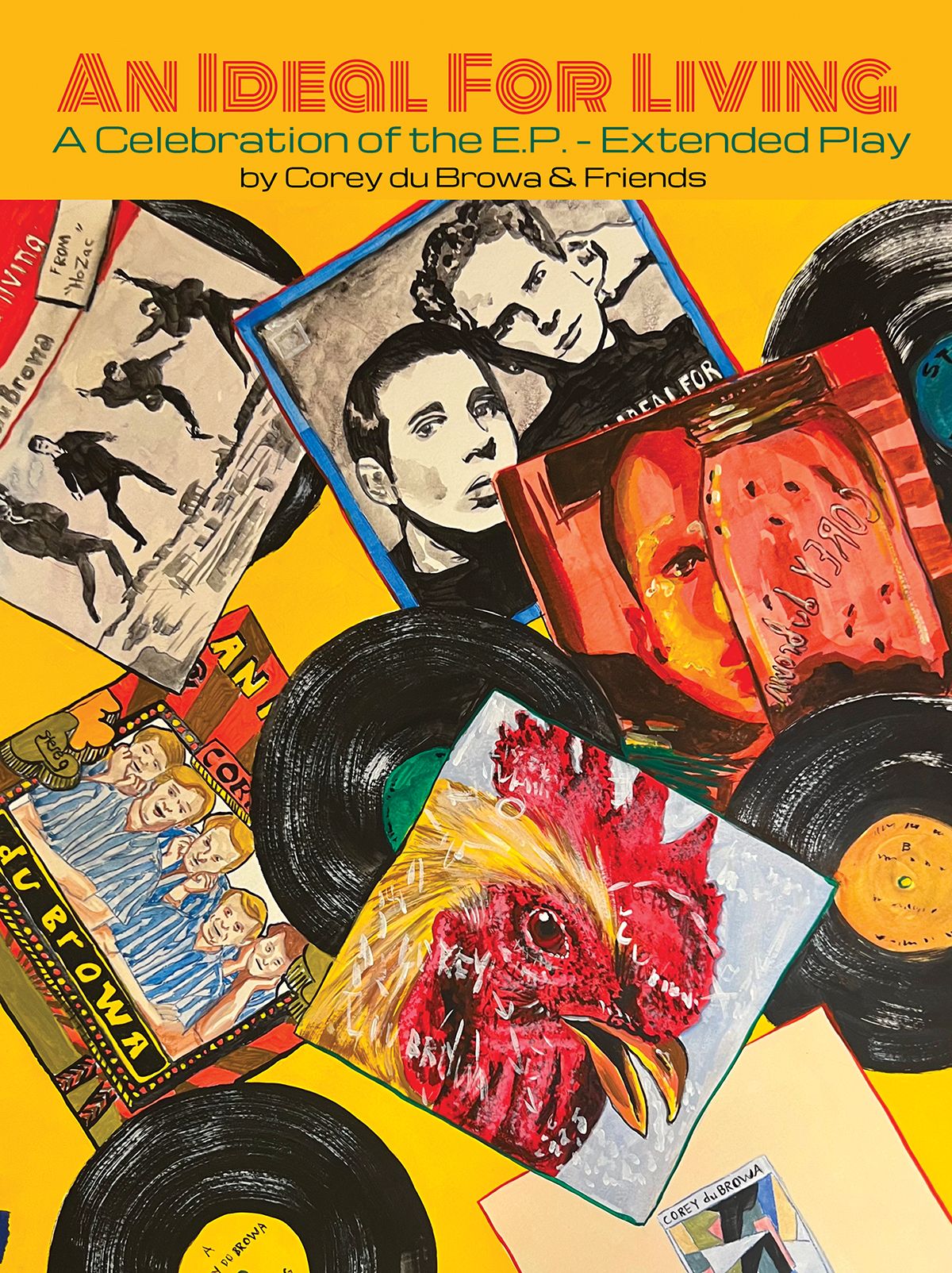
An Ideal For Living is a book about music, but it is written from a deeply personal angle. When did you realise that you had “a thing” for the EP format?
You're right, it's almost my "mash note" to the EP.
In the book's introduction, I recall my Auntie Dee taking me to a Licorice Pizza in my hometown of Long Beach, CA at age 13 as a birthday gift and picking up a copy of Oingo Boingo's 1980 debut -- a 4-track, ten-inch EP that probably first caused me to pay attention to (and then fall in love with) the format.
It was certainly the first EP I was ever aware of.
There are hints of an answer in the book, but I'd love to hear a little more what you personally love, specifically, about the EP format? Why did An Ideal For Living turn into a book about EPs rather than just about the music you love?
I feel like all the music writers I know who have written a book have already opined about the music they love; my friend Bob Mehr's book about the Replacements, "Trouble Boys," is SO GOOD that I had kind of ruled out writing about a single artist or even genre after reading it.
But there was so little reliable information out there about the Extended Play -- even the Wikipedia entry was relatively flimsy -- and I felt like the EP's development, once I researched it, quite nearly mirrored that of the music industry. So writing about a somewhat obscure format (or as my wife describes it, "niche interest") and its historical development seemed like the perfect way to distill nearly 25 years of writing about an art form I love into a specific angle that might relay this affection but also teach me -- and perhaps, readers -- something in the process.
In a way, because of how the book is formatted (25 "top EPs" per decade since the 1950s, when the EP first became a distinct form factor, plus a best-of list, with reviews written by over 40 contributors), it became a bit like a puzzle to assemble -- clue by clue, piece by piece, brick by brick.
A large part of the book is taken up by a discussion of important and rewarding EPs across the decades. What are characteristics of a great EP for you?
For me, what merited an EP's inclusion in the book related to a few specific attributes: was it a historically important artist (who may or may not have been given their due) whose best work was captured on an EP, like Little Richard or Glen Campbell, Hank Williams or Diana Ross and the Supremes? That was pretty typical of the earliest EPs, to treat them like a "greatest hits at a discount" sort of object.
Was it an artist or act with songs that could only be found via an EP release and were available nowhere else in their catalog? Pavement, Echo & the Bunnymen, Alice in Chains (the first EP to ever top the pop charts), the Breeders and R.E.M.'s debut EPs are all examples of this.
Was the EP in question a culturally significant or unique object? There are several extremely rare/hard to find EPs in the book, at least in their original format -- such as the limited-edition Factory label sampler that includes some very early Joy Division work, David Roback's pre-Mazzy Star band Opal, the XX's tour-only releases fit that description, among so many others.
So these tended to be the "tipping point" for inclusion in the book, particularly in decades such as the 1980s and 1990s when so many good EPs were released -- and of course, not every favorite could be included.
What are the creative possibilities that the shorter time of an EP allows, do you feel? In which sense is less truly more here?
Spoon founder/frontman Britt Daniel does a great job of talking about this in his foreword -- he describes the EP as a "dodge ... a musical sweet spot where you can be on your own, under the radar, secure in the knowledge that what you're making is just for you and those who love you enough to follow you anywhere."
What a great description: short, sweet, inexpensive, or what Britt says might "seem small or superfluous by design, but its impact can be huge." Small stakes, to steal from the title of another of his songs. None of the grand design of an album, and very little of the "it better be a hit" implied by a single.
It's the musical Goldilocks; not too hot, not too cold. Just right.
Tell me a bit about the idea of the EP as a “laboratory for cutting edge music.”
Britt talks about this too! The EP he discusses in the book, 1997's "Soft Effects," is basically where Spoon first discovered and then developed its lean signature sound;
This hadn't been evident on its first major label release, "A Series of Sneaks," but after the band was dropped from Elektra the pressure was off and they were working with a new producer, feeling more free to improvise and experiment and -- in so doing -- essentially BECAME Spoon right before our eyes.
Earl Sweatshirt's EP in the book is essentially one lengthy track broken into different "movements" and released only via YouTube.
Gal Costa's 1971 EP is one of the gems of the Tropicalia movement with tracks that are nowhere else in her catalog but became a core part of her live repertoire.
When the pressure is off -- and you don't have a big release in the hopper with the record company breathing down your neck for a "hit" -- that's when all the cool shit happens.
One of the most extreme examples for the value of the EP format is the "Stutter EP" by Elastica. Could one say that one prime pro of the EP is that it extends the excitement of a single brilliant single just a little longer, whereas an album will inevitably have to go through peaks and troughs?
I love that you singled that EP out -- Justine Frischmann and Elastica are among the most underrated parts of the '90s Britpop movement (frankly more punk than Britpop!) and that song has such a strong, feminist point of view. It's a 2:22 bullet of a tune about erectile dysfunction!
And on this EP, it's matched up with other similarly brief blasts that might not have felt right on their 1995 debut LP (although the demo of "Blue" included here did eventually make the cut) but perfectly fill out a four-song EP.
The Cure's "The Walk" EP also basically fits this description -- a terrific title single surrounded by a number of great songs that can't be found anyplace else.
To me, it seems like the format is foremost a way of looking at the relationships between songs and how their combination yields something bigger than the sum of its parts. Do you think it is harder or easier to come up with a great EP than a great album?
They both have their puts/takes, I think. Songs on EPs don't have anywhere to hide because of the format's brevity -- so if something isn't good, it stands out a bit more (my friend Tim Stegall points this out about Elvis Presley's 1956 self-titled EP; he clearly loves "I Got A Woman" but criticizes the other choices as mere filler).
But the EP's stakes are so much lower than an LP -- the label hasn't invested as much in the recording or production, the charts aren't really oriented to EPs (then or now) so the commercial skin-in-the-game is much lower -- and LPs just have bigger built-in expectations attached to them, they're seen as more of an artistic statement and so there is more implied pressure for an album to hold it all together like an artistic "work" in a way that no EP will ever have to live up to.
Plus, when you ask a rock critic to review an EP -- as I was countless times during a 25-year period of writing about music -- it's almost always a joy. Sometimes reviewing a full album and placing it in artistic and historic context can be like eating your spinach. It's work. The EP isn't freighted with all that.
The book mentions the closeness between “B-side-culture” and the EP. Do you think the creative processes for writing a great B-side are the same as writing a great EP-piece? Or is there something different at play here?
Very much so. I think you've hit the nail on the head here. The Kinks are a band that wrote a million amazing b-sides and it's no surprise that the band released a string of must-have EPs during their artistic heyday in the 1960s;
"Kwyet Kinks" is included in the book and basically makes your exact point but there are loads of other examples sprinkled across An Ideal For Living.
Not just EPs, but albums, too, have changed considerably over the years. How do you see the relationship between format and creativity? Would you say, for example, that there are songs which were only written because they would become part of an EP?
This is absolutely true; when I think about the Grouper EP in the book, or King Krule's 2011 debut EP, the first boygenius EP, or Liz Drummond's amazing 2022 EP "Congratulations," it's almost like these songs were bookmarks for that moment in the artist's development, as though there was no other way for them to come out EXCEPT for an EP.
This clearly isn't how the EP began back in the 1950s -- as more of a "skim the cream/album at a discount price" philosophy for artists who were better known, such as the Beatles and many of their British Invasion brethren.
But as the format stuck around through all the form factor evolutions (vinyl to tape to CD to download to stream), artists seemed to view the EP as its own unique thing, a territory that was wholly different than an LP or a single with all the creative possibilities that implies.