

Name: Dan Rosenboom
Nationality: American
Occupation: Trumpet player, composer, improviser, producer, label founder at Orenda
Current Release: Dan Rosenboom's new album Coordinates is out August 29th 2025. Two singles have been released so far: "Coordinate 1: Many Worlds, Many Dances" and "Coordinate 2: Apophis."
If you enjoyed this Dan Rosenboom interview and would like to know more about his music, current live dates and releases, visit his official homepage. He is also on Instagram, Facebook, and bandcamp.
For a deeper dive into the Orenda artist family, we recommend our Max Walker interview, our Matz Muntz interview, and our Jacqueline Kerrod interview.
Where does the impulse to create something come from for you? What role do often-quoted sources of inspiration like dreams, other forms of art, personal relationships, politics etc play?
It’s impossible for me to pin down exactly where the creative impulse originates – it can be so different from project to project. But I can definitely say it originates with a feeling, something that piques my curiosity or excites my sense of “play.”
In the case of my new album Coordinates, the creative spark came in the form of a game. I’ve often been fascinated by the way number patterns can direct certain aspects of my writing. In this case I challenged myself to use a set of “found” coordinates to create a set of compositions that pushed the boundaries of my relationship to rhythm and groove.
The resulting music called for a broad mix of different instruments, personalities and aesthetic leanings, so it was a wonderful option to reach out to colleagues from across the stylistic spectrum. The friendships represented by the musicians on the record in turn gave fresh life to all my ideas and spurred further creative choices in response.
For other projects, politics have played a big role, especially with my band Burning Ghosts, and there are specific instances where visual art and dance especially have inspired music in my mind.
Personal relationships have perhaps driven my projects more than almost any other factor.
For a long time, the main impetus for many of my projects was to make music with specific people. I love connecting different musicians and friends with each other, especially if they haven’t worked together before – it’s always exciting to see what happens when powerful creative people collaborate.
When the combination of personalities is right, the music is truly like a potent chemical reaction!
For you to get started, do there need to be concrete ideas – or what some have called a 'visualisation' of the finished work? What does the balance between planning and chance look like for you?
This is completely project specific – I like both ways of working.
Sometimes, I have a very specific and concrete idea about what I want, and the process of creation is most akin to sculpture. I whittle away at the composition and production until the music takes the shape I envisioned. That’s definitely the case with Coordinates.
However, I embrace chance and improvisation equally in other contexts. A lot of the music I do, especially in a live context, can be 100% improvisational, leaving nearly everything to chance. I love the feeling of being on the razor’s edge, not knowing what will happen next.
When you’re performing with a band that has a deep connection, it can be like ESP. You can really leave your own perception and merge with the group’s flow and creative momentum.
For Coordinates, what did you start with? If there were conceptual considerations, what were they?
Coordinates started as a conceptual game based on a set of found number patterns.
These “coordinates,” which I borrowed from a favorites science fiction show, formed the rhythmic foundations for a set of 5 compositions, and the game was to make these numbers dance and groove without changing any of the original parameters. I laid them out as a metric grid, a series of time signatures that in essence created the game board.
I imagined each of these pieces as chance to explore different aspects of my own personality – “coordinates of being," so to speak. At the same time, I imagined each as being a sort of ritual dance from an unknown civilization.
I love the “many worlds” concept and they idea that there could be infinite iterations of reality occurring simultaneously. What would that mean in terms of music and a relationship to rhythm? It was a really interesting process of exploring my own intuitions through this sci-fi lens.
Many writers have claimed that as soon as they enter into the process, certain aspects of the narrative are out of their hands. Do you like to keep strict control or is there a sense of following things where they lead you?
As I was writing these pieces, they seemed to gain their own momentum.
In a way the compositional choices became almost inevitable, like there was only one way things could develop. I’m not sure how to describe this really – it was a feeling, that this trust in the numbers would lead to something new and timeless for me. It was almost like exploring sacred geometry, but in musical form.
Once the pieces were written, that momentum continued as I started to think about how to present them, and who to invite into the project. Those choices almost presented themselves – as I explained the concept to various friends and collaborators, a select group of people stepped forward, volunteering a lot of time and creative input to help realize this music. Each time I’d have another idea about production or instrumentation, someone would almost magically enter the picture and dive in to the process.
So many of the people on this project donated enormous time and energy, and seemed to be excited and invested in bringing it to fruition. In this way, the production part of this album took on a life and community of its own. It was mind-blowing and really humbling for me.
There are many descriptions of the creative state. How would you describe it for you personally? Is there an element of spirituality to what you do?
There is definitely a spiritual element to what I do, although it’s very hard to describe in words. I don’t think that the lightning-bolt of creativity strikes in a “Eureka!” moment very often.
For me, the true creative state is usually doing the work. Dedicating oneself to the craft, the day-in-day-out work on fundamentals, structure, and building something bit-by-bit creates an conduit for the creative spirit to flow. Through focus and consistent work, one develops a fluidity of movement and clarity of expression that can manifest in compositions or performances that reach people on a deep level.
That interpersonal connection, the exchange of spirit, ripples outward and allows art to have an impact on our fellow humans.
How do you think the meaning, or effect of an individual piece is enhanced, clarified or possibly contrasted by the EPs, or albums it is part of? Does each piece, for example, need to be consistent with the larger whole?
For me, an album is a complete statement. However, that statement can be a through-line or a collection of anecdotes, a wildly contrasting journey or a meditation on a single theme. And so many other things. It’s just like literature – there are as many ways to construct a novel as there are ways to experience poetry.
I’ve always looked at “the album” as my format, my canvas. I grew up on symphonic music, and I’ve always loved concept albums, so I tend toward constructing albums that have a cohesive vision. It’s hard for me to get excited about the idea of a single – that always feels like working on the corner of a painting.
In the case of Coordinates, the suite of five central pieces are augmented by a few other compositions that draw from similar inspiration and complement the vibe of the core. It’s intended to be a complete listen, from track one through track nine. There’s a flow and an arc to it, that’s incomplete with just one or two tracks. However, the challenge is to make each of the components, the singles, interesting in their own right and enticing to listen more.
I realize this may be a somewhat antiquated view at this point in history. It seems everything in the culture around us is geared toward shorter and shorter experiences. Personally, my impulse is to reject that.
But maybe that’s also the next challenge for me – maybe I need to embrace the short-hand experience and “learn to love the bomb,” so to speak.
What's your take on the role and importance of production, including mixing and mastering for you personally? In terms of what they contribute to a song, what is the balance between the composition and the arrangement (performance)?
This is a very case-specific question. I produce, mix and master a lot of my own music, so I tend to feel it plays a huge role in things. But there are countless examples of recordings, especially live recordings, where the mix /master is sketchy and yet the music is amazing! So, the lesson to be drawn there is the music has to come first.
Composition, arrangement, performance, feeling, etc. – this is the heart of a recording. The production, mix, and master are all there to bring out the best qualities of the performance, to enhance the message, and translate the feeling to the audience.
I spent a ton of time producing and mixing Coordinates, but I’ll be the first to admit that a lot of the detail work that I did would likely be imperceptible to 90% of my audience. It was more about being honest with myself: making sure I put as much attention and dedication to the craft into the project as I possibly could.
Ultimately though, the audience shouldn’t “hear” the mix – they should just experience the music! Easier said than done …
Music and the accompanying artwork are often closely related. Can you talk about this a little bit for your current project and the relationship that images and sounds have for you in general?
I have to tip my hat to visual artist Kio Griffith for doing an absolutely stellar design for Coordinates. We talked at length about the underlying ideas about self-exploration and the interstellar “many worlds” aspect of the music. What he was able to put together for the cover image as well as the rest of the package is nothing short of astounding.
In general, I think there is a very close relationship between imagery and sound, especially with regard to album artwork. One of the foundational ideas I had when launching my record label, Orenda Records, was that the design should be primarily abstract art that allowed the listener to gaze and open their minds while experience the music.
I’ve always loved that aspect of album artwork, particularly on glorious 12” vinyl. It can set the mood, compliment the sounds, and even guide a listener’s expectations.
After finishing a piece or album and releasing something into the world, there can be a sense of emptiness. Can you relate to this – and how do you return to the state of creativity after experiencing it?
I can definitely relate to this. But one of the benefits in embracing the day-to-day work aspect of being a musician and composer, is that you just continue to get up and chip away.
I used to feel some aspect of artistic postpartum depression or emptiness after releasing a project into the world. However, now I try to embrace a sense of patience. I want to give the world a chance to live the art I just released, and give myself time to reflect and chisel away at whatever the next thing might be. I don’t feel the same hurry to move on to the next project that I did when I was younger.
And, as someone who was quite prolific in my earlier years, now I want to take more time with projects and really sculpt them into something unique and different, so there’s a real reason for them to exist.
I would love to know a little about the feedback you've received from listeners or critics about what they thought some of your songs are about or the impact it had on them – have there been “misunderstandings” or did you perhaps even gain new “insights?”
It’s always fascinating to hear what people think of my work, whether casual listeners, fans, or critics. I write music that is quite idiosyncratic and that draws from a wide aesthetic range, and the way people seem to experience it is never what I expect.
While I’ve had a lot of positive response from music critics, I feel like I’m always butting up against their expectations for what a trumpet player/composer should be. I often feel like they want me to be more “jazz,” when a big part of what I’m doing is to reject genre distinctions all-together. People like to describe things simply and easily, and categorization makes that possible. But I find categorization to be the enemy of creativity, so I don’t make music that is easily categorizable. I don’t even think I could – I just don’t hear things that way.
As far as “misunderstandings” or “insights” go, I think the biggest thing is just that when people let go of their expectations, my music seems to resonate very deeply. And when they bring their own biases to the table, maybe not so much. I can live with that, though.
Creativity can reach many different corners of our lives. Do you personally feel as though writing a piece of music is inherently different from something like making a great cup of coffee? What do you express through music that you couldn't or wouldn't in more 'mundane' tasks?
I think a big reason I’m drawn to instrumental music in particular, is that I feel there’s a power in wordless sound to connect with people on a purely vibrational level. Beyond the literal aspect of sound waves vibrating molecules in space, I think people can experience wordless music in a profoundly open way, and the lack of lyrics or instructions allows them to have a completely unique internal reaction.
I’m sure there are cups of coffee in the world that could bring a true coffee love to tears. But I’m not the guy who can make that cup. I can make sounds that will blow your mind, invite you to meditate, or pull your heart strings, though. So for me, music is the way.

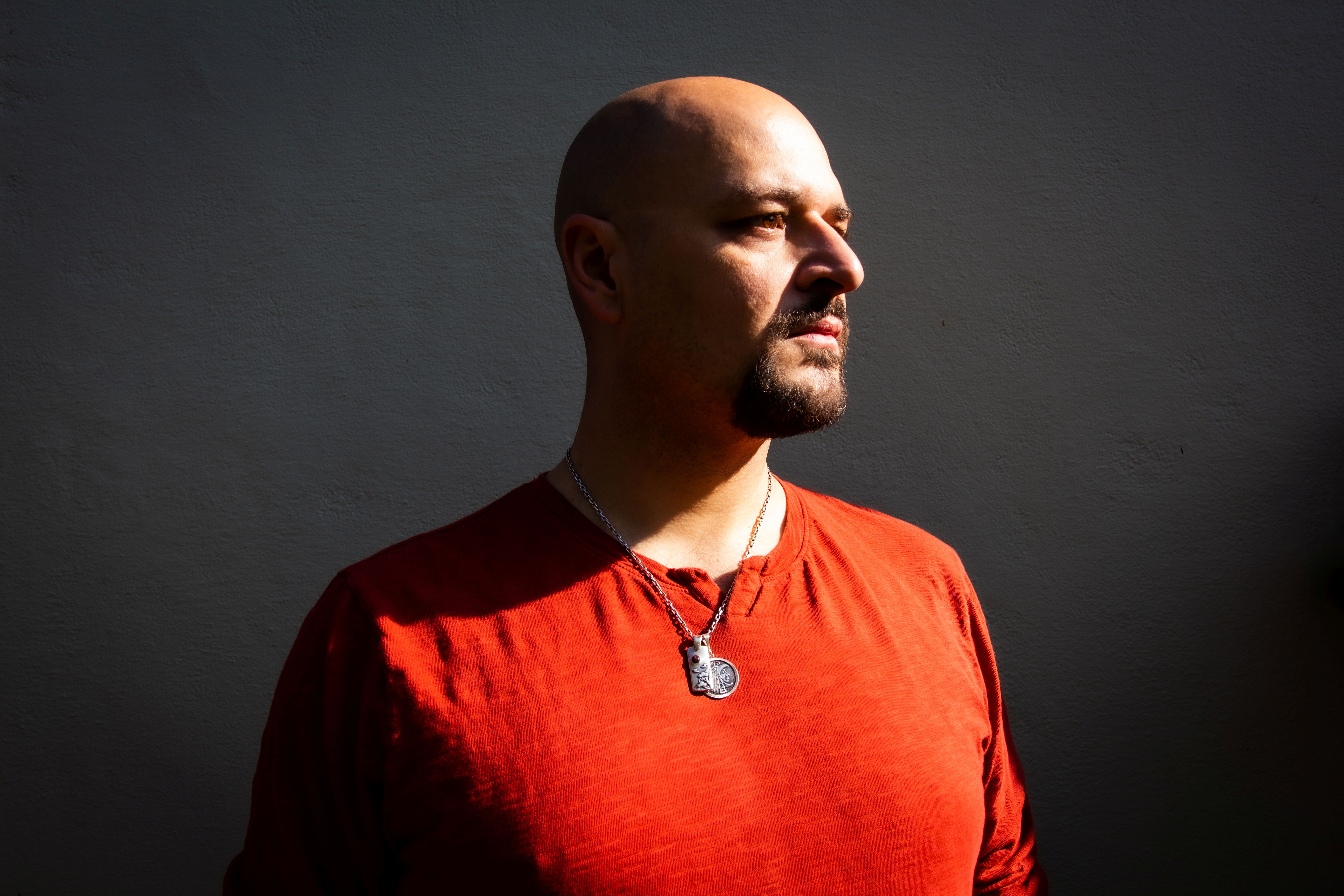 Dan Rosenboom Interview Image by Aubre Hill
"It’s hard for me to get excited about the idea of a single – that always feels like working on the corner of a painting."
Video
