Published
Part 2
The choice in creative tools can be overwhelming. Are there ways to deal with- and embrace this wealth and channel it to support your creative goals?
I think it’s really unhealthy and lot of people seem to be obsessed with gear as an alternative to actually being creative. I sometimes get trapped in that when it’s the school holidays and my kids don’t leave time for going to the studio but there is just enough time to look at synths on the internet: Window shopping as a substitute for actual music time …
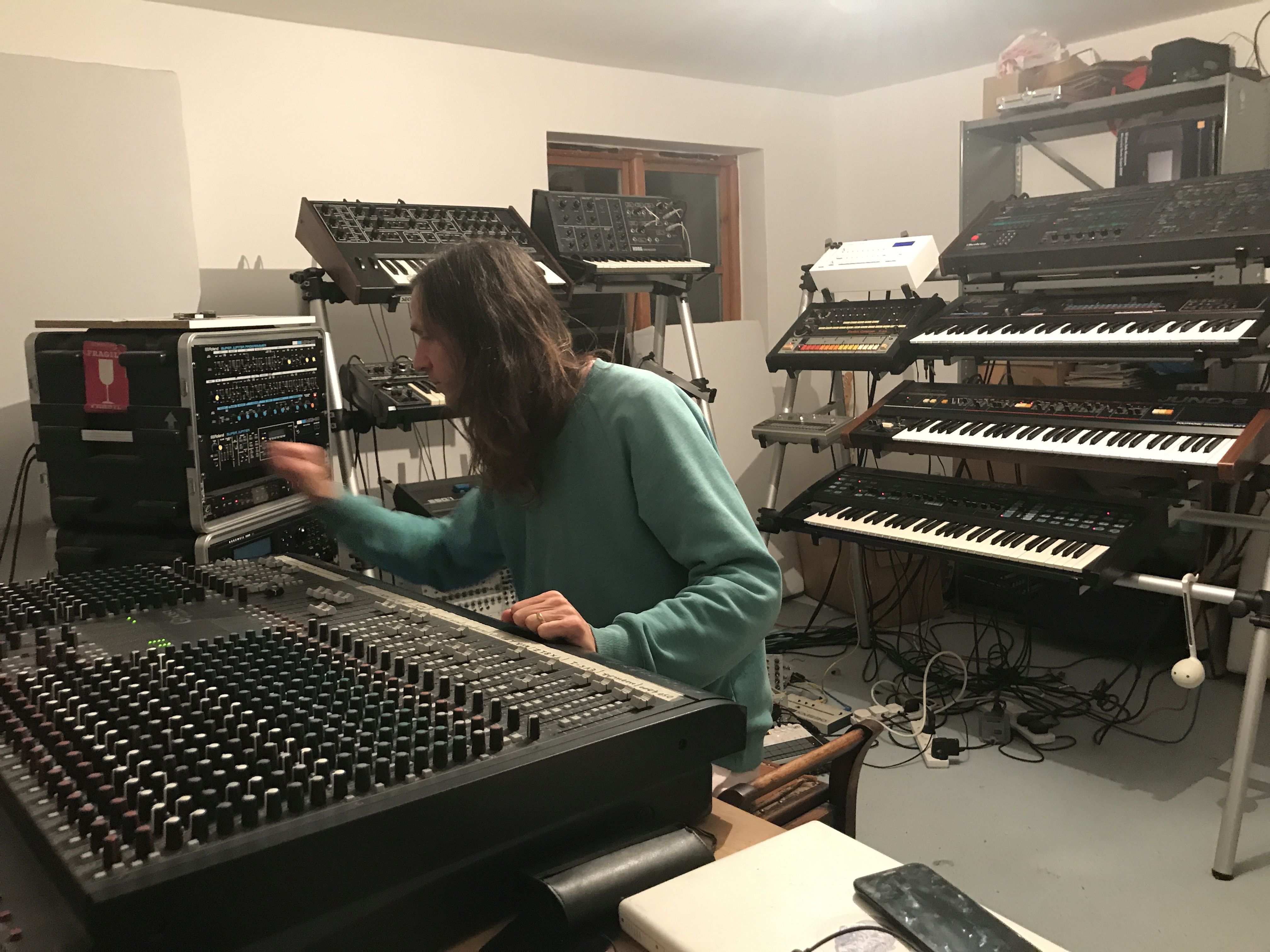
But I always say you can make music on any gear. I still make 90% of my music on the same few synths I have had for many years, just adding a new sound here and there from time to time. I am still exploring synths I bought 20 years ago and finding new sounds and methods.
When people ask me about gear I always say: just get anything and make some music.
The sound sculpting capacities of current music technology are remarkable. So is the abundance of high-quality and ready-to-use samples. Which of these do you prefer and what does your process of working with them look like?
I have never used someone else’s samples apart from things like the drum hits on a Linndrum or something. Doesn’t interest me, it’s like buying a colouring book and saying you are a a painter.
Current music technology is great but I don’t feel it is really a lot better than it was 20 years ago, just a lot cheaper (apart from old analogue synths). I just use synths and machines to try to make a recording of the music in my head.
Within a digital working environment, it is possible to compile huge archives of ideas for later use. Tell me a bit about your strategies of building such an archive and how you put these ideas and sketches to use.
I really try to avoid it.
This week I looked at my computer and there were maybe 10 or 15 unfinished songs sitting in their folders on the desktop. A couple of them were over a year old. I finished about 8 of them and deleted the rest. Some of the ones I deleted were pretty good but I have so many ideas and I can usually make a track in a few hours.
So if a track is unfinished for a year and I’ve tried a few times to spend a few hours finishing it and it hasn’t happened, then it just becomes an obstacle using up time and making me feel bad. Once I realised that, it felt great to delete those tracks. There will always be more ideas.
I come from a time when we made the whole track with a MIDI sequencer and recorded stereo to DAT and that was it. If you listened the next day and the snare was too loud, then it was too loud and you just had to decide if you still liked it or not. Most of my synths and my mixer don’t have any memory so once you move the controls, the track is gone. I still try to work like that because it’s a lot more exciting to just express yourself and move on.
I only occasionally multi-track some stuff because my time is so limited that sometimes I just need to record the bassline quickly while I can remember it, before I rush off to look after the kids. Then I can EQ it later or something. The computer is really great for that but I do feel I express myself better if I can just have enough time to get the whole mix sounding good, press record, perform the track and then say it’s finished.
In many interviews I've done, artists have emphasised the happy accidents as a result of human imperfections and unreliable machines. What's your view on this and how does an element of surprise enter your productions?
Yes I think it’s really important, and not only with machines but also just playing around on a keyboard or piano and being able to really listen and hear when something unintentional sounds good. If you can’t do that then you end up either repeating the same ideas forever or copying other people. So I try to be relaxed, play the keyboards freely and listen to the sounds.
I very often leave mistakes in. They are often the highlight of a track. I like it when records aren’t mixed “perfectly”, with something too loud or too quiet. It catches your attention. Things that are perfect are boring and sound like hotel lobby music.
Production tools can already suggest compositional ideas on their own. How much of your music is based on concepts and ideas you had before entering the studio, how much of it is triggered by equipment, software and apps?
It all comes from somewhere in outer space and falls into my head and then I hear it and try to find a way to record it. I don’t use any machines that make ideas for you.
Sometimes if I don’t have time to go to the studio I will just play the piano and record on my phone or sing into my phone and then I can make the actual track later. Once I am in the studio working on the recording, then I listen out for good mistakes as discussed above.
I guess when I used to have more time I might just go to the studio and twiddle until I heard something but not any more.
To some, the advent of AI and 'intelligent' composing tools offers potential for machines to contribute to the creative process. What are your hopes, fears, expectations and possible concrete plans in this regard?
I think it won’t affect me artistically but it might affect me financially. If people are happy to dance to and listen to AI produced music, I guess I will be out of a job. It might be fun to ask the AI for 100 new Aphex Twin songs from 1992 ...
But I will never stop making music because it’s what I love to do. It doesn’t matter if another producer is better than me and it doesn’t matter if a machine is as good as me, doesn’t even matter if anyone hears it. I just want to spend the time making the stuff because it makes me happy.
The sleeve of my album Glad To Be Sad was designed by a computer program (that was written by a person).
Technology has continually taken on more steps of the compositional process and "creative" tasks. From your point of view, where does "technology" end and "creativity" begin?
I disagree. For me technology has taken on the mechanical tasks, ie. I don’t need to learn to play drums or guitar really well, I can sample the sounds I want and program a beat or something. But I have no interest in making music based on loops or sounds created by other people or by machines.
I don’t use machines to decide what notes to play. When I make new sounds on machines, I feel like it’s me leading the process, not the machine. For example I had a chat with Aphex about the idea of a graphic equaliser that you could sequence and then I made this effect on the Eventide DSP4000:
Another DSP4000 experimental patch: This time I wanted to make a reverb that let you modulate the room size, as if the walls are closing in and zooming away while the music is playing. The Eventide didn’t have this idea built into it, I had the idea and I programmed it deliberately using their programming environment:
If you could make a wish for the future – what are developments in tools/instruments you would like to see and hear?
There is way too much gear already, I don’t need anything else. It might be nice if there was a new good hardware sampler but on the other hand there are good software samplers and you can always buy an old Emax or EIII if you really want analogue filters.
I built my own drum machine to try and get some ancient lo-fi sampler sound: