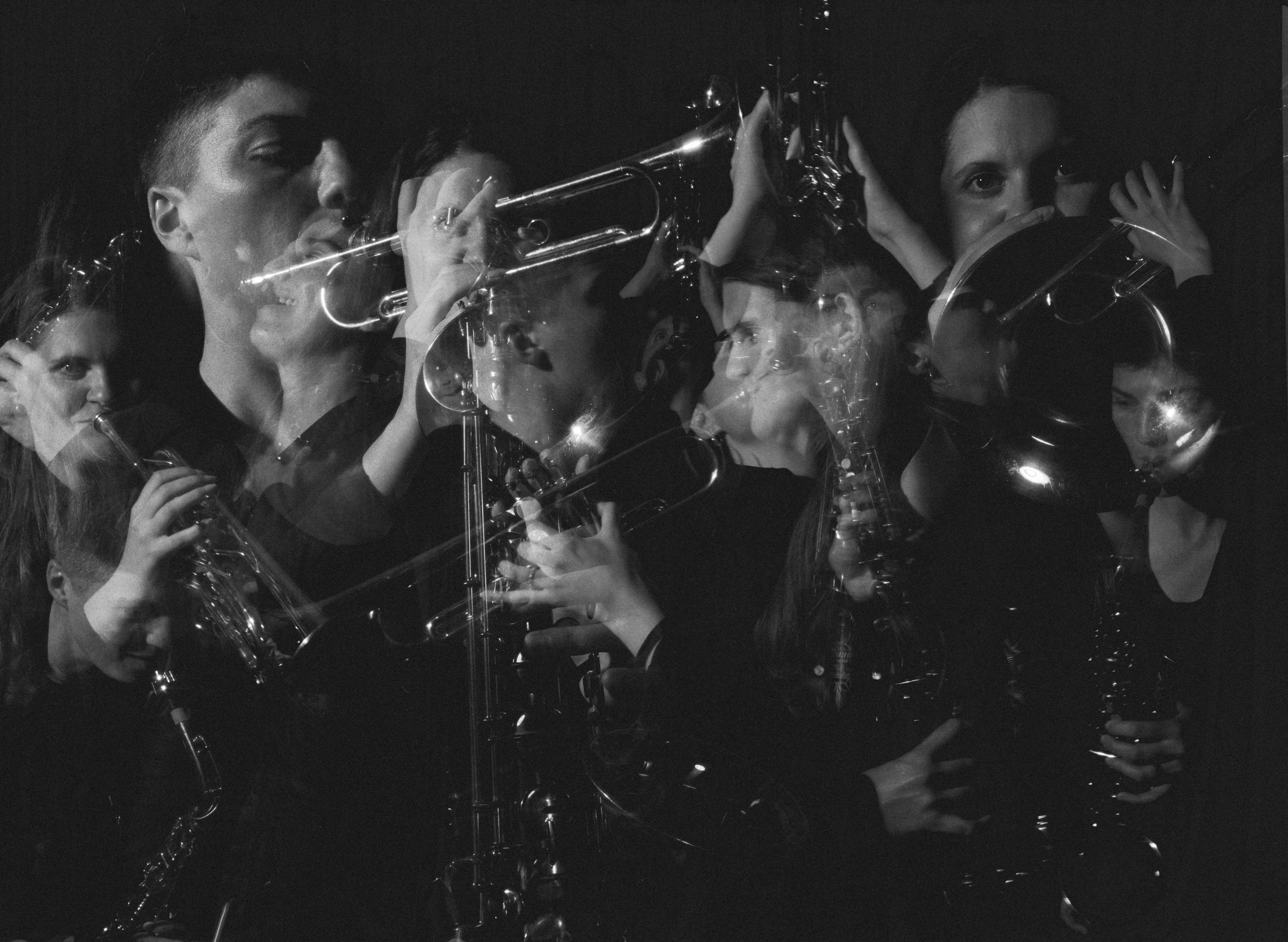
Published
Name: Emily Mikesell
Nationality: American
Occupation: Composer, producer and trumpet player
Current Release: Emily Mikesell teams up with Kate Campbell Strauss for their duo album Give Way, slated for release January 24th 2025 via Ears&Eyes. First single "WWYD" is out now.
Recommendations: Lately I’ve been digging in to Robert Fripp more and have been really enjoying his album with Brian Eno, Evening Star.
Recently I also loved reading 1Q84 by Haruki Murakami.
[Read our Kate Campbell Strauss interview]
[Read our Brian Eno interview feature about Climate Change]
If you enjoyed this Emily Mikesell interview and would like to know more about her music, visit her on Instagram.
Do you think that some of your earliest musical experiences planted a seed for your interest in improvisation?
My parents and my older brother are all musicians so I grew up around a lot of music. I think just hearing them practice all the time and going to so many concerts growing up opened my ears a lot.
I didn’t really think about improvisation until I started playing trumpet in middle school but the melodies always came to me in a pretty natural way.
When did you first consciously start getting interested in musical improvisation? Which artists, teachers, albums or performances involving prominent use of improvisation captured your imagination in the beginning?
When I was in 7th grade I was getting ready to audition for big band and I got into Kind of Blue for the first time. I was immediately drawn to Miles’ sound and started learning some of his “Freddie Freeloader” solo.
In high school I got really into Miles’ earlier records like Cookin’, Relaxin’, and Porgy and Bess and his later electric stuff, like A Tribute to Jack Johnson.
I also got really interested in John Coltrane, Alice Coltrane and Charles Mingus around that time. Mingus especially peaked my interest in the different sounds he could get out of a band through his arrangements, specifically on The Black Saint and the Sinner Lady and Mingus Ah Um.
Tell me about your instrument and/or tools, please. What made you seek it out, what makes it “your” instrument, and what are some of the most important aspects of playing it?
I chose the trumpet in sixth grade because I didn’t want to play a traditionally feminine instrument or the trombone like my older brother.
My dad found an old cornet at an antique store for me right before school started and that was it for me.
How would you describe your own relationship with your instrument – is it an extension of your self/body, a partner and companion, a creative catalyst, a challenge to be overcome, something else entirely?
I feel like I’m married to my trumpet. It’s a very physically demanding instrument so you really have to keep up with it everyday or you loose your muscles.
Like a marriage, you have to commit to sticking with it on the days where it feels awful and also on the days where it’s really easy and fun.
Derek Bailey defined improvising as the search for material which is endlessly transformable. What kind of materials have turned to be particularly transformable and stimulating for you?
I’m always just trying to find the most expansive melodies possible. I’m still trying to dig deeper into diatonic harmony and draw out the most beautiful melody I can hear.
On my upcoming album with Kate Campbell Strauss, Give Way, I felt like I could really tap into this approach and the melodies set the stage for the whole album.
Do you feel as though there are at least elements of composition and improvisation which are entirely unique to each? Based on your own work or maybe performances or recordings by other artists, do you feel that there are results which could only have happened through one of them?
In my experience, the main difference between composition and improvisation is the time and judgment it takes to make decisions. In improvisation, it comes out automatically and you can’t edit it, but in composition you can labor over each note until it’s perfect. Both are valid ways to create but extensive laboring can cloud the creative juices.
Our record Give Way is an interesting mix of these two methods. Before starting the recording process we agreed on a few ground rules. One person would start the track with a solo line or a fully fleshed out section with layered horns. We’d send it off and the next person would add on to that section and/or create the next section. This would go on until the composition was deemed finished.
We decided that once an idea is on the recording, it can’t be edited or deleted. We also gave ourselves roughly 2 weeks to complete the song and would send a prompt from Brian Eno and Peter Schmidt’s Oblique Strategies to each other upon each pass. The idea was to trust the first idea that comes to you.
The compositional process was incredibly spontaneous but the drawn out recording process really gave us time to sit with these melodies and let them marinate.
There can be surprising moments during improvisations – from one of the performers not playing a single note to another shaking up a quiet section with an outburst of noise. Have you been part of similar situations and how did they impact the performance from your point of view?
I’ve been in this situation in many performances but especially in my compositional process with Kate our album Give Way.
For this album, we borrowed the improv comedy ethos of “yes, and,” choosing not to edit an unexpected idea but rather accept and elaborate on it.