Published
Part 2
What kind of musical settings and situations do you think are ideal for your own voice?
Nice of you to ask. I am one of those singers that does enjoy a somewhat wet environment for my human voice. A roomy and natural reverb is great.
When I am talking to a sound engineer; in one of the venues, while traveling with music, I will often be asked the question if I want “something” on the voice, something being an effect like delay or reverb or compression. I tend to say, “sure, a natural jazzy reverb would be great, whatever that might mean to you.” Rarely a hitch. I have heard so many natural jazzy reverbs in response and almost all of them have been quite a treat to hear.
Of course, nothing beats singing in the shower. Solid gold.
We have a speaking voice and a singing voice. Do these feel like they are natural extensions of each other, ends on a spectrum or different in kind?
Hmm. Fuck if I know. When Robert Ashley speaks, it is singing.
I just went online there to take a look at what the folks are saying and it seems like an often touted difference between the two is that speaking happens at a lower frequency and within a narrower range. Hog wash!
Singing and speaking may, but most certainly not undoubtedly, have different relationships to language. And we can imagine what some of them may be, especially in their relation to language as communication and a communication that relies on a sense of comprehension.
From whispers to screams, from different colours to dynamics, what are the potentials and limits of your voice? How much of your vocal performance can and do you want to control?
Voice and control is a vast territory well worth discussing. And I think that it can be somewhat lumped into a group of various controls of the body and image and image projection, the place and import put on our relationship with their own concept and construction of subjectivity. Ouph! Please do not feel an obligation to put that last sentence together. There is something there and we can leave it at that.
Playing the human voice, which is a phrase I wished we heard more of, is a game or dance of restraint (or compliance) and disobedience. And I think we may savour thinking that how much of one and how much of the other is an ever changing dynamic and is one of the things that makes singing so unknowably beautiful and strange.
When one wishes to praise a singer it often said that the singer “has” a beautiful voice. We do not use the possessive in this way for any other musical instrument. Dorothy "Dot" Wiggin is an amazing guitar player.
Jeanne Lee has an amazing voice.
How we think about instruments, technology and bodies are some of the luggage being performed alongside this distinction. We also hear the old chestnut, “he uses his voice like an instrument.”
What?
Do words deactivate the human voice from being an instrument?
Ridiculous.
And.
How unthoughtful.
When you're writing song lyrics, do you sense or see a connection between your voice and the text? Does it need to feel and sound “good” or “right” to sing certain words? What's your perspective in this regard of singing someone else's songs versus your own?
I have spoken of my admiration and love for Ryan Driver here. So, I will let one of his lyrics think about this.
There is a contradiction.
And there is no contradiction.
And that’s an awkward line to try and sing.
from “The Seasons The Months And The Days”
Strain is a particularly serious issue for many vocalists. How do you take care of your voice? Are the recipes or techniques to get a damaged voice back in shape?
The morning is a very interesting time to encounter one’s own singing voice. It is often as if you can feel the entirety of your nights rest or restlessness in the timbre.
And there are limits, physical limits, that may be less present later in the day when the body has warmed a bit, when you have spoken a bit, when you have drank and eaten a bit. You know, morning shower aside (the steam and shower reflections take care of all of that, and so sweetly).
I have found that if I am performing in a venue or environment with loud music or other loudnesses, and that if I have to speak in the way that we often do to be heard over the din, that my voice is pretty shot when it comes time to sing, if in fact that time does come. And it often does.
I wonder if it is a good idea to be quiet before singing. I also wonder if it is a good idea to be quiet.
For recording engineers, the human voice remains a tricky element to capture. What, from your perspective, makes voices sound great on record and in a live setting?
I have not heard that but I do believe you. Things are indeed tricky these days. Recording the human voice included.
Well, certain microphones suit certain voices. That is one way to start talking about this vast subject. I remember (cue strings) the first time I sang into a Lomo 19a9. Radwan Moumneh thought I would like it and the world of recording my voice changed. I heard my own voice in ways I had not before.
“What did he love about it”, one may ask. “Give us some details at least!” Well, It had a sweet sheen in the upper “air” end of the treble that allowed me to play with the air in my falsetto in ways that I had not before. It is also somewhat carved out in the low mids (or so I think), which my voice gives a lot of already, so the distortingly gravelly presence is diminished as the air up top opens up. A wonderful discovery.
I now sing into another microphone, which has many of the same qualities but with a slightly less piquante top end. I do like things to be smooth, but also quite present in the upper frequencies. But I am not sure that I am the best person to answer this question. My engineering skills are quite limited.
Have you guys ever interviewed a sound and/or recording engineer for this 15 Questions? That could be interesting, you know, if you get the right one. If I may, I would suggest Cyril Harrison, my friend and the sound engineer with whom I have been working with since moving to France. He is not only an incredibly skilled engineer but an amazing listener and quite skilled at unearthing that space inbetween the musician and the music.
That space that can be as unknowable and tricky a space to inhabit as any other.
Motherese may have been the origin of music, and singing is possibly the earliest form of musical expression, and culture in general. How connected is the human voice to your own sense of wellbeing, your creativity, and society as a whole?
Again, it sounds like you may be quite right. I do not know. I do not know what Motherese is. I probably should hey? Oh ok, so that is what Motherese is. Wow, not what I thought it would be, although, I have no idea why I thought I would have a thought about something I do not know.
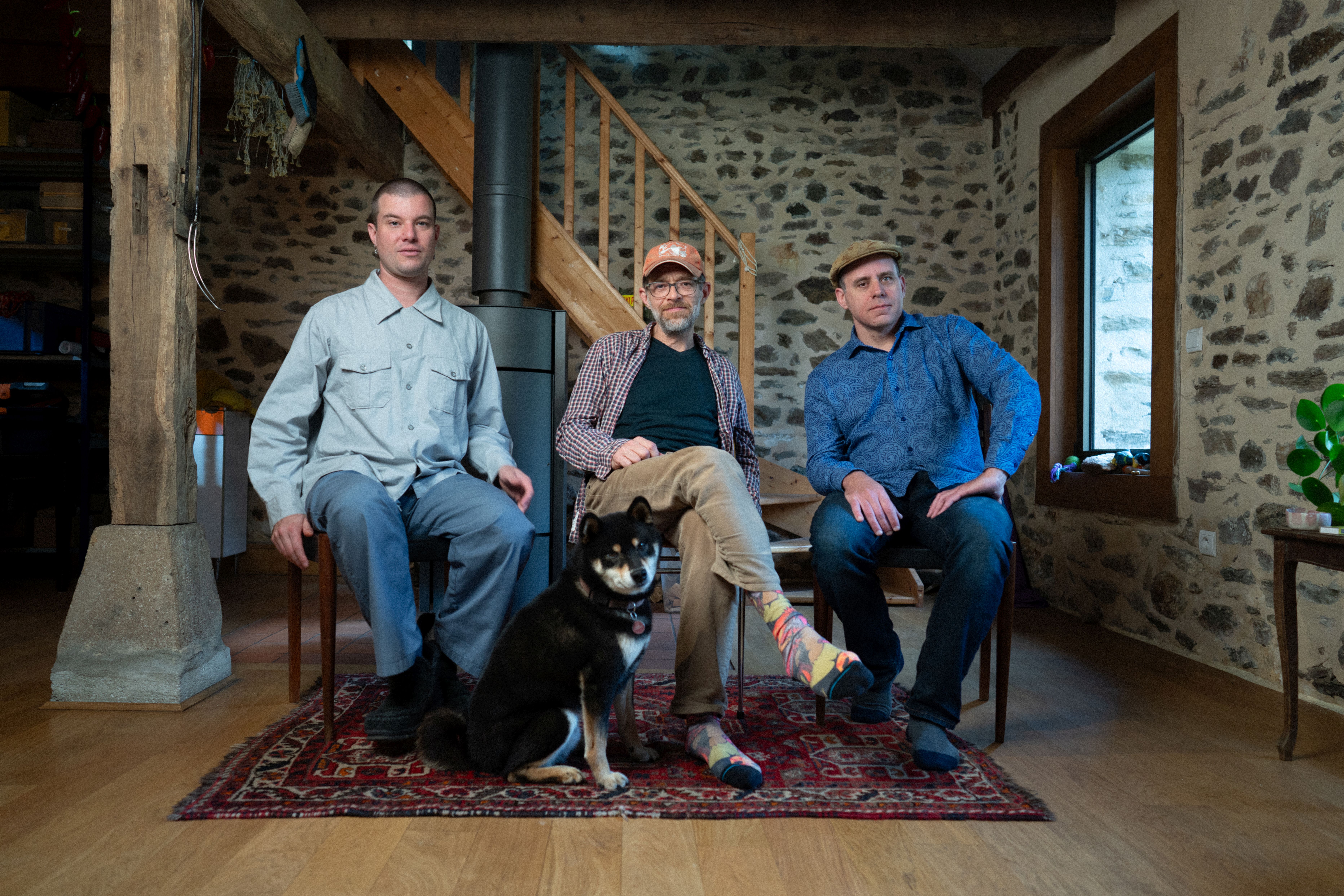
Well, we do that all the time, don’t we. Tricky folks. Not the most wonderful part of the human project. I really do not know anything about any of this. I am not a mother nor do I have a child but I do have a dog with whom I often adopt a certain voice so that he (Blinky Palermo is his name) knows that I am talking to him.
So, now, thinking about this, about these intimacies that we may now be getting to, I think that this may be starting to sound more and more right to me. This whole Motherese as music origin conception. It is too early to go more deeply into it. Perhaps we should let ourselves sit with it. And perhaps we can think about the tonalities and timbres we use with others and with other things, and think about birds and what they may be going on about up and over there. And whether they are really communicating something (oh, here he goes again).
Is it always a language that comes out of an animals’ mouth? Are we saying something when we sing? Are we just singing over here? And even then, after reflecting about this more, an amazing possibility may emerge, that we may, even after thinking about it more, have even less to say about it. That sounds pleasant to me now.
I've been fascinated by pure vocal recordings for a long time. Do you have some recommendations in this direction?
Ah. I love lists.
I imagine that you may mean unaccompanied vocal recordings.
Just human voice?
I may forget a lot.
As I tend to.
Mike Waterson singing “Tam Lim”.
Even though it has harmonium I will say Charlemagne Palestine’s Karenina.
Any recordings you can find of Sean Nòs singing.
David Toop’s “Do The Bathosphere”
Joe Heaney would be a sweet place to start.
June Tabor singing “Waltzing Matilda”.
Oliver Messiaen’s “O sacrum convivium” The London Sinfionetta perform a shattering version.
Anne Briggs singing anything.
There is a record called A Collection.
Oh, yes, then there is the Ars Nova.
French medieval psychedelia.
Let’s start with the Ferrara Ensemble, Figures Of Harmony - Songs Of Codex Chantilly C. 1390.
And speaking of that music, there is one song in particular that may be of interest for many reasons: Baude Cordier, “Tout par compas” and a vocal version of it is found on an Ensemble Organum record of Codex Chantilly. The lyrics sound like they were written by Rodney Graham in a rather poetic mood.
All with a compass am I composed,
properly, as befits a round
to sing me more surely.
Look how I am disposed,
companion, I pray you kindly.
All with a compass am I composed,
properly, as befits a round.
Three times my circumference enclosed;
you can chase me with joy,
if in singing you are true to me.
All with a compass am I composed,
properly, as befits a round
to sing me more surely.
And please feel very free to check out the score. It is absolutely stunning.
And in closing let us listen to Robert Ashley’s “Love, Is A Good Example”.